Maryknoll Father Roy BourgeoisIn yesterday’s post I mentioned Christian clergy whose prophetic stand put them at odds with orthodoxy. The creative tension is what leads to growth in the Holy Spirit.
Today I’m posting more in the saga of Maryknoll priest Fr. Roy Bourgeois who is slated to be dismissed from the priesthood and his religious community unless he recants his belief that women should be ordained in the Catholic church. His recent step to ask his order to engage “reputable theologians” to reconsider the issues stemming from his case is a way of keeping this story in the light of public scrutiny and not letting hierarchy drive it underground.
At a time when the International Criminal Court is being asked to investigate the Pope and other Vatican officials for concealing child-sex crimes throughout the world, the church needs leaders like Fr. Roy to show us the proper way to live prophetically the gospel.
I often say that “all teaching is simply learning in public.” Fr. Roy is continuing to teach by pushing for a public conversation that can respectfully allow us all to learn how to live more deeply into becoming the children of God.
Fr. Roy Bourgeois recently took another step in his fight to remain a member of the Maryknoll Fathers and Brothers, when he asked his superiors to engage reputable theologians to reconsider issues stemming from his support for the ordination of women.
“In spite of the apparently clear orders of the Congregation for the Doctrine of the Faith and the related norms of church law, the overall situation with Roy is anything but clear-cut and simple,” Dominican Fr. Thomas Doyle, a canon lawyer representing Bourgeois, wrote in an Aug. 16 letter to Fr. Edward Dougherty, Maryknoll’s superior general. Doyle is most widely known for his advocacy on behalf of victims of sexual abuse by clergy.
Doyle contends that the church’s prohibition of female ordination is not infallible teaching and asks in his letter “that the assistance and input of reputable theologians be sought in order to look much more deeply” into two central issues: the church’s claim that the teaching is infallible and the right of a Catholic “to act and think according to the dictates of his conscience” even if the conclusions put one in conflict with the church’s highest authorities.
Doyle also argues that the punishment of excommunication and expulsion from the society is disproportionate. As a comparison, he notes that priests and bishops who sexually abused children and/or covered up the abuse have not been excommunicated. … Read more.
When theologian William Stringfellow and Anthony Townes wrote about The Bishop Pike Affair in the 1967, they dug deep into the decision by the Episcopal Church’s House of Bishops to resurrect heresy laws to address behavior by Pike that was either outlandish and heretical or prophetic and revelatory, depending on your point of view. In the person of Pike, an early proponent of ordination of women, racial desegregation, and the acceptance of LBGT people within mainline churches, his actions were a messy human mix of both and all.
Though Pike lost the trial, the Pike Affair raised in stark relief the fact that, on occasion, mature religious conscience could come into conflict with religious orthodoxy. It was a highly significant revelation in American religious thought.
This week American Christians lay to rest another brother who lived and died in that same stream: Walter Righter, the Episcopal bishop who ordained the first woman in the Iowa diocese in 1976 and ordained an openly gay partnered man to the diaconate in 1990, after “changing his mind” on ordaining “homosexuals,” died at home in Pittsburgh and was interred in Calvary Church’s columbarium.
Bishop Righter was also brought up on charges that by ordaining a gay man he violated the doctrine of the church and Righter’s own ordination vows. But this time the battle was won. In May 1996, the Bishops Court stated in a 7-1 decision that the Episcopal Church “has no doctrine prohibiting the ordination of homosexuals,” and that Bishop Righter did not contradict the “core doctrine” of the church. Righter reflected on the trial and his life in his book A Pilgrim’s Way. Well done, good and faithful servant.
The Rt. Rev. Walter C. Righter, an Episcopal bishop whose victory at a 1996 heresy trial played a key role in the push for gay rights in the church, died on Sunday (Sept. 11) at the age of 87.
“I look around the Episcopal Church today where there are no impediments to the ordination of gay or lesbian members … none of that would have happened without Bishop Righter’s leadership,” said the Rev. Susan Russell of All Saints Church in Pasadena, Calif., former president of the pro-gay group Integrity USA. Righter was bishop of Iowa from 1972 to 1988, during which time he ordained the first female deacon in Iowa. From 1989 to 1991, he served as assistant bishop in the Diocese of Newark.
Righter ordained Barry Lee Stopfel, a noncelibate gay man, as a deacon in 1990. Ten bishops brought charges against Righter, alleging that he violated both the doctrine of the church and his ordination vows by ordaining Stopfel. In a verdict issued on May 15, 1996, a church court stated that the Episcopal Church “has no doctrine prohibiting the ordination of homosexuals,” and that Bishop Righter did not contradict any “core doctrine” of the church.
A member of the court, Bishop Cabell Tennis, told The New York Times that the verdict offered neither an opinion “on the morality of same-gender relationships” nor guidance on whether a bishop “should or should not” ordain sexually active gays and lesbians. When asked after the trial to speculate on the future of homosexuality in the church, Righter told The Times, “I think we’re making too much out of the bedroom.”
The Episcopal Church now has two openly gay bishops and allows for the ordination of gays and lesbians in most dioceses, and will likely debate formalized rites for same-sex unions at its General Convention next year. “When the history of the movement for the full inclusion of the LGBT community in our church is written, there is no doubt that Walter Righter will be one of its great heroes,” said Russell.
In a statement Monday on Righter’s death, Presiding Bishop Katharine Jefferts Schori said: “The Episcopal Church can give thanks for the life of a faithful and prophetic servant…. His ministry will be remembered for his pastoral heart and his steadfast willingness to help the church move beyond old prejudices into new possibilities.”
“As for us, our days are like grass; We flower… the wind blows… We are gone.”– Psalm 103
The psalmist speaks out of a social situation from which our generation and culture need to learn: To the psalmist life is temporary, fragile, daily “redeemed from the grave.” Survival is a matter of massive human effort and natural hardship. The land to be cultivated is desert; water is scarce; foliage is sparse and scrawny and fragile. Every day life is a blessing of mammoth proportions.
But now we take life for granted. We feel invulnerable. Therefore, we lose sight of the brief gift of time and our needs. We know better the needs and weaknesses of others than of our own.
We act as if we’re here forever. We spend time as if we have nothing but time. We fritter away the great things of life: gospel commitments, family, prayer, nature, and responsibility for play and things that serve ourselves—ambition, clothes, consumption.
We think we have forever. We’ll do what we have to do later: we’ll reconcile “later;” we’ll settle down “later;” we’ll pray “later;” we’ll get some order in our lives “later;” we’ll study the nuclear thing, the economic thing, the racism thing, the sexism thing, “later.” After we get finished with the very important things we’re doing now.
Nevertheless, today we too have been “redeemed from the grave.” The question is “Why?” Whatever the reason: do it now. —Joan Chittister, OSB
At Mass today at St. Camillus, newly minted Franciscan friar Erick Lopez preached a powerful sermon. Drawing on the prescient lectionary readings from Sirach, Romans, and Matthew, he reminded us of the great compassion that we have all felt toward the victims of the al-Qaeda attacks.
He also read a letter from an Afghan third-grader to her American counterparts, in which she also expressed her compassion for those who had suffered in the attacks. This kind of unjustified violence is something her country has experienced for more than 30 years.
He laid out the path that one must walk to follow the Prince of Peace. A path that is paved with our human brokenness and that leads toward healing when we make a decision – every morning when we wake up – to choose to forgive. He concluded with a thundering voice from the pulpit: “We must NOT look for our security in flags, but in the cross of Jesus Christ.” The congregation responded with thunderous applause.
Below is a letter signed by representatives from eight Franciscan provinces in the U.S. and U.K. addressing the Sept. 11 memorial.
As the 10th anniversary of the Sept. 11 attacks approaches, the friars of Holy Name Province and seven other Franciscan provinces — six American along with one in England — have released a statement urging Catholics in the United States and around the world to stay informed, to stand firmly against all forms of prejudice and discrimination and to find responses that “can unlock the full potential of the human imagination for good.”
In this message, distributed last week to Holy Name friars, the collaborating provinces recommend five ways that friars and partners-in-ministry can “live the Gospel in the way of St. Francis.” The statement is also available in Spanish.
As we remember and honor, may we move away from fear and toward “the other”
Throughout the liturgical year, as Catholics and Franciscans we are called to remember events in the life of Christ, the Church and the holy men and women who served the Church. Likewise as Americans, we annually remember those individuals and events that have significantly shaped our nation. These days of remembrance — both religious and civil — invite us to examine where we’ve been as a Church and as a nation, where we are now, and where we need to go.
For the past 10 years, since Sept. 11, 2001, we have remembered the men, women and children — our family members, our friends and co-workers — who lost their lives on that tragic day. For many, the process of healing from that trauma continues to this day. In addition to summoning us to solemnly honor the dead and gratefully remember the many compassionate “first responders,” these annual commemorations also have underscored the urgent need to understand the complexity of our world in terms of politics, economics, culture and religion, particularly that of Islam.
To this end, many of our ministries have developed close relationships with local Muslim communities in order to learn from one another, to address common concerns, and to stand in solidarity with one another. The desire to know “the other” as friend is an essential challenge and a necessary aim for those who endeavor to follow Christ in the manner of St. Francis. We need only recall Francis’ encounter with the Sultan al-Malik al-Kamil in which he chose to engage Muslims peacefully and respectfully in a time of violence and hatred.
Seek Patience and Discipline. Such an effort on the part of friars and their partners-in-ministry is needed now more than ever, for while 9/11 has generated an interest in Islam for some, it has engendered excessive fear and hatred for Muslims in others. Left unanswered and unchecked, these fears can lead to prejudice, racism, hate-speech and even violence against our Muslim brothers and sisters. In the past decade, this has sometimes taken the form of attacks on Muslims in the U.S., their houses of worship and their Scriptures.
Many of these fears are based on perceived differences of values and faith. Yet, if the recent revolutions and uprisings in the Middle East are any indication, the vast majority of Muslims in the world fervently desire many of the rights and privileges that we enjoy under the U.S. Constitution.
These “spring uprisings” in the Middle East highlight for us a second challenge since Sept. 11, 2001: the urgent need to develop effective policies and strategies to deal with global violence and international terrorism through non-violent means. Ten years ago, the dominant belief was that the only way to respond to the attacks of Sept. 11 was by means of military force. We lacked the non-violent tools of robust diplomacy and crisis resolution which, coupled with an internationally shared strategy for police action, might have brought the perpetrators of the attack to justice without massive military intervention and additional loss of lives.
Regrettably, seeking the non-violent tools of robust diplomacy and crisis resolution is not an easy road to follow, but we must always seek the patience and discipline to pursue this path as a first option. We remain challenged to find responses that can unlock the full potential of the human imagination for good.
Be Not Afraid. As we move into the second decade after the tragedy of Sept. 11, we must, as people of faith, remember the words of Jesus who tells us: “be not afraid.” Actions based solely on fear are rarely fruitful, and frequently destructive. We are at a crossroads as a nation and world. We can choose to remain primarily on a path of excessive fear and the use of force, or we can choose to find new ways of building communities of respect and cooperation across faith traditions and national boundaries.
As brothers and sisters committed to living the Gospel in the way of St. Francis, we encourage you, your partners-in-ministry, and your families and friends to:
• Increase and deepen your efforts to understand and build relationships with our Muslim brothers and sisters, and indeed with all those from faith traditions different from our own.
• Stand firmly against all forms of prejudice and discrimination, including Islamophobia.
• Stay informed about world events through reliable sources of information in order to better access American foreign policies and their impact on others.
• Call for deeper investments in diplomacy and development so that options beyond military violence are employed.
• Take time for prayer, both private and communal, asking God for peace in your hearts and minds, for wisdom and understanding, for healing and forgiveness.
Followers of the Gospel — in particular followers of St. Francis — must never be timid or satisfied with lesser “solutions” born of fear and prejudice. Rather, let us be inspired by the bold example of our brother Francis who, obeying Jesus’ new commandment to “love one another,” reached out to the Sultan and thereby created new paths of peace.
Cover by Art SpiegelmanA week after the Twin Towers collapsed, Shanksville, and smoke covered D.C. while the Pentagon burned, The New Yorker ran Polish poet Adam Zagajewski’s “Try to Praise the Mutilated World” on the final page of its special 9/11 issue. Written a year and a half before the attacks, the poem nevertheless quickly became the best-known poem of the last 10 years.
A critic, writing in The New York Times Book Review when the poem first was published, lightly mocked its appeal, “as if America were entering the nightmare of history for the first time and only a Polish poet could show us the way.”
As is true with good poets, prophecy is sometimes the by-product of sustained negative capability, “capable of being in uncertainties, Mysteries, doubts without any irritable reaching after fact & reason,” as John Keats put it.
Today, we hold in tension bodies falling through a bright blue morning sky, office workers walking miles from city centers to reach home, military jets scrambling to nowhere, the Golden Gate bridge that wasn’t bombed, the Capitol building that was left standing.
We hold in tension that suspended time between rescue operations and remains recovery. We also remember Fr. Mychal Judge, ofm, Franciscan priest, chaplain to New York City firefighters, gay celibate, and first certified fatality of the September 11, 2001 attacks. When everyone else was running out of the World Trade Center building, Mychal ran in. Video footage shows him trapped in an upper floor mouthing words as bodies fell from floors above him. Those who knew him say he was administering last rites. (See Saint of 9/11 and “Remembering Mychal” by Brendan Fay.)
Try To Praise The Mutilated World
by Adam Zagajewski
Try to praise the mutilated world.
Remember June’s long days,
and wild strawberries, drops of wine, the dew.
The nettles that methodically overgrow
the abandoned homesteads of exiles.
You must praise the mutilated world.
You watched the stylish yachts and ships;
one of them had a long trip ahead of it,
while salty oblivion awaited others.
You’ve seen the refugees heading nowhere,
you’ve heard the executioners sing joyfully.
You should praise the mutilated world.
Remember the moments when we were together
in a white room and the curtain fluttered.
Return in thought to the concert where music flared.
You gathered acorns in the park in autumn
and leaves eddied over the earth’s scars.
Praise the mutilated world
and the grey feather a thrush lost,
and the gentle light that strays and vanishes
and returns.
One of America’s top preachers and teachers Will Willimon, presiding bishop of the North Alabama Conference of the United Methodist Church, cuts to the heart of what Sept 11 has meant for the American Christian church.
On 9/11 I thought, For the most powerful, militarized nation in the world also to think of itself as an innocent victim is deadly. It was a rare prophetic moment for me, considering Presidents Bush and Obama have spent billions asking the military to rectify the crime of a small band of lawless individuals, destroying a couple of nations who had little to do with it, in the costliest, longest series of wars in the history of the United States.
The silence of most Christians and the giddy enthusiasm of a few, as well as the ubiquity of flags and patriotic extravaganzas in allegedly evangelical churches, says to me that American Christians may look back upon our response to 9/11 as our greatest Christological defeat. It was shattering to admit that we had lost the theological means to distinguish between the United States and the kingdom of God. The criminals who perpetrated 9/11 and the flag-waving boosters of our almost exclusively martial response were of one mind: that the nonviolent way of Jesus is stupid. All of us preachers share the shame; when our people felt very vulnerable, they reached for the flag, not the Cross.
September 11 has changed me. I’m going to preach as never before about Christ crucified as the answer to the question of what’s wrong with the world. I have also resolved to relentlessly reiterate from the pulpit that the worst day in history was not a Tuesday in New York, but a Friday in Jerusalem when a consortium of clergy and politicians colluded to run the world on our own terms by crucifying God’s own Son.–From Christianity Today
Joan Chittister offers a reminder of the stance that we as Christians are called to take toward kin, strangers, and even enemies. This “stance” only comes after years of intentional inner work, as well as outward practice, failure, and practice.
Over the archway of every medieval monastery were carved the words, Pax Intrantibus, “Peace to those enter here.” The words were both a hope and a promise. In a culture struggling with social chaos, Benedict sketched out a blueprint for world peace. He laid a foundation for a new way of life, the ripples of which stretched far beyond the first monastery arch, to every culture and continent from one generation to another, from that era to this one, from his time and now to ours. To us.
That is our legacy, our mandate, our mission—as alive today as ever, more in need in today’s nuclear world than ever before. Benedictine peace, however, is not simply a commitment to the absence of war. It is, as well, the presence of a lifestyle that makes war unacceptable and violence unnecessary.
Even if we dismantled all the war machines of the world tomorrow, it would be no guarantee that we would have peace. The armies of the world simply demonstrate the war that is going on in our souls, the restlessness of the enemy within us, the agitation of the human condition gone awry.
To all these things we need to bring our own world—new spiritual imagination. Imagine a world where people choose their work according to the good it will do for the poorest of the poor—because they saw it in us. Imagine a world where holy leisure, spiritual reflection rather than political expedience began to determine everything we do as a nation—because they saw it in us. Imagine a world where the care of the earth became a living, breathing, determining goal in every family, every company, every life we touch—because they saw it in us.
Imagine a world devoted to becoming a community of strangers that crosses every age level, every race, every tradition, every difference on the globe—because they saw it in us. Imagine a world where humble listening to the other became more important than controlling them—because people saw it in us. Imagine a world where what makes for peace becomes the foundation of every personal, corporate, national decision—because they were called to it by us.
Let us resolve again to follow the fiery-eyed radical Benedict of Nursia whose one life illuminated the western world. Let us, in other words, live Benedictine spirituality and illuminate our own darkening but beautiful world.–Joan Chittister, OSB
As of today, more than 900 people have been arrested at the White House as part of the Tar Sands Action demanding that President Obama reject the Keystone XL pipeline and take positive steps to shift the U.S. away from fossil fuels.
Cherri Foytlin, who took part in the Tar Sands Action demonstration in Washington, D.C., said she was directly affected by last year’s BP oil spill and came to Washington to “make a bigger voice and to protect our world.” She calls herself an “accidental activist” who got involved with environmental awareness campaigns after the BP spill, which she says continues to degrade the ecosystems of her home state, Louisiana.
It is clear to me now that smaller, regional groups that have been fighting local effects of oil spills and fighting the oil companies are joining together in the Tar Sands Action. A much larger movement is in the making. It’s a movement that is not going away.
As we head into an election season, President Obama will have to engage directly this “line in the sand.” (Listen to NPR’s story on the Tar Sands Action.)
Joe Uehlin, who served on the UN Commission on Global Warming in the 1980s and 1990s, said, “I saw how our international and national mechanisms have failed us,” Uehlin said “We need drastic action to stop putting carbon in the atmosphere.”
Steve Clemens at Tar Sands protest.As part of the follow-up to the arrest of more than 60 religious leaders on Monday at the White House, we asked participants to take time to craft their “public story,” as civil rights organizer Marshall Ganz calls it. We encouraged them to ask someone in the next few days to do a 15-minute interview with them on the civil disobedience action. The interviewer should ask “Who, What, When, How, Where?” The participant should start answers with her or his senses: Taste, Smell, Hearing, Sight, Touch.
Using the interviewers notes on the answers, craft a good public story that has a plot – challenges they faced, choices they made, and outcomes they experienced – texture, dialogue, and scene. We told folks to stay away from the “issue” and stick with what they personally were wrestling with in their hearts. Write this up in a 2-3 paragraphs. Practice telling the crafted story aloud. Then go tell it to others! This story can then be submitted to the local paper, denominational newsletters, used to preach, tell others in the grocery store, and sent back to Tar Sands Action.
My friend Steve Clemens has posted a wonderful tale of his experiences over at Mennonista. Below is an excerpt:
When I first signed up to come to Washington and return to the White House, I thought to myself: wasn’t it just a year and a half ago that I told Christine that I’m getting too old to spend another night in jail? My experience protesting President Obama’s continuation of the Afghan and Iraq Wars had left me physically very sore (but spiritually content) after 28 hours in the four different DC jails we occupied after our “die in” at the White House the day before the 2010 State of the Union address.
This time it was an email from my friend, Rabbi Arthur Waskow of the Shalom Center in Philadelphia that got the juices flowing again. He sent me a letter signed by Bill McKibben, Jim Hansen, Naomi Klein, and Wendell Berry (among others) asking us to come to DC at the end of August to nonviolently pressure President Obama to declare that allowing the Trans-Canada project to build the Keystone XL pipeline linking the Alberta Tar Sands oil fields to Houston, TX refineries and Gulf Coast shipping would not be in “the national interest”. Since the proposed 1,700 mile pipeline would cross the international border, Obama can unilaterally declare it is or isn’t in our national interest without Congressional interference. Come to Washington, the letter said, and risk arrest in a two-week civil disobedience campaign. The letter especially encouraged we older folk who have made a very large carbon footprint over our lives to share some of the burden of risking arrest to change our policies. …
My mom keeps asking me why the national news hasn’t covered my arrest yesterday as part of the Tar Sands Action. I’m sure ABC will get to me soon. In the meantime, the Real News Network has an excellent 7 minute video on Tar Sands mining and the Keystone XL pipeline. If you are looking for something to show to your groups, I suggest using this.



 At Mass today at St. Camillus, newly minted Franciscan friar Erick Lopez preached a powerful sermon. Drawing on the prescient lectionary readings from Sirach, Romans, and Matthew, he reminded us of the great compassion that we have all felt toward the victims of the al-Qaeda attacks.
 One of America’s top preachers and teachers Will Willimon, presiding bishop of the North Alabama Conference of the United Methodist Church, cuts to the heart of what Sept 11 has meant for the American Christian church.
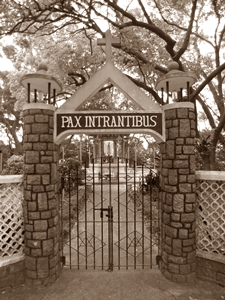 Joan Chittister offers a reminder of the stance that we as Christians are called to take toward kin, strangers, and even enemies. This “stance” only comes after years of intentional inner work, as well as outward practice, failure, and practice.

