-
Keystone XL Pipeline: ‘Bishops and Bulldozers’
On a gorgeous fall day, several hundred people stood outside the Ronald Reagan [sic] Building in downtown D.C. to demonstrate against the Keystone XL pipeline. Inside, the final public hearing about the pipeline was going on and dozens of speakers went inside to “testify” (in the most powerful religious sense of that word). Below you’ll find my contribution to the rally.
-
Fred Shuttlesworth: #Occupying Heaven

Rev. Fred Shuttlesworth with wife, Sephira in Selma, Alabama, at the 46th anniversary of Bloody Sunday at the Edmund Pettus Bridge. (Photo: Rose Berger) Rev. Fred Shuttlesworth, who withstood fire hoses and dogs unleashed by Birmingham’s public safety conmmissioner, and survived bombings and beatings during the civil rights movement, died on Wednesday (Oct. 5) at age 89.
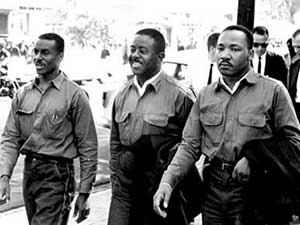
Rev. Fred Shuttlesworth (left), Ralph Abernathy (center), Dr. King (right) on Good Friday on April 12, 1963, in Birmingham. I met Rev. Shuttlesworth last year in Birmingham with his lovely wife Sephira when I joined the 46th anniversary of Bloody Sunday on a civil rights tour of Alabama led by Congressman John Lewis.
Rev. Shuttlesworth’s body was a bit ravaged, but his eyes were fierce and he was tracking everything that was going on.
He made it across the Edmund Pettus bridge one more time. And now he’s crossed a bridge where there’s nothing but angels on the other side.
“I think God created Fred Shuttlesworth to take on people like Bull Connor. He was one of the most courageous men that I have ever known. I don’t know of anyone else that could have led the movement in Birmingham.”–Rev. Joseph Lowery
Read more about Rev. Shuttlesworth over at Sojourners.
-
October 4: Francis of Assisi
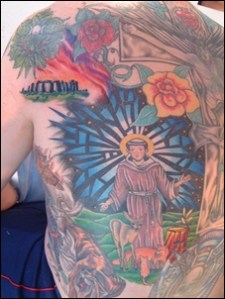
October 4 is the Feast of Saint Francis of Assisi, il poverello, the poor one, whose voice in the newly emerging mercantile class of the 13th century warned of the greed and corruption and destitution that would come when the world was run more on profit for the rich than it was on a prophetic commitment to the poor. And he was right.
But Francis was known for more than protests.
Francis loved animals, too. He was a walking apostle for ecology and the protection of woodlands, which, having been destroyed for parking lots and housing estates, leave animals who once lived in caves and forests to spill over into our largest cities. He talked to the animals. He understood them. He knew their place in creation.
No doubt about it. In a world where species after species is disappearing under the rubric of “progress,” where animals are being used for research on materials and cosmetics, where the boundaries between forests and cities are fast disappearing, where bears show up in shopping districts of major cities and crocodiles show up on people’s front lawns, we need St. Francis now.
It is also becoming clear that Francis knew what we are only now discovering.
-
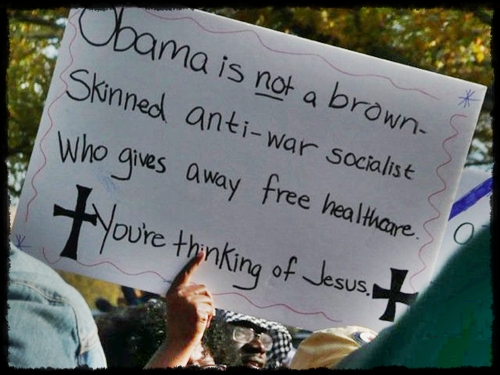
Photo of the Day
-
Sandra Schneiders: Religious Women and Expertise in Ministry
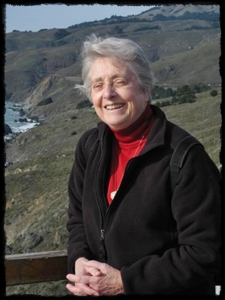 Theologian Sandra Schneiders has become one of the most cogent voices for articulating Catholic women religious’ life in the contemporary U.S.
Professor emerita at the Jesuit School of Theology in Berkeley, Calif., and a member of Sisters, Servants of the Immaculate Heart of Mary of Monroe, Mich., Schneiders is speaking to a much larger audience than only nuns. For any Christian who is passionate about living the gospel and makes sacrifices to follow that call, Schneiders can help you understand your role in modern America.
For faithful women clustered around the cross and active in The Way, whatever your denomination, Schneiders has something to say to you about internal authority, mutual freedom, life in tension.
 Schneiders recent speech titled The Future of Religious Life is addressing themes in the American Catholic church, but it conveys more broadly. Below is one section I found helpful in my own thinking, but I hope you’ll read and be encouraged by the whole article.
Increasingly, religious women have taken their expertise into ministries that, while still in continuity with those of the past and arising directly out of their communities’ charisms, are not ones most Catholics tend to associate with “the Sisters.”
Schneiders grouped them into four “clusters”:
*Social justice ministers focused on systemic or structural change, whose “theological glue” tends to be Catholic social teaching. These include social scientists, activists, lawyers, political and community organizers, economists and sociologists, urban farmers and legislators. -
Wangari Maathai Dies, Farewell to ‘Mother of Trees’
 Catholic Kenyan environmental activist Wangari Maathai won the 2004 Nobel Peace Prize – a first for an African woman and a first for environmentalism – for her work with the Green Belt Movement, the largest community-based environmental organization in Africa.
Maathai (1940-2011), who died this week of ovarian cancer, was particularly known for leading poor Kenyan women in a reforestation movement that has planted 30 million trees and for actively resisting the corruption of Kenyan president Daniel Arap Moi. At the announcement of the prize, the international press ran photos of Maathai standing tall, proud, beaming – and alone – in the spotlight.
“The Nobel Prize is absolutely a singular recognition,” explained Kenyan activist Njoki Njehu, director of the Washington, D.C.-based “50 Years is Enough” debt-relief campaign to Sojourners. “But it is also a collective recognition…[of] African women in terms of a way of valuing women’s work that has not been valued.” (Taking Root, a film about Maathai and the Greenbelt Movement, has just been released.)
Wangari Maathai opened her memoir with an scripture from Ezekiel. “The trees of the field will yield their fruit and the ground will yield its crops; the people will be secure in their land. They will know that I am the LORD, when I break the bars of their yoke and rescue them from the hands of those who enslaved them” (34:27). Below is an excerpt from the opening chapters of her extraordinary autobiography.
I was born the third of six children, and the first girl after two sons, on April 1, 1940, in the small village of Ihithe in the central highlands of what was then British Kenya. My grandparents and parents were also born in this region near the provincial capital of Nyeri, in the foothills of the Aberdare Mountain Range. To the north, jutting into the sky, is Mount Kenya.
-
Cosmas and Damian: Patron Saints of Universal Health Care
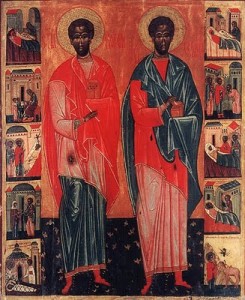
Saints Cosmas and Damian
Martyr. Patron saints of doctors. According to legend, these two early Christian martyrs were twins. Born in Arabia, they are said to have studied medicine in Syria. They then set up a practice in Aegeae, in Cilicia.
They were considered brilliant at their work, but what set them apart from other doctors at the time, was their refusal to charge any fees for their services. They believed that as Christians this was the best form of charity they could practice.
During the Diocletian persecutions, Lysias, the governor of Cilicia, had them arrested and tried. They were hung on crosses and a mob stoned them. Archers then shot them with arrows. Finally they were cut down and beheaded. This took place around 303AD.
The bodies of the two doctors were taken to Syria and buried at Cyrrhus.
In later years many people, including the Emperor Justinian I, would dream of these two saints when ill. In the dreams the doctors would advise patients on treatments and many healings took place after the dreams.
Justinian built a church in their honour in the city of Constantinople. A basilica at Cyrrhus and another in Rome was also dedicated to them. Their names are mentioned in the Roman Canon of the Mass. —Independent Catholic News
-
What Would You Do If Your Neighbor Was Killed in a Hate Crime?

Thanks to Jonathan Langer for alerting me to this. Jonathan writes:
The PBS special documentary Not In Our Town-Light in the Darkness will be shown on many PBS stations this Wednesday night at 10 pm. It is the story of how our town Patchogue came together after the hate killing of Manuel Lucero by 7 young men.
I know you have highlighted this story on Latino USA, I thought you might like to be aware of this program. The church shown in the trailer is St. Francis de Sales Roman Catholic Church which my wife and I attended for up until 3 years ago when we switched to a neighboring parish. The mayor and most of the Trustees are Catholic and attend St. Francis. Thanks again for your excellent work. Peace and Grace, Jonathan
Not In Our Town: Light in the Darkness premieres Wednesday, September 21, 2011. Check Local Listings to see when it’s airing on your local PBS station.
Not In Our Town: Light in the Darkness is a one-hour documentary about a town coming together to take action after anti-immigrant violence devastates the community. In 2008, a series of attacks against Latino residents of Patchogue, New York, culminate with the murder of Marcelo Lucero, an Ecuadorian immigrant who had lived in the Long Island village for 13 years.
Over a two-year period, the story follows Mayor Paul Pontieri, the victim’s brother Joselo Lucero, and Patchogue residents as they address the root causes of the violence, heal divisions, and take steps to ensure that everyone in their village will be safe and respected. In addition to the national broadcast, viewers can follow the case and learn more about the civil suits, find out more about how libraries got involved and learn about reporting hate crimes to local law enforcement.
-
Thousands Occupy Wall Street; Bronze Bull Needs Police Protection
“He who oppresses the poor to increase his wealth and he who gives gifts to the rich – both come to poverty.”–Proverbs 22:16
On Sunday, more than a thousand demonstrators occupied Wall Street in New York City to draw attention to Wall Street’s criminal behavior and call for structural economic reforms, reports Zaid Jilani.
“People have a very simple reason to be angry — because Wall Street’s actions made tens of millions of people dramatically poorer through no fault of their own. In 2010, the International Monetary Fund and World Bank conducted studies of the effects of the global recession — caused largely by Wall Street financial instruments that were poorly regulated by government policies — and found that the recession threw 64 million people [worldwide] into extreme poverty.” Watch this short video below for a great quote from 9-year-old Sam Kessler!
The International Monetary Fund estimates that the global economy contracted by 0.6 per cent in 2009 and the implications of this have been severe for many. Economic growth in developing countries was only 1.7 per cent in 2009 compared with 8.1 per cent in 2007. However, if China and India are excluded, the economies of developing countries actually contracted by 1.8 per cent. The World Bank has estimated that an additional 64 million people will be living in extreme poverty on less than US$1.25 a day by the end of 2010 as a result of the global recession.
The question is, why aren’t even more people in the streets of the financial district in New York City?
-
Julie Polter: ‘For those things we’re afraid to talk about and those things we’re afraid to hear’
 Over at Sojourners, Julie Polter provides the weekly ministry of producing SojoMojo, an in-house newsletter for our local community.
She’s been doing it for years. It’s a little “handmade” gift of the heart that knits together an amazing community of faith. Below is an excerpt from last week’s Mojo:
Prayers, concerns, and joys: Please remember all mourning the death of Fay Walker this week, mother of former Sojourners intern Susanne Walker Wilson (1991-92). Fay was a remarkable Christian activist, with much to inspire in her life story.
For those suffering famine in Somalia and the surrounding region. All those who mourn.
For refugees and outcasts, sinners and the sinned against, the victims and the aggressors; for all who hunger, mourn, or despair; for all who have no one to pray for them. For those things we’re afraid to talk about and those things we’re afraid to hear; for love instead of fear, abundance instead of scarcity, compassion instead of anger; for turning cheeks without turning away.
-
Subscribe
Subscribed
Have a WordPress.com account? Log in now.

