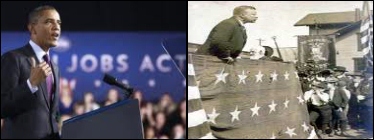
Tonight, President Obama is slated to “go populist” on America in his third State of the Union address. Insiders say he’s going to lay out a “blueprint for an economy that’s built to last.”
The speech will continue a theme President Obama laid out in Kansas last month – that in today’s economy the game has been rigged against the nation’s middle class.
On December 6, Obama gave an important and revealing speech in Osawatomie, Kansas — the best we’ve heard from him since the campaign trail. Building on Theodore Roosevelt’s New Nationalism language from Roosevelt’s Aug. 31, 1910, speech in Osawatomie honoring abolitionist John Brown, Obama reprises his platform of populist economics. But Obama is not yet Roosevelt. (See The Osawatomie Speech: Obama and Roosevelt.)
“We grudge no man a fortune in civil life if it is honorably obtained and well used. It is not even enough that it should have gained without doing damage to the community,” Roosevelt said in his speech. “We should permit it to be gained only so long as the gaining represents benefit to the community.”
Before watching tonight’s State of the Union address, read up on its historical context. Read Roosevelt’s original speech and President Obama’s December address. Here are some quotes from both:
“One of the chief factors in progress is the destruction of special privilege. The essence of any struggle for healthy liberty has always been, and must always be, to take from some one man or class of men the right to enjoy power, or wealth, or position, or immunity, which has not been earned by service to his or their fellows.”–President Theodore Roosevelt
“Long before the recession hit, hard work stopped paying off for too many people. Fewer and fewer of the folks who contributed to the success of our economy actually benefited from that success. Those at the very top grew wealthier from their incomes and their investments – wealthier than ever before. But everybody else struggled with costs that were growing and paycheques that weren’t – and too many families found themselves racking up more and more debt just to keep up.”–President Barack Obama
Here’s the word from the horse’s mouth (aka The State Department):
Today, the Department of State recommended to President Obama that the presidential permit for the proposed Keystone XL Pipeline be denied and, that at this time, the TransCanada Keystone XL Pipeline be determined not to serve the national interest. The President concurred with the Department’s recommendation, which was predicated on the fact that the Department does not have sufficient time to obtain the information necessary to assess whether the project, in its current state, is in the national interest.
Since 2008, the Department has been conducting a transparent, thorough, and rigorous review of TransCanada’s permit application for the proposed Keystone XL Pipeline project. As a result of this process, particularly given the concentration of concerns regarding the proposed route through the Sand Hills area of Nebraska, on November 10, 2011, the Department announced that it could not make a national interest determination regarding the permit application without additional information. Specifically, the Department called for an assessment of alternative pipeline routes that avoided the uniquely sensitive terrain of the Sand Hills in Nebraska. The Department estimated, based on prior projects of similar length and scope, that it could complete the necessary review to make a decision by the first quarter of 2013. In consultations with the State of Nebraska and TransCanada, they agreed with the estimated timeline.
On December 23, 2011, the Congress passed the Temporary Payroll Tax Cut Continuation Act of 2011 (“the Act”). The Act provides 60 days for the President to determine whether the Keystone XL pipeline is in the national interest – which is insufficient for such a determination. The Department’s denial of the permit application does not preclude any subsequent permit application or applications for similar projects.–State Department Memo Issued 18 January 2012
The Merton Seasonal is a quarterly joint publication of the International Thomas Merton Society and the Thomas Merton Center at Bellarmine University.
Dekar’s book is fantastic and has all kinds of hidden gems. Below is a portion of my review.
…The exciting find in Dekar’s book is previously unpublished lectures by Merton on technology. These lectures have been available on audio tape, but haven’t been used in print before. They make a worthy contribution to a critical current conversation. In a 1997 lecture at Stanford University, anti-civilization theorist and former Catholic John Zerzan said, “Technology claims to be neutral, merely a tool, its value or meaning completely dependent on how it is used. In this way it hides its end by cloaking its means.” Zerzan has resurged in popularity among some of the new monastics and other young radical Christians experimenting with intentional community and new ways of living. The excerpts from three previously unpublished Merton lectures on technology show Merton anticipating anarcho-primitivist philosopher Zerzan by more than 30 years. While Zerzan outright denies the claim that technology is neutral, Merton asserts with novices what he considered an overlooked insight from the Second Vatican Council. “Created goods may be perfected by human labor, technical skill and civic culture for the benefit of all men according to the design of the Creator and the light of His Word,” Pope Paul VI wrote in Lumen Gentium, the Council’s Pastoral Constitution on the Church in the Modern World. “May the goods of this world be more equitably distributed among all men, and may they in their own way be conducive to universal progress in human and Christian freedom.” In other words, products and technologies are neutral tools, but may be perfected if they are used to serve the common good and Christian freedom.
As Dekar displays in his excellent chapter “Thomas Merton, Guide to the Right Use of Technology” (85), Merton pushes home a paradox in his lectures: the monastery is being revolutionized by technology, whether recognized or not, but the material nature of technology is not nearly as threatening to the contemplative life as is “the technological society” (208), the way technology molds thinking, social relationships and the inner life. Merton forces critical questions about “the essences of things” (211), about the value and meaning in technology. “You can save your soul in a technological environment,” said Merton, “but there is no machine for saving your soul” (211).
Merton’s speaking on technology is more middle-of-the-road than his private letters and writings. While publicly he defines technology as a tool whose end use justifies its existence, in his April 1963 journal entry he raises much more serious concerns about “technologism that separates man from the world and makes him a kind of little god in his own right” (118). At a conference in September 2011 on Merton and technology at Bellarmine University, Albert Borgmann described Merton’s perspective on technology in this way: “He was clear about the effects of technology as a cultural force and could see that the effects were both dynamic and stultifying at the same time. It was an energetic and transforming force, but in the end it leaves us with experiences that are ultimately joyless.” When Anne Ford sent Merton a copy of Rachel Carson’s Silent Spring shortly after it was published, he began to put together the consistent pattern of thinking that ran through developing the atom bomb, indiscriminate use of DDT, and various other technological “remedies” that are “expressions of the sickness itself” (120), as he put it.
By focusing the insights of these previously unpublished lectures, Dekar has made a wonderful contribution of Merton wisdom to a very real contemporary issue. “The Christian in a Technological World” (205) resurrects early writings by Karl Marx on the purpose of the machine, as well as looks at monastic experiments in the 1960s that were bringing more technology into monastic life. Merton’s lecture titled “Marxism and Technology” is an amazingly prescient look at the role of computers in society and the process of depersonalization. Merton begins to probe the questions about who owns the means of technological production and what does it mean when those owners have no Biblical values. “For industry,” says Merton, “it doesn’t matter if it is safe, what matter is to sell it … and make some money out of it” (217). To industry, Merton says, morality “is regarded as sentimental” (217).
“It is not dutiful observance that keeps us from sin, but something far greater: it is love. And this love is not something which we develop by our own powers alone. It is a sublime gift of the divine mercy, and the fact that we live in the realization of this mercy and this gift is the greatest source of growth for our love and for our holiness.”–Thomas Merton
Some of you young folks been saying to me, “Hey Pops, what you mean ‘What a wonderful world’? How about all them wars all over the place? You call them wonderful? And how about hunger and pollution? That aint so wonderful either.”
Well how about listening to old Pops for a minute. Seems to me, it aint the world that’s so bad but what we’re doin’ to it. And all I’m saying is, see, what a wonderful world it would be if only we’d give it a chance.
Love baby, love. That’s the secret, yeah. If lots more of us loved each other, we’d solve lots more problems. And then this world would be better. That’s wha’ ol’ Pops keeps saying.–Louis “Satchmo” Armstrong
This quote is from the founding father of American Jazz Louis “Satchmo” Armstrong from the spoken word introduction to the 1970 recording of “What A Wonderful World.”
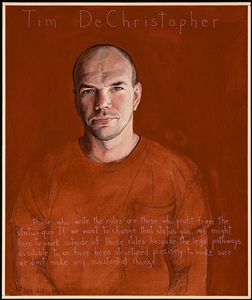
Tim DeChristopher by Robert ShetterlyTim DeChristopher, co-founder of the environmental group Peaceful Uprising, protested an highly contested oil and gas lease auction of 116 parcels of public land in Utah’s redrock country by signing a Bidder Registration Form and placing bids to obtain 14 parcels of land (totaling 22,500 acres) for $1.8 million. He didn’t have the money. DeChristopher was removed from the auction by federal agents and taken into custody.
On March 2, 2011, DeChristopher was found guilty on two felony charges for violation of the Federal Onshore Oil and Gas Leasing Reform Act and for making false statements. He refused any type of plea bargain. On July 26, 2011, he was sentenced to two years in a federal prison with a $10,000 fine, followed by three years of supervised probation. After several transfers from three states, he is now serving the remainder of his time in the Herlong Federal Correctional Institution in California.
His courtroom statement, reminiscent of Thoreau’s On The Duty of Civil Disobedience, was a deeply inspiring call to action. Author Terry Tempest William interviewed DeChristopher in May 2011. Below is an excerpt from Orion magazine:
TIM: I think what I was really trying to get across was the idea of not backing down. Because it’s important to make sure that the government doesn’t win in their quest to intimidate people into obedience. They’re trying to make an example out of me to scare other people into obedience. I mean, they’re looking for people to back down.
TERRY: Right. And I think democracy requires participation. Democracy also requires numbers. It is about showing up. And we do need leadership. And I think what your actions say to us as your community is, “How are we going to respond so you are not forgotten? So that this isn’t in vain?” And I think that brings up another question: we know what we’re against, but what are we for? Our friend Ben Cromwell asked this question. What are you for? What do you love?
TIM: I’m for a humane world. A world that values humanity. I’m for a world where we meet our emotional needs not through the consumption of material goods, but through human relationships. A world where we measure our progress not through how much stuff we produce, but through our quality of life—whether or not we’re actually promoting a higher quality of life for human beings. I don’t think we have that in any shape or form now. I mean, we have a world where, in order to place a value on human beings, we monetize it—and say that the value of a human life is $3 million if you’re an American, $100,000 if you’re an Indian, or something like that. And I’m for a world where we would say that money has value because it can make human lives better, rather than saying that money is the thing with value.
TERRY: I think about the boulder that hit the child in Coal River Valley. What was that child’s life worth—$14,000? The life of a pelican. What was it—$233? A being that has existed for 60 million years. What do you love?
TIM: I love people. [Very long pause.] I think that’s it.
Kai WrightColorLines editor Kai Wright always provides incisive commentary. As the Republican candidates move from New Hampshire to South Carolina and on to Florida, I’m wondering how to push Obama to change abusive economic policies and practices that “crush my people, and grind the face of the poor into the dust” (Isaiah 3:15). Wright says that the collapse of the Republican party may allow Obama to maintain a politics of the mushy middle, rather than the progressive reforms he campaigned on. Here’s an excerpt from Wright’s recent column:
” … [O]nce we set the horse race of partisan politics aside, the Republican collapse begins to look less gratifying. Here’s the thing: Elections are for incumbents all about being held accountable for their choices. And what the Obama White House needs more than anything at this juncture is a jolt of accountability from the social justice reformers who believed in the change it sold four years ago.
Democratic Party leaders have for generations distracted their own base with the horrific threat of their Republican challengers. From LGBT people to unionized workers, the message is too often the same: Never mind our failings, look at the scary other guys. That’s long been a winning strategy for uniting the Democratic coalition. But the Obama team has wielded it against progressive critics with particular vengeance. Indeed, the tea party has in some ways been as helpful a distraction for the White House as it has been an obstructionist tool for the Republicans.
In this light, the Republican field that’s emerging from Iowa and New Hampshire is tailor made for the Obama administration to avoid a much needed reality check with its own reformists supporters. The president will be able to run simultaneously against the lunacy of a Rick Santorum—or, whoever wins the so-called “conservative primary”—and the weakness of Mitt Romney. The latter poses little threat with voters and the former keeps picky progressives off his tail. As long as he faces no meaningful challenge, the president has little reason to vow a course correction from the choices of his first term. …–Excerpt from Why The GOP’s Spectacular Collapse Isn’t Good For Social Justice by Kai Wright
Camp X-Ray, Guantanamo Bay Indefinite Detention Center, January 2012Blind Willie Johnson had it right back in 1927 when he sang, “If I had my way, I’d tear this building down.” The U.S. concentration camps on Guantanamo Bay turn 10 years old on Wednesday. As Americans — and as people of faith — we should tear those buildings down.
I’m not naive about who some of the prisoners are being held there. But if there’s one thing the U.S. does extremely well, it’s prisons. We’ve got lots of them. There’s no reason why the men and boys held at Guantanamo can’t be moved into stateside prisons – military or civilian – and held accountable under a clear rule of law.
I want to be part of the civilian team of Americans — with families of international victims — who come to Guantanamo this year with hammers in our hands. It is time to dismantle these concentration camps.
Read below for Abraham’s haggling with God about punishing the innocent with the guilty and further down read Murat Kurnaz’ reflections five years after his release from Guantanamo.
Abraham approached the Lord and asked, “Are you really going to destroy the innocent with the guilty? If there are fifty innocent people in the city, will you destroy the whole city? Won’t you spare it in order to save the fifty? Surely you won’t kill the innocent with the guilty. That’s impossible! You can’t do that. If you did, the innocent would be punished along with the guilty. That is impossible. The judge of all the earth has to act justly.” –Genesis 18:23-25
I left Guantánamo Bay much as I had arrived almost five years earlier – shackled hand-to-waist, waist-to-ankles, and ankles to a bolt on the airplane floor. My ears and eyes were goggled, my head hooded, and even though I was the only detainee on the flight this time, I was drugged and guarded by at least 10 soldiers. This time though, my jumpsuit was American denim rather than Guantánamo orange. I later learned that my C-17 military flight from Guantánamo to Ramstein Air Base in my home country, Germany, cost more than $1 million.
When we landed, the American officers unshackled me before they handed me over to a delegation of German officials. The American officer offered to re-shackle my wrists with a fresh, plastic pair. But the commanding German officer strongly refused: “He has committed no crime; here, he is a free man.”
I was not a strong secondary school student in Bremen, but I remember learning that after World War II, the Americans insisted on a trial for war criminals at Nuremberg, and that event helped turn Germany into a democratic country. Strange, I thought, as I stood on the tarmac watching the Germans teach the Americans a basic lesson about the rule of law.
How did I arrive at this point? This Wednesday is the 10th anniversary of the opening of the detention camp at the American naval base at Guantánamo Bay, Cuba. I am not a terrorist. I have never been a member of Al Qaeda or supported them. I don’t even understand their ideas. ….
… a number of American and German intelligence documents from 2002 to 2004 [that] showed both countries suspected I was innocent. One of the documents said American military guards thought I was dangerous because I had prayed during the American national anthem.
Now, five years after my release, I am trying to put my terrible memories behind me. I have remarried and have a beautiful baby daughter. Still, it is hard not to think about my time at Guantánamo and to wonder how it is possible that a democratic government can detain people in intolerable conditions and without a fair trial.
It’s rumored that Pope Benedict may this year complete the canonization process for the great Rhineland mystic Hildegard von Bingen and also make her a “doctor of the church” to honor her tremendous contributions to the Christian faith. If you have never listened to Hildegard’s music, please treat yourself here.
Below are excerpts from Pope Benedict’s 2010 teachings on Hildegard who has long been regarded as a feminist icon for strong female leadership within the Church:
In 1988, on the occasion of the Marian Year, Venerable John Paul II wrote an Apostolic Letter entitled Mulieris Dignitatemon the precious role that women have played and play in the life of the Church. “The Church”, one reads in it, “gives thanks for all the manifestations of the feminine“genius’ which have appeared in the course of history, in the midst of all peoples and nations; she gives thanks for all the charisms that the Holy Spirit distributes to women in the history of the People of God, for all the victories which she owes to their faith, hope and charity: she gives thanks for all the fruits of feminine holiness” (n. 31).
Various female figures stand out for the holiness of their lives and the wealth of their teaching even in those centuries of history that we usually call the Middle Ages. Today I would like to begin to present one of them to you: St Hildegard of Bingen, who lived in Germany in the 12th century. She was born in 1098, probably at Bermersheim, Rhineland, not far from Alzey, and died in 1179 at the age of 81, in spite of having always been in poor health. Hildegard belonged to a large noble family and her parents dedicated her to God from birth for his service. At the age of eight she was offered for the religious state (in accordance with the Rule of St Benedict, chapter 59), and, to ensure that she received an appropriate human and Christian formation, she was entrusted to the care of the consecrated widow Uda of Gölklheim and then to Jutta of Spanheim who had taken the veil at the Benedictine Monastery of St Disibodenberg. A small cloistered women’s monastery was developing there that followed the Rule of St Benedict. Hildegard was clothed by Bishop Otto of Bamberg and in 1136, upon the death of Mother Jutta who had become the community magistra (Prioress), the sisters chose Hildegard to succeed her. She fulfilled this office making the most of her gifts as a woman of culture and of lofty spirituality, capable of dealing competently with the organizational aspects of cloistered life. A few years later, partly because of the increasing number of young women who were knocking at the monastery door, Hildegard broke away from the dominating male monastery of St Disibodenburg with her community, taking it to Bingen, calling it after St Rupert and here she spent the rest of her days. Her manner of exercising the ministry of authority is an example for every religious community: she inspired holy emulation in the practice of good to such an extent that, as time was to tell, both the mother and her daughters competed in mutual esteem and in serving each other.
But what was it that induced them to worship? For neither was the Virgin conspicuous, nor the house distinguished, nor was any other of the things which they saw apt to amaze or attract them. Yet they not only worship, but also “open their treasures,” and “offer gifts;” and gifts, not as to a man, but as to God. For the frankincense and the myrrh were a symbol of this. What then was their inducement? That which wrought upon them to set out from home and to come so long a journey; and this was both the star, and the illumination wrought of God in their mind, guiding them by little and little to the more perfect knowledge.– John Chrysostom (c.347-407), homily on Matthew 2:2
 Tonight, President Obama is slated to “go populist” on America in his third State of the Union address. Insiders say he’s going to lay out a “blueprint for an economy that’s built to last.”
 Thanks to The Merton Seasonal editor Patrick O’Connell for inviting me to review Paul Dekar’s new book Thomas Merton: Twentieth-Century Wisdom for Twenty-First-Century Living.




 When we landed, the American officers unshackled me before they handed me over to a delegation of German officials. The American officer offered to re-shackle my wrists with a fresh, plastic pair. But the commanding German officer strongly refused: “He has committed no crime; here, he is a free man.”
 It’s rumored that Pope Benedict may this year complete the canonization process for the great Rhineland mystic Hildegard von Bingen and also make her a “doctor of the church” to honor her tremendous contributions to the Christian faith. If you have never listened to Hildegard’s music, please treat yourself here.