-
Richard Rohr: To the Center by Circuitous Route

Labyrinth at Ave Maria Retreat Center in Limpopo, South Africa. “How do we find what is supposedly already there? How do we awaken our deepest and most profound selves? By praying and meditating? By more silence, solitude, and sacraments? Yes to all of the above, but the most important way is to live and fully accept our reality. This solution sounds so simple and innocuous that most of us fabricate all kinds of religious trappings to avoid taking up our own inglorious, mundane, and ever-present cross.
Living and accepting our own reality will not feel very spiritual. It will feel like we are on the edges rather than dealing with the essence. Thus most run toward more esoteric and dramatic postures instead of bearing the mystery of God’s suffering and joy inside themselves. But the edges of our lives—fully experienced, suffered, and enjoyed—lead us back to the center and the essence.
We do not find our own center; it finds us. Our own mind will not be able to figure it out. Our journeys around and through our realities, or “circumferences,” lead us to the core reality, where we meet both our truest self and our truest God. We do not really know what it means to be human unless we know God. And, in turn, we do not really know God except through our broken and rejoicing humanity.–Richard Rohr, ofm
Adapted from Everything Belongs: The Gift of Contemplative Prayer by Richard Rohr (pp. 17-19)
-
Video: The Responsible Bank Initiative
Ignatian News Network joins the non-partisan group LA Voice at a meeting in downtown LA outside of City Hall, to hear about their proposed bill, The Responsible Bank Initiative. LA Voice is part of the PICO National Network, which organizes community congregations of all different faiths that fight against various local neighborhood issues and obstacles.
-
Julia Jack-Scott: Spiritual Practices for Keeping Greed in Check

Artist Julia Jack-Scott Julia Jack-Scott has launched Searching for a Sacred Economy exploring the work of Charles Eisenstein on “sacred economics.” Julia is a tremendous writer and gifted thinker and artist. Here’s an excerpt from one of her posts:
I have a minister friend who told me about a sermon he preached about our relationship with money. He told everyone in his congregation to take out a dollar bill from their wallets and rip the bills up then and there. He asked them to do it again, this time with a larger bill if they could stand to, and to pay attention to what emotions and attachments they were encountering. I am guessing probably a bit of reluctance, some panicked thoughts about what it could have been spent on, or perhaps even inability to cooperate. I am not sure I could bring myself to tear up a twenty dollar bill. Or fifty. Or one hundred. Probably few of us could. But given a similar size piece of scrap paper, it would be no problem. You begin to see through this exercise how much power we assign to money. It is not hard to make the mental leap to an image of Golum in his cave stroking “his precious,” the ring. Golum is hopefully an exaggerated character of the sense of constriction, scarcity and greed we can sometimes feel around money, but we need collective practices to stop us from becoming so imbalanced in what we truly value.
I don’t think it is a coincidence that many world religions have teachings and practices around money, to keep greed in check. In Islamic tradition, the Quran condemns riba, or interest: “O, you who believe! Devour not riba, doubled and redoubled, and be careful of Allah; but fear Allah that you may be successful.” This is followed by Muslims to this day and serves as a check against greed and wealth amassing. In Buddhism, the practice of dana or voluntary giving, was one of the Buddha’s essential teachings, the very foundation of spiritual growth and self-transcendence. When I lived in Thailand, I loved seeing the early-morning ritual of dana unfolding, people giving a bit of food, a donation of money, or other gifts (like soap), to monks who would walk through the villages with their begging bowls. Setting aside something to give was built into the everyday consciousness of the Thai people, and also a daily joy of connection with the monks. [Read more.]
-
The People’s Prayer Breakfast: ‘Enough for Everyone’

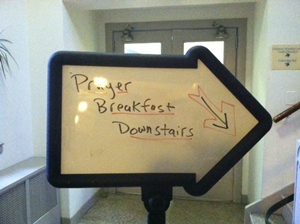
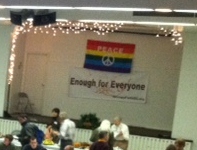
I got up early this morning to join the People’s Prayer Breakfast held at The Church of the Pilgrims in Washington, D.C. In order to get there I had to thread my way through police barricades and closed streets around the Washington Hilton Hotel. Thousands of people of faith-based leaders were gathered at the Hilton for the annual National Prayer Breakfast, where President Obama gave the keynote address. The cost is several hundred dollars per plate. The People’s Prayer Breakfast charged nothing. With signs pointing us to the church basement I walked in to a room twinkling with tiny white Christmas lights. The round tables were hugged tight by chairs–the room was fully occupied. Coffee and tea flowed freely. The Hari Krishna’s provided fruit salad. Someone had boiled mountains of eggs. An abundant table was set for whosoever would come and the banner stretched over head read “Enough for Everyone.”
We were led in prayer and silence by a nun from the Tibetan Buddhist monastery in Poolsville, Maryland. And Sweet-Honey-In-The-Rock-great Dr. Ysaye Barnwell sang an earth-groaning rendition of “Kumbaya, My Lord” to a generation who were experiencing for the first time the power of Black church music as a political and social force to be reckoned with.
The People’s Prayer Breakfast was not a protest against the National Prayer Breakfast, as some have framed it. Indeed, there were some leaders who were attending both. Instead, the People’s Prayer Breakfast extended the circle, opened the table, fired up the prayer, and grounded good spirituality in the lives and experiences of the humble, the poor, the young and the old, the disenfranchised and the powerless.
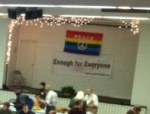
“To abstain from prayer is to refuse to let oneself be loved,” Brian Merritt reminded us, quoting Gabriel Marcel. I don’t know how folks at the Hilton felt afterward, but OccupyFaithDC, OccupyChurch, OccupyJudaism, OccupyJummah invited the people to breakfast and all went away marveling at the love they felt in the breaking of the bread.–Rose Marie Berger
Rose Marie Berger is a Catholic peace activist and poet. She blogs at www.rosemarieberger.com.
-
Abbot Philip: ‘We are not called to be unctuous or overly sweet or overly pious in a bad way.’

Today we have an odd collection of readings. Job, in the first reading, is so depressed and overwhelmed by the awfulness of life that he is sure that he will never see happiness again. The ending of the Book of Job, of course, shows him totally restored and once again happy. All of go through periods, however, in which we have some doubts about the happiness of this life, some doubts about God’s care for us and perhaps even a lot of doubts about our capacity to keep on living.The second reading, from the First Letter to the Corinthians, is about preaching the Gospel. The word, Gospel, means Good News or Good Tidings.
This is a huge contrast to the feelings of Job in the first reading. Paul is willing to give his whole life to preaching the Gospel and will receive no human recompense at all. Why? Because he knows that only in this way can he also share in the promises of the Gospel.You and I are called to preach the Gospel in the way we live each day. It is not as though we must leave what we are doing, get on the road and go about talking. No, we are invited to live in such a way that people will become interested in the Gospel just by seeing how we live. Mark’s Gospel picks up this same theme of preaching the Gospel. Jesus Himself tells us that He has come to proclaim the Gospel. No matter if He is tired, not matter if He is pushed on all sides—still, He knows that the Father has sent Him to proclaim the Good News.We are invited today to live with Christ. It is He who lives in us. All we need to do is allow His presence to shine through us. We don’t have to do anything spectacular. If we live with love and care for others, this shows through us. If we are willing to suffer for Christ, this also shows through us. We are not called to be unctuous or overly sweet or overly pious in a bad way. We are called to know Christ’s love for us and to respond to that love by loving others.–Abbot Philip,OSB, Christ in the Desert Monastery, Abiquiu, New Mexico
-
Good Pope John and the Announcement that Shook the World
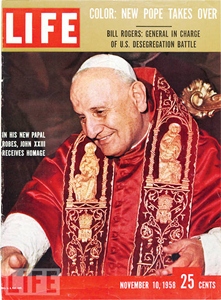 The National Catholic Reporter is running an “occasional series of articles about the Second Vatican Council” that will appear this year in NCR leading up to 50th anniversary of the council’s opening on Oct. 11, 2012. (You can read more about the Second Vatican Council anniversary issue here.)
Desmond Fisher, former editor of The Catholic Herald, London, wrote the first of these “viewpoint” articles, titled Curial horror greeted John XXIII’s announcement of ecumenical council. It gives great insight into just how surprising–and necessary–John XXIII’s council vision was. As we celebrate these three years of the 50th anniversary of Vatican II, I hope we will immerse ourselves again in John XXIII’s original vision and spirit and let our faith be renewed.
Here’s an excerpt from Fisher’s engaging opening:
Wednesday, the Catholic church should have celebrated — but didn’t — an important anniversary, the day 53 years ago when Pope John XXIII invited 18 Curia cardinals to accompany him to a ceremony at St. Paul Outside the Walls. It was the feast day of St. Paul, who is believed to have been executed in Rome about 67 A.D. and buried where the basilica named after him now stands.
It was also the final day of the Octave for Christian Unity, an objective close to the pope’s heart. Presumably because of the attendance of so many Vatican higher-ups, the ceremony lasted longer than usual. The result was that the content of the carefully timed announcement the pope made to the cardinals had been released to the media before the cardinals were told.
-
The Joy of “Keeping Custody” of One’s Self
 Catholic culture of an earlier era taught about “keeping custody” of one’s tongue, one’s mind, one’s eyes, one’s body. For example, “keeping custody of one’s eyes” meant that a person was very careful about what she allowed herself to see (cf Job 31:1; Mat 5:28; Psalm 119:37 etc.). It might mean focusing one’s gaze on the cross during prayer and not letting your eyes wander every time someone new entered the room.
According to Neilsen ratings, the average American is exposed to 1600 advertisements per day. Keeping custody of one’s eyes and ears has spiritual as well as political ramifications.
Keeping custody of one’s tongue meant “mindfulness” about speaking and silence, tone and tenor. The concept of “keeping custody” both roots in our own authority, power, and responsibility and also develops spiritual habits and practices that orient us toward what is essential and relegate to the margins what is non-essential. It’s a practice that quiets the heart and calms the spirit.
For those of us who spend a lot of time online there are actually free downloadable software apps that block advertisements. Consider whether one of these “overapps” might be good for your soul.
“Watch your thoughts; they become words.
Watch your words; they become actions.
Watch your actions; they become habits.
Watch your habits; they become character.
Watch your character; it becomes your destiny.”
—Unknown -
30 January: 64th Anniversary of Gandhi’s Assassination
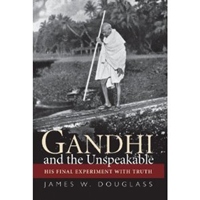 Today marks the 64th year since Mohandas Gandhi was assassinated.
In India, this day is known as Martyr’s Day and the entire country observes two minutes of silence at 11 a.m. to remember when the prophet of nonviolence and Indian liberation “stopped three bullets.” (There’s an interesting commentary by Nilanjan Mukhopadhyay in The AsianCorrespondent).
If you haven’t already, please read the just-released book Gandhi and the Unspeakable: His Final Experiment with Truth by Jim Douglass. It details the little-known history of who killed Gandhi, why, and how the repercussions continue to influence nuclear policy between Pakistan and India today.
Thanks to friend Art Laffin who sent this lovely reflection for the day:
Today is the anniversary of Gandhi’s assassination. At our weekly Dorothy Day Catholic Worker sponsored Pentagon vigil this morning, I prayed in gratitude for Gandhi’s life–for all he did to show the world the transforming power of nonviolence and the use of nonviolent resistance as a means to bring about revolutionary change. Gandhi is best known for espousing the nonviolent philosophy of “ahimsa” (Sanskrit term meaning “nonviolence” or “non-injury” — literally: the avoidance of himsa: violence) and “satyagraha” (literally translated “insistence on the truth”), and for leading a civil disobedience campaign which ended British rule of India.
Gandhi’s commitment to nonviolence and resistance was deeply influenced by Jesus as evidenced by his belief that: “Jesus was the most active resister known perhaps to history. This was nonviolence par excellence.”
As one of the most influential figures in modern social and political activism, Gandhi considered the following traits (seven deadly sins) to be the most spiritually perilous to humanity:
- Wealth without Work
- Pleasure without Conscience
- Science without Humanity
- Knowledge without Character
- Politics without Principle
- Commerce without Morality
- Worship without Sacrifice
Living in a society and world where violence and killing have tragically become the norm, where the U.S. is the world’s preeminent nuclear superpower, the following quotes from Gandhi point the way to creating a culture of nonviolence. “The first condition of nonviolence is justice all round in every department of life.”
“Nonviolence is the greatest force at the disposal of (hu)mankind. It is mightier than the mightiest weapon of destruction devised by the ingenuity of man.”
“Nonviolence is not a garment to be put on and off at will. Its seat is in the human heart, and it must be an inseparable part of our very being.”
“Nonviolence is the only thing the atom bomb cannot destroy…Unless now the world adopts nonviolence, it will spell certain suicide for (hu)mankind.”
“If there were no greed, there would be no occasion for armaments. The priciple of nonviolence necessitates complete abstention from exploitation in any form…Real disarmament cannot come unless the nations of the world cease to exploit one another.”
“My optimism rests on my belief in the infinite possibilities of the individual to to develop nonviolence. The more you develop it in your own being, the more infectious it becomes till it overwhelms your surroundings and by and by might oversweep the world.”
Mohandas Gandhi, prophet of nonviolence, pray for us!--Art Laffin, Dorothy Day Catholic Worker, Washington D.C.
-
Alice Walker on Teilhard de Chardin
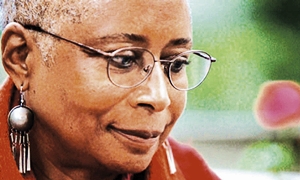 The wonderful writer Alice Walker has a new web site that is rich in wisdom. Here’s a quote from her opening text:
I encountered “Everything that rises must converge” while reading Flannery O’Connor, one of my favorite writers from the American South. It is the title of one of her books. She was quoting Teilhard de Chardin, a Catholic priest. In my own life this expression has rung quite true, though the meaning I make of it may be different than theirs. Everything I have ever worked for, rising regardless of circumstances to do my best, has led eventually to the lives of other people who are also rising – sometimes against even greater odds than mine. Embracing this reality removes fear of striking out and upward. Everyone you truly wish to encounter will be there when you arrive (you will realize you have been rising together though on separate continents, perhaps, or even during separate centuries!) or will appear shortly thereafter. There is much joy and celebration whenever we converge, i.e. meet each other. The spirits we knew. The faces we did not. Usually.–Alice Walker
-
Subscribe
Subscribed
Have a WordPress.com account? Log in now.

