-
Richard Rohr: Laying Down One’s ‘Stage Mask’
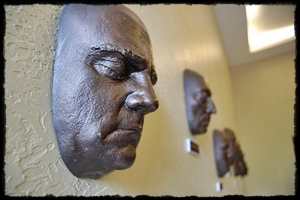
“In the second half of life, we have been in regular unwelcome contact with the shadow self, which gradually detaches us from our not-so-bright personas that we so diligently constructed in the first half of life. Our “stage mask” (persona in Greek) is not bad, evil, or necessarily egocentric; it is just not “true.” It is manufactured and sustained unconsciously by our mind; but it can and will die, as all fictions must die.
Person and shadow are correlative terms. Your shadow is what you refuse to see about yourself, and what you do not want others to see. The more you have cultivated and protected a chosen persona, the more shadow work you will need to do. Be especially careful therefore of any idealized role or self-image, like that of minister, mother, doctor, nice person, professor, moral believer, or president of this or that. These are huge personas to live up to, and they trap many people in lifelong delusion. The more we are attached to and unaware of such a protected self-image, the more shadow self we will likely have. Conversely, the more we live out of our shadow self, the less capable we are of recognizing the persona we are trying to protect and project. It is like a double blindness keeping you from seeing—and being—your best and deepest self. As Jesus put it: “If the lamp within you is, in fact, darkness, what darkness there will be” (Matthew 6:23).” —Richard Rohr, ofm
From Falling Upward: A Spirituality for the Two Halves of Life, pp. 127-128, pp. 127-128
-
Happy International Women’s Day!
Men: Wish the women around you “Happy International Women’s Day!” Perhaps give them a symbolic “bread and roses” to honor them.
Women: Who are three women who have had a profound and positive influence in your life? Tell the story.
I chose this particular video of the 1912 Lawrence, Massachusetts, women textile workers strike because I was delighted to see that it had been translated into Arabic – a contemporary twist to match our global winds of change.
And here’s the lyrics so you can learn the song:
Bread and Roses play mp3 or http://unionsong.com/button/musicplayer.swf?&song_url=http://unionsong.com/u159.mp3&
As we go marching, marching, in the beauty of the day
A million darkened kitchens, a thousand mill lofts gray
Are touched with all the radiance that a sudden sun discloses
For the people hear us singing, bread and roses, bread and roses.As we come marching, marching, we battle too, for men,
For they are in the struggle and together we shall win.
Our days shall not be sweated from birth until life closes,
Hearts starve as well as bodies, give us bread, but give us roses.As we come marching, marching, un-numbered women dead
Go crying through our singing their ancient call for bread,
Small art and love and beauty their trudging spirits knew
Yes, it is bread we. fight for, but we fight for roses, too.As we go marching, marching, we’re standing proud and tall.
The rising of the women means the rising of us all.
No more the drudge and idler, ten that toil where one reposes,
But a sharing of life’s glories, bread and roses, bread and roses. -
Video: Desert Monks on What Work Means
In the 1990s I was able to visit Christ in the Desert Monastery near Abiquiu, New Mexico. Though my time there as a guest was too short, the visit expanded by gaze of the spiritual landscape. The lives of the monks there connected me more deeply with the early Desert Mothers and Fathers. Walking the rough lumenaria-lit trail to the chapel at 3 a.m. under a diamond-studded velvet desert sky was a conversion experience.
Possibly most profound was for the first time in my life I experienced a community of men where I felt completely safe and cared for. Women around the world live in constant fear and rarely have the joys of walking at night alone. At Christ in the Desert I experienced the best of the masculine spirit in service to God.
Lent seems a good time to go back to the desert.
-
Merton: Window-Cleaning the Soul

“The humble [one] receives praise the way a clean window takes the light of the sun. The truer and more intense the light is, the less you see of the glass.” —Thomas Merton
From Seeds of Contemplation by Thomas Merton (New Directions Books, 1949, p112)
-
Rowan Williams: Bonhoeffer, Lent, and Freedom
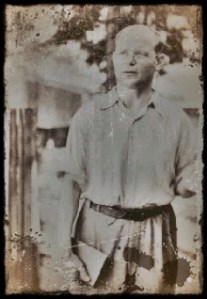
Dietrich Bonhoeffer Anglican Archbishop of Cantebury, Rowan Williams, preached at King’s School Canterbury on the first Sunday of Lent this year. He took his text from Confessing Church theologian Dietrich Bonhoeffer’s reflections on the nature of true freedom and what it means that “the truth shall set you free.” Quiet contemplation and learning to release the “fictions” of our lives are part of the Lenten practice.
You can read Williams’ entire sermon or listen to it here. Below is the opening section:
In 1939, the young German theologian, Dietrich Bonhoeffer, was in New York, exploring whether he should stay there as pastor to the German emigrants in the city and considering a string of invitations to lecture in the United States. He had made himself deeply unpopular with the German regime, making broadcasts critical of Hitler and running a secret training institution for pastors in Germany who could not accept the way that the Nazi state was trying to control the Church.
But, after a draining inner struggle, he decided to sail back to Germany. In July 1939, after just over a month in New York, he left – knowing that he was returning to a situation of extreme danger. Six years later, he was dead, executed for treason in a concentration camp, leaving behind him one of the greatest treasure of modern Christianity in the shape of the letters he wrote to family and close friends from prison. He had left behind the chance of freedom as most of us would understand it and plunged into a complex and risky world, getting involved in the plot to assassinate Hitler, living as a double agent, daily facing the prospect of arrest, torture and death.
But freedom was one of the things he most often wrote about. In a famous poem he wrote in July 1944, he sketched out what he thought was involved in real freedom – discipline, action, suffering and death. Not quite what we associate with the word – but with these reflections, he takes us into the heart of what it is for someone to be lastingly free.
The freedom he is interested in is the freedom to do what you know you have to do. The society you live in will give you all sorts of messages about what you should be doing, and, far more difficult, your own longings and preferences will push you in various directions. You have to watch your own passions and feelings and test them carefully, and then you have to have the courage to act. When you act, you take risks. You seemingly become less free. But what is really happening is that you are handing over your freedom to God and saying, ‘I’ve done what I had to; now it’s over to you.’ Freedom, he says, is ‘perfected in glory’ when it’s handed over to God. And this finds its climax in the moment of death, when we step forward to discover what has been hidden all along – the eternal freedom of God, underlying everything we have thought and done. … —Rowan Williams, Archbishop of Cantebury
Read Rowan Williams’ complete sermon.
-
Richard Rohr: Antidote To ‘The Dirty Rotten System’?
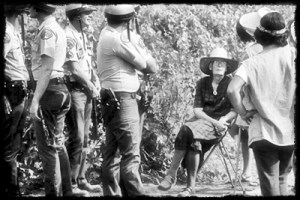
Police flank Dorothy Day, seated at a farm workers picket line in Lamont, California, in 1973. “We are all complicit in and benefitting from what Dorothy Day called ‘the dirty rotten system.’ That’s not condemning anybody; it’s condemning everybody because we are all complicit and enjoying the fruits of domination and injustice. (Where were your shirts and underwear made?) Usually the only way to be really non-complicit in the system is to choose to live a very simple life. That’s the only way out of the system!
Thus most of the great wisdom teachers like Gandhi, Saints Francis and Clare, Simone Weil, Dorothy Day, Jesus and Buddha—lived voluntarily simple lives. That’s almost the only way to stop bending the knee before the system. This is a truly transfigured life in cultures which are always based on climbing, consumption, and competition (1 John 2:15-17).
Once we idealize social climbing, domination of others, status symbols, power, prestige and possessions, we are part of a never ending game that is almost impossible to escape. It has its own inner logic that is self-maintaining, self-perpetuating, and self-congratulating as well as elitist and exclusionary. It will never create a just or happy world, yet most Christians never call it into question. Jesus came to free us from this lie which will never make us happy anyway, because it’s never enough, and we never completely win.”–Richard Rohr, ofm
Adapted from Spiral of Violence by Richard Rohr
-
Video: Dorothy Stang, Saint of the Amazon
Seven years ago on Feb. 13, 2005, Dorothy Stang, an American Sister of Notre Dame de Namur, was martyred in the Amazon as a result of her work with the landless poor there. When two hired gunmen met her on a muddy path they asked if she was carrying a weapon. In reply, she took out a Bible and began to recite the Beatitudes. “Blessed are the poor in spirit…blessed are the peacemakers.” Then she was shot six times and killed.
James Martin, over at America magazine, posted this wonderful video by students James Newton and Sam Clements that is one part of a series of four on Dorothy’s work in the Amazon.
In the summer of 2003 Newton and Clements headed to Brazil with a video camera, a map, and the idea to make a documentary. While filming in Southern Brazil, they heard about the extraordinary work of U.S. missionary Sister Dorothy Stang, a nun with a price on her head. For more than 20 years she had been fighting to preserve the Amazon rainforest, while helping peasant farmers live sustainably. Inspired by a mere five-minute call to Sister Dorothy, they set off on a 2500-mile journey to find her. Little did they know of the dangers ahead, or that Sister Dorothy would later be killed by hired gunmen.
-
Richard Rohr: ‘Original Fissure’

Leonard Cohen’s song, “Anthem,” states in the refrain: “There is a crack in everything. That’s how the light gets in.” That is a much more poetic way of naming what we unfortunately called “original sin”—a poor choice of words because the word sin implies fault and culpability, and that is precisely not the point! Original sin was trying to warn us that the flaw at the heart of all reality is nothing we did personally, but that there is simply “a crack in everything” and so we should not be surprised when it shows itself in us or in everything else. It keeps us patient, humble, and less judgmental.
The deep intuitions of most church doctrines are invariably profound and correct, but they are still expressed in mechanical and literal language that everybody either adores, stumbles over, denies, or fights. Hold on for a while until you get to the real meaning, which is far more than the literal meaning! That allows you to creatively critique things—without becoming oppositional, hateful, arrogant, and bitter yourself. Some call this “appreciative inquiry” and it has an entirely different tone that does not invite or create “an equal and opposite reaction.” The opposite of contemplation is not action; it is reaction. Much of the “inconsistent ethic of life,” in my opinion, is based on ideological reactions and groupthink, not humble discernment of how darkness hides and “how the light gets in.”–Richard Rohr, OFM
Adapted from Spiral of Violence by Richard Rohr
-
Richard Rohr: The Political Subversion of ‘Jesus Is Lord’

“Jesus is Lord” (Romans 10:10) was proclaimed by the early church as their most concise creedal statement. No one ever told me this was a political and subversive statement, until I studied the Scriptures. To say “Jesus is Lord” was testing and provoking the Roman pledge of allegiance that every Roman citizen had to shout when they raised their hand to the Roman insignia: “Caesar is Lord.” Early Christians were quite aware that their “citizenship” was in a new universal kingdom, announced by Jesus (Philippians 3:20), and that the kingdoms of this world were not their primary loyalty systems. How did we manage to lose that? And what price have we paid for it?
Jesus showed no undue loyalty either to his Jewish religion nor to his Roman-occupied Jewish country; instead, he radically critiqued both of them, and in that he revealed and warned against the idolatrous relationships that most people have with their country and their religion. It has allowed us to justify violence in almost every form and to ignore much of the central teaching of Jesus.–Richard Rohr, OFM
Adapted from Spiral of Violence by Richard Rohr.
-
Richard Rohr: The Spiritual Gift of Discernment

The spiritual gift of discernment (1 Corinthians 12:10) is when good things can be recognized sometimes as bad things, and vice versa. Discernment has largely been undeveloped among ordinary Christians, except among those good Jesuits! It invites people into “both/and” thinking, rather than simplistic “either/or” thinking. This is the difference between merely having correct information and the spiritual gift of wisdom (1 Corinthians 12:8-9). Both knowledge and wisdom are good, but wisdom is much better. It demands the maturity of discernment, which is what it takes to develop a truly consistent ethic of life. I admit the vast majority of people are not there yet.
Once we have learned to discern the real, disguised nature of both good and evil, we recognize that everything is broken and fallen, weak and poor, while still being the dwelling place of God—you and me, your country, your children, your churches, even your marriage. That is not a put-down, but finally a freedom to love imperfect things! As Jesus told the rich young man, “God alone is good!” (Mark 10:18). In this, you may have been given the greatest recipe for happiness for the rest of your life. You cannot wait for things to be totally perfect to fall in love with them or you will never love anything. Now, instead, you can love everything.–Richard Rohr, OFM
Adapted from Spiral of Violence by Richard Rohr.


-
Subscribe
Subscribed
Have a WordPress.com account? Log in now.

