Here’s a great 3-minute video on Pacem in Terris, the encyclical written by Pope John XXIII. What does it mean 50 years later? It includes quotes from John Carr, Bryan Hehir, Maryanne Cusimano Love, Meghan Clarke, Gerry Powers, and Peter Turkson.
Thanks to Dennis Sadowski and Chaz Muth over at Catholic News Service for putting it together. Find out more here.
Abbot Philip is a Benedictine monk who lives in the New Mexico desert at Christ in the Desert monastery. I find his reflections honest and clear. Here’s an excerpt from The Abbot’s Notebook (24 April 2013):
“For the past 50 years, there has been a movement of the Holy Spirit throughout the Church, bringing new ways of thinking, new ways of relating, new ways of dreaming.
This happens at times in the history of the Church and we should not be afraid of it. Not everything that happens in such movements is of lasting value. Not every road that is chosen leads directly to the Lord. Always there is enthusiasm and always there is resistance. The early monastic movement was in the midst of this kind of movement as well. What is important in our spiritual lives is seeking to choose the Lord Jesus and His ways. It is a personal encounter with the Lord that draws us to Him. I can sit here in my cell and spend time being still and listening. I can read Holy Scripture and understand what has been written.
I found this great 18-minute video by Simon Sinek, author of Start With Why, on communicating what you believe. Here’s a quote from Sinek’s talk that got me thinking:
“Now let me give you a successful example of the law of diffusion of innovation. In the summer of 1963, 250,000 people showed up on the mall in Washington to hear Dr. King speak. They sent out no invitations, and there was no website to check the date. How do you do that? Well, Dr. King wasn’t the only man in America who was a great orator. He wasn’t the only man in America who suffered in a pre-civil rights America. In fact, some of his ideas were bad. But he had a gift. He didn’t go around telling people what needed to change in America. He went around and told people what he believed. “I believe, I believe, I believe,” he told people. And people who believed what he believed took his cause, and they made it their own, and they told people. And some of those people created structures to get the word out to even more people. And lo and behold, 250,000 people showed up on the right day at the right time to hear him speak.
How many of them showed up for him? Zero. They showed up for themselves. It’s what they believed about America that got them to travel in a bus for eight hours to stand in the sun in Washington in the middle of August. It’s what they believed, and it wasn’t about black versus white: 25 percent of the audience was white. Dr. King believed that there are two types of laws in this world: those that are made by a higher authority and those that are made by man. And not until all the laws that are made by man are consistent with the laws that are made by the higher authority will we live in a just world. It just so happened that the Civil Rights Movement was the perfect thing to help him bring his cause to life. We followed, not for him, but for ourselves. And, by the way, he gave the “I have a dream” speech, not the “I have a plan” speech.”–Simon Sinek
At nearly 90 years old, Israeli peace activist Uri Avnery wrote a powerful reflection last week on spending the eve of Israel’s “Memorial Day” with Israeli and Palestinian families who have lost loved ones in the ongoing violence.
Avnery is an Israeli writer and founder of the Gush Shalom peace movement. He was a member of the Irgun, a Zionist paramilitary group as a teenager and a member of the Knesset from 1965–74 and 1979–81. His essay In Praise of Emotion, hints to me of the healing power of a the psalms as they are sung in lament, anger, confusion, and grief — especially when we sing them with our enemies. Here’s an excerpt:
Last Sunday, on the eve of Israel’s Remembrance Day for the fallen in our wars, I was invited to an event organized by the activist group Combatants for Peace and the Forum of Israeli and Palestinian Bereaved Parents.
The first surprise was that it took place at all. In the general atmosphere of discouragement of the Israeli peace camp after the recent elections, when almost no one dared even to mention the word peace, such an event was heartening.
The second surprise was its size. It took place in one of the biggest halls in the country, Hangar 10 in Tel-Aviv’s fair grounds. It holds more than 2000 seats. A quarter of an hour before the starting time, attendance was depressingly sparse. Half an hour later, it was choke full. (Whatever the many virtues of the peace camp, punctuality is not among them.)
The third surprise was the composition of the audience. There were quite a lot of white-haired old-timers, including myself, but the great majority was composed of young people, at least half of them young women. Energetic, matter-of-fact youngsters, very Israeli.
I felt as if I was in a relay race. My generation passing the baton on to the next. The race continues.
BUT THE outstanding feature of the event was, of course, its content. Israelis and Palestinians were mourning together for their dead sons and daughters, brothers and sisters, victims of the conflict and wars, occupation and resistance (a.k.a. terror.)
An Arab villager spoke quietly of his daughter, killed by a soldier on her way to school. A Jewish mother spoke of her soldier son, killed in one of the wars. All in a subdued voice. Without pathos. Some spoke Hebrew, some Arabic.
They spoke of their first reaction after their loss, the feelings of hatred, the thirst for revenge. And then the slow change of heart. The understanding that the parents on the other side, the Enemy, felt exactly like them, that their loss, their mourning, their bereavement was exactly as their own. …–Uri Avery
“Life is pure flame,” Thomas Browne wrote, “and we live by an invisible sun within us.” It is this invisible sun, this light within, this call to something worthwhile in life that is meant to dispel life’s darkness. It gives us our reason to be. And it is this call to the fullness of ourselves that drives us on, that becomes our internal measure of worth and, in the end, it is, as well, the judge of our quality of happiness.
Life is not about having a job. Life is about responding to the great human call to make life more than a series of aimless occupations. A call is a sacred reason to be alive.
The spiritual value of discovering the star by which we are steering the entire rest of our lives shapes us both internally and publicly. It affects the way we feel about ourselves, it determines how we relate to others, it defines our place in the world, and it provides a sense of purpose to life. When those things are defined, the emptiness goes, the rootlessness goes, the capriciousness of life that eats away at the heart of us disappears. Days may be difficult after that, yes, but they at least have a sense of meaning. We are no longer simply spinning around in the space called our lives, fearful of the future, dissatisfied with the present. We are now going someplace for a reason larger than ourselves and feeling more humanly significant than simply self-important.–Joan Chittister, OSB
Finally! The May issue of Sojo on Climate Change is available. I’ve been working on this for months! Thanks to everybody out there who are sitting in trees, and lobbying Congress, and saying prayers, and on and on. I guess what I do is write. So here’s an excerpt:
In the wake of the Sept. 11 attacks, the United States launched two ground wars and a worldwide “war on terror.” Within two months, Congress federalized the Transportation Security Administration to secure airports. More than 263 government organizations were either created or reorganized. Some 1,931 private companies were put to work on counterterrorism, homeland security, and intelligence. Rightly or wrongly, America moved heaven and earth to stop terrorism in its tracks. It was seen as both an ongoing threat and a moral affront that had to be dealt with.
What about Climate Change?
In February, a New York State Senate task force on Superstorm Sandy compared the hurricane that affected 24 states to the 9/11 terrorist attacks. “[On 9/11] there were more than 3,000 souls lost, but in terms of the geographic destruction, it was isolated to Lower Manhattan,” said Sen. Andrew Lanza (R-Staten Island). “[After Sandy] we have miles and miles and miles of destruction. Hundreds of thousands of homes affected, 60 … New Yorkers killed, 250,000 to 260,000 businesses affected.”
Hurricane Sandy killed 253 people in seven countries. It was the second largest Atlantic hurricane ever recorded—and the most expensive. It smashed into the East Coast with barely three days’ warning. Like hurricanes Katrina and Rita before it, Sandy was a disaster of biblical proportions.
After 9/11, Americans knew in our gut that something was seriously wrong. Our moral intuition had been sucker punched.
Climate change—and its deadly implications—has been harder to grasp. There’s a lot of complicated science involved. Instead of a single incident, we’re inundated with seemingly disconnected events. And, despite the evidence, we often fail to see it as a “crime.”
But global warming is a clear and present danger—with perpetrators, victims, and, most important, solutions.
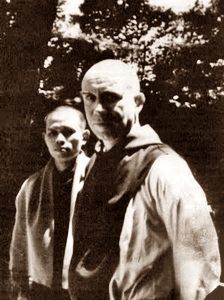
Thích Nhat Hanh and Thomas Merton, 1966“The ultimate perfection of the contemplative life is not a heaven of separate individuals, each one viewing his own private intuition of God; it is a sea of Love which flows through the One Body of all the elect, all the angels and saints, and their contemplation would be incomplete if it were not shared, or if it were shared with fewer souls, or with spirits capable of less vision and less joy.”–Thomas Merton
For the fourth time in two weeks Pope Francis has chosen to focus on women in the Church as part of his teachings and witness.
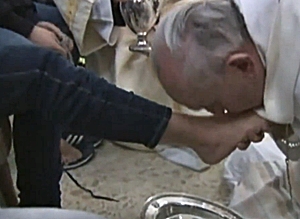
On Holy Thursday he washed the feet of 12 prisoners at a juvenile facility prison in Rome. Francis washed black feet, white feet, male feet, female feet and even a foot with tattoos. Kneeling on the stone floor as the 12 youngsters sat above him, the 76-year-old Francis poured water from a silver chalice over each foot, dried it with a simple cotton towel and then bent over to kiss each one. In addition to including girls and women in this service, also included were an Orthodox Christian and a young Muslim man. (The traditionalist custom has been to wash the feet of 12 retired priests in a high Mass in church.)
Pope Francis told the detainees that Jesus washed the feet of his disciples on the eve of his crucifixion in a gesture of love and service. “This is a symbol, it is a sign — washing your feet means I am at your service,” Francis told the youngsters. “Help one another. This is what Jesus teaches us. This is what I do. And I do it with my heart. I do this with my heart because it is my duty, as a priest and bishop I must be at your service.”
Holy Saturday he dedicated his Easter Vigil homily to the women as the first witnesses to the Resurrection. “There is one last little element that I would like to emphasize in the Gospel for this Easter Vigil,” he said. “The women encounter the newness of God.” On Tuesday he spoke about Mary Magdalene’s tears and how we should follow her example of faith.
On Wednesday Pope Francis expanded his reflections to the women of the world, whom he said have a special and fundamental role in the Church and the transmission of the faith. He says:
In the professions of faith of the New Testament, only men are remembered as witnesses of the Resurrection, the Apostles, but not the women. This is because, according to the Jewish Law of the time, women and children were not considered reliable, credible witnesses. In the Gospels, however, women have a primary, fundamental role. Here we can see an argument in favor of the historicity of the Resurrection: if it were a invented, in the context of that time it would not have been linked to the testimony of women. Instead, the evangelists simply narrate what happened: the women were the first witnesses. This tells us that God does not choose according to human criteria: the first witnesses of the birth of Jesus are the shepherds, simple and humble people, the first witnesses of the Resurrection are women.
There are difficult days ahead for this pope — with the Vatican bank, the ongoing sexual abuse scandal, and the fundamental corruption that clericalism is wreaking on the church. But in the past 21 days, he has done more to restore integrity to the Catholic church than at least the previous two popes. And he is modeling Christ for the world. I intend to soak up all the healing, all the pastoral and inspiring gospel teaching and all his humble actions that he’s pouring out on the soul of the world.
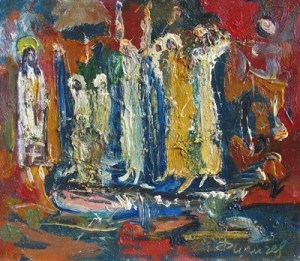
Resurrection by Ivan FilichevI’ve been away over Holy Week and Easter. I’ve missed the opportunity to pray together with all of you through these postings.
As we enter Eastertide, here’s a short reflection from Catholic Benedictine Joan Chittister:
“To say ‘I believe in Jesus Christ . . . who rose from the dead,’ is to say I believe that the Resurrection goes on and on and on forever. Every time Jesus rises in our own hearts in new ways, the Resurrection happens again. Every time we see Jesus where we did not recognize him before — in the faces of the poor, in the love of the unloved, in the revelatory moments of life, Jesus rises anew. The real proof of the Resurrection lies not in the transformation of Jesus alone but in the transformation awaiting us who accept it.
To say, ‘I believe in Jesus Christ . . . who rose from the dead,’ is to say something about myself at the same time. It says that I myself am ready to be transformed. Once the Christ-life rises in me, I rise to new life as well. ‘Christ is risen, we are risen,’ we sing at Easter. But it has a great deal more to do with life than with death. If I know that Jesus has been transformed, then I am transformed myself, and as a result, everything around me.
Until we find ourselves with new hearts, more penetrating insights, fewer compulsions, less need for the transient, greater awareness of the spiritual pulse of life, resurrection has not really happened for us. Jesus has risen but we have not. Resurrection is change at the root of the soul. It marks a whole new way of being in life.
Jesus, help me to understand that in every life, something good fails, something great ends, something righteous is taken unjustly away, something looms like an abandonment by God. Give me the wisdom to know that You rose from the dead as a sign to us that every one of these ‘little deaths’ is life become new all over again. Be with me in living Your Resurrection over and over again.–Joan Chittister, OSB
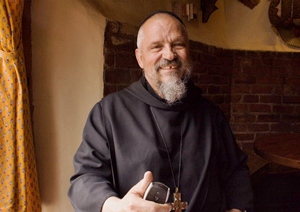 Abbot Philip is a Benedictine monk who lives in the New Mexico desert at Christ in the Desert monastery. I find his reflections honest and clear. Here’s an excerpt from The Abbot’s Notebook (24 April 2013):
 I found this great 18-minute video by Simon Sinek, author of Start With Why, on communicating what you believe. Here’s a quote from Sinek’s talk that got me thinking:
 At nearly 90 years old, Israeli peace activist Uri Avnery wrote a powerful reflection last week on spending the eve of Israel’s “Memorial Day” with Israeli and Palestinian families who have lost loved ones in the ongoing violence.


 For the fourth time in two weeks Pope Francis has chosen to focus on women in the Church as part of his teachings and witness.