As I listened to the BBC coverage of Mandela’s funeral service in Qunu, I was thrilled and amazed to hear Mandela’s Xhosa “praise poet,” Zolani Mkiva (left), perform during the ceremony.
These traditional poets are called imbongi and they travel with tribal royalty and introduce them at special events.
I haven’t found video of him performing during the ceremony, but I did find this video of him “saying what he was going to say” to a reporter.
Former Dominican priest Matthew Fox has a new book out called Letters to Pope Francis. He also just published a “condensed version” essay in Tikkun magazine. Here’s an excerpt, but read the whole thing.
“… Teachings of Pope Francis that stand out include some of the following.
1. A walking of his talk of simpler lifestyle. Pope Francis was well known in Argentina for taking public transportation to work and refusing any limousine-like service, which so many prelates take for granted. He has done the same in his new position as pope, where he chooses not to live in the papal apartments but in a far more modest guest house or hotel in the Vatican (might he give over the apartments to Rome’s homeless?). He drives a Ford Focus in Vatican city. He has also drawn some press recently for sneaking out at night from the Vatican in the simple priestly garb of black suit and color and hanging out with homeless in the streets of Rome. One senses he is trying to walk the talk and follow his own preaching about simplification. And he is putting pressure on other prelates to do the same.
The Archbishop Desmond Tutu discusses with Sir David Frost what it was like in the early days after Nelson Mandela was released and lived at Bishop’s Court. The Archbishop further describes Nelson Mandela’s character as a leader and as a man. Video footage from the Sir David Frost interview in January 2013. At the end of the clip, Tutu mentions a name, Dr. Verwoerd. Hendrik Verwoerd was the former Prime Minister of South Africa who died in 1966. He is considered the “primary architect of apartheid.”
Watch more videos on Nelson Mandela and the South African Freedom Movement here.
In the fall of 1981 I was a freshman at the University of California, Davis. It didn’t take long for me to step into the “Free South Africa” divestment movement sweeping the U.C. system.
I already had some traction with political protest. My first “demonstration” that I can remember was the 1966. I was three years old and it was the United Farm Workers march on the California state capitol in Sacramento. I was – and still am – a child of La Causa.
The University of California system had billions of dollars invested in South Africa – as did many U.S. and international corporations and governments. The aim of the divestment movement was to “drain the swamp of the apartheid regime.” The ANC and the South African church movement was calling for divestment and sanctions against the South African apartheid regime — even though it would but additional burdens on ordinary people. Millions around the globe responded.
The divestment movement spread like wildfire through the U.C. system. We had regular noon rallies outside the administration offices. And more than once in my college career we blocked the steps to Sproul Hall and were subsequently arrested by campus police with the Davis city police looking on.
The most amazing thing about all that hard work and direct action and perseverance was that we WON! On July 18, 1986, on Nelson Mandela’s birthday, the U.C. Regents voted for full divestment of the of the systems 3.1 billion dollars. When the U.C. system voted to divest, suddenly a number of other major schools, like Harvard, became vulnerable to a divestment campaign. There was a kind of domino effect that began to happen.
When the South African President Botha tried to make cosmetic changes to the racial separation laws, the divestment movement didn’t falter. It was a free South Africa or nothing. Then in 1990 the de Klerk regime began to negotiate with the ANC. On February 2, 1990, he made his first public comment announcing his commitment to release South Africa’s most famous prisoner, Nelson Mandela. On Feb. 11, Nelson Mandela walked free from prison, where he had been sentenced to hard labor for 27 years.
In 1994, South Africans held their first free and democratic elections. People waited in lines for days to vote. Here in the U.S. many of us watched it on television for hours. Just to see hundred-year-old South African black women, vote for the first time. It was truly a long walk and a long struggle to freedom.
There had always been strong Christian leadership in the black community against apartheid–Rev. Desmond Tutu, Dr. Manas Buthelezi, Alan Boesak, and Frank Chikane. But, after the Sharpsville massacre in 1960, Beyers Naude, an white Afrikaner Dutch Protestant, stepped forward to lead the white and global church in resistance to apartheid. He brought the World Council of Churches into the freedom struggle. And soon church and Christian communities around the world, including Sojourners, were singing South African Freedom Songs in church. St. George’s Anglican Cathedral in Cape Town and Regina Mundi, the largest Catholic church in South Africa in Soweto became two of the leading “struggle churches” or “peoples’ churches” where organizers met and prayed and sang and mourned and strategized and healed and went on.
Now, with Mandela dead, these are the churches where the people return to sing, and mourn, and dance, and celebrate. May all our churches be such places. I’m so happy that I am a child of these freedom struggles. Watching the South Africans around the world toi toi in grief and thanksgiving helps me understand what resurrection means.
Photo taken by Joseph Ross“Nelson Mandela is a hero to me. Back in 1985, in graduate school at the University of Notre Dame, I was part of the Anti-Apartheid Network, a student group opposed to South Africa’s policy of racial separation. We were part of the international movement, largely of college students, urging divestment from firms doing business in South Africa. Mandela himself, after becoming president, said the divestment movement played a key role in bringing down the apartheid government. At Notre Dame, we used to gather every Friday at noon on the Main Building’s steps. We learned about the week’s events in South Africa from Professor Peter Walshe, a South African teaching at Notre Dame. I also became friends with Rev. Malusi Mpumlwana, a South African Anglican priest studying at Notre Dame. Malusi developed my understanding of systemic violence in ways no book could have taught me. I learned a great deal from him over endless cups of coffee and loud laughter. We students were somewhat naive, but we brought a passion to the divestment cause. It was my first experience in such a political movement and I learned a great deal about my own responsibility for those who suffer around the world. The lessons I learned from Malusi and others in the Anti-Apartheid movement guide me still. …”–Joseph Ross
Poet Baron Wormser’s novel Teach Us That Peace shows how the seemingly impossible–racial harmony in the United States–began to become possible. How did we glimpse a vision of the Beloved Community?
Set in Baltimore, Wormser’s novel chronicles two very important years in American history–1962 and 1963–through the experiences of a 39-year-old mother of three and high school English teacher named Susan Mermelstein and her 16-year-old son Arthur.
This book is a great one to have over the holidays–especially as a conversation starter between generations. What were the critical events that shaped the Baby Boomers in your family? How do those events still shape their values and social-political and cultural life? What do you need to know from them about how we live today?
I studied with Baron Wormser at the Stonecoast MFA program in Maine. He’s an amazing teacher, exceedingly compassionate and gifted writer, and a man who” walks the walk” even more than he “talks the talk.” ORDER NOW.
Today, Dolores Huerta joined the National Fast4Families on the National Mall in Washington, D.C. At the Fasters’ Google Hangout, Dolores explained where the United Farm Workers’ rallying cry “Si, se puede!” came from:
“In California in the farm worker movement every night ended with Mass and prayer. But in Arizona, the “professional Hispanics” said “Oh, no Dolores! You can do Mass in California, but no se puedeaqui in Arizona.” And I responded, “Si, se puede!” Not only can we, but we must.” —Dolores Huerta, Fast4Families, December 3, 2013
“Give us thankful hearts, O God, in this the season of Thy Thanksgiving. May we be thankful for health and strength, for sun and rain and peace. Let us seize the day and the opportunity and strive for that greatness of spirit that measures life not by its disappointments but by its possibilities, and let us ever remember that true gratitude and appreciation shows itself neither in independence nor satisfaction but passes the gift joyfully on in larger and better form. Such gratitude grant us, O Lord. Amen.”–W.E.B. DuBois on Psalm 100
From Prayers for Dark People by W.E.B. DuBois, founder of the NAACP (p.12)
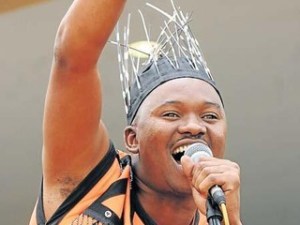 As I listened to the BBC coverage of Mandela’s funeral service in Qunu, I was thrilled and amazed to hear Mandela’s Xhosa “praise poet,” Zolani Mkiva (left), perform during the ceremony.
 Former Dominican priest Matthew Fox has a new book out called Letters to Pope Francis. He also just published a “condensed version” essay in Tikkun magazine. Here’s an excerpt, but read the whole thing.
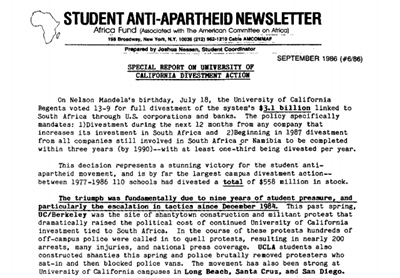 In the fall of 1981 I was a freshman at the University of California, Davis. It didn’t take long for me to step into the “Free South Africa” divestment movement sweeping the U.C. system.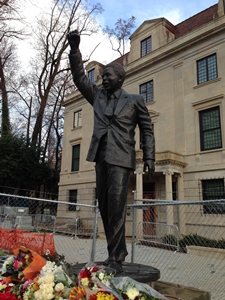
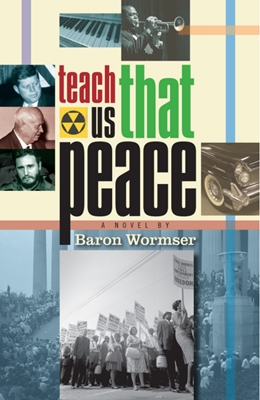 Poet Baron Wormser’s novel Teach Us That Peace shows how the seemingly impossible–racial harmony in the United States–began to become possible. How did we glimpse a vision of the Beloved Community?
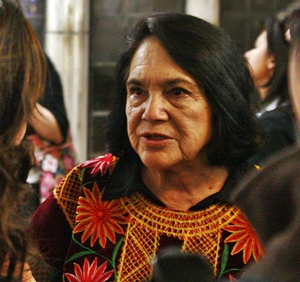 Today, Dolores Huerta joined the National Fast4Families on the National Mall in Washington, D.C. At the Fasters’ Google Hangout, Dolores explained where the United Farm Workers’ rallying cry “Si, se puede!” came from:


