That numinous healer who preached Saturnalia and paradox
has died a slave’s death. We were manoeuvered into it by priests
and by the man himself. To complete his poem.
He was certainly dead. The pilum guaranteed it. His message,
unwritten except on his body, like anyone’s, was wrapped
like a scroll and despatched to our liberated selves, the gods.
If he has now risen, as our infiltrators gibber,
he has outdone Orpheus, who went alive to the Shades.
Solitude may be stronger than embraces. Inventor of the mustard tree,
he mourned one death, perhaps all, before he reversed it.
He forgave the sick to health, disregarded the sex of the Furies
when expelling them from minds. And he never speculated.
If he is risen, all are children of a most real high God
or something even stranger called by that name
who knew to come and be punished for the world.
To have knowledge of right, after that, is to be in the wrong.
Death came through the sight of law. His people’s oldest wisdom.
If death is now the birth-gate into things unsayable
in the language of death’s era, there will be wars about religion
as there never were about the death-ignoring Olympians.
Love, too, his new universal, so far ahead of you it has died
for you before you ever met it, may seem colder than the favours of gods
who are our poems, good and bad. But there never was a bad baby.
Half his worship will be grinding his face in the dirt
then lifting it to beg, in private. The low will rule, and curse by him.
Divine bastard, soul-usurer, eros-frightener, he is out to monopolise hatred.
Whole philosophies will be devised for their brief snubbings of him.
But regained excels kept, he taught. Thus he has done the impossible
to show us it is there. To ask it of us. It seems we are to be the poem
and live the impossible. As each time we have, with mixed cries.
“This is the night
that with a pillar of fire
banished the darkness of sin.
This is the night
that even now throughout the world,
sets Christian believers apart from worldly vices
and from the gloom of sin,
leading them to grace
and joining them to his holy ones.
This is the night
when Christ broke the prison-bars of death
and rose victorious from the underworld.”
–from the Exsultet, 7th century hymn sung at the Easter Vigil
From the far star points of his pinned extremities,
cold inched in—black ice and squid ink—
till the hung flesh was empty.
Lonely in that void even for pain,
he missed his splintered feet,
the human stare buried in his face. …
On Good Friday, Pope Francis, the Bishop of Rome, led the Via Crucis, or Way of the Cross, service at the Roman Colosseum, where thousands accompanied Christ’s path to the Cross by the light of candles and torches.
From the Palatine Hill Pope Francis listened to the reflections that accompanied each of the fourteen stations, dedicated this year to the economic crisis that afflicts many countries, to immigration, poverty, and the situation of women and the marginalized in today’s world.
The cross was carried to the various stations by a worker and a businessman, two immigrants, two homeless people, two detainees, two former drug addicts, two patients, two children, a family, two elderly people, two nuns, the Custodians of the Holy Land and, in the first and last stations, the Cardinal Archbishop of Rome, Agostino Vallini.
At the end the Pope addressed some unscripted remarks to the participants:
“God placed on Jesus’ Cross all the weight of our sins, all the injustice perpetrated by every Cain against his brother, all the bitterness of the betrayals of Judas and Peter, all the vanity of tyrants, all the arrogance of false friends. It was a heavy Cross, like the night of abandoned people, as heavy as the death of loved ones, heavy because it carried all the ugliness of evil. However it is also a glorious Cross, like the dawn after a long night, as it represents all of God’s love, which is greater than our iniquity and our betrayals. In the Cross we see the monstrosity of man, when we allow ourselves to be guided by evil; but we also see the immensity of God’s mercy; He does not treat us according to our sins, but according to His mercy.
Before the Cross of Christ, we see, we can almost touch with our hands how much we are eternally loved; before the Cross, we feel like ‘children’ and not ‘things ‘ or objects, as St. Gregory of Nazianzus affirmed when he turned to Christ with this prayer: ‘If it were not for you, O my Christ, I would feel as a finished creature. … O, our Jesus, guide us from the Cross to the Resurrection and teach us that evil will not have the last word, but rather love, mercy, and forgiveness. O Christ, teach us to exclaim anew, “Yesterday I was crucified with Christ; today I am glorified with Him”’.
And in the end, all together, let us recall the sick, let us think of all those people abandoned beneath the weight of the Cross, so that they might find in the trial of the Cross the strength of hope, of the hope of the Resurrection and the love of God.”
The Philippine’s news outlet Rappler offers seven Holy Week “sacred spaces” in cyberspace with it’s online stations of the cross.
See more below and step into the world’s Holy Week.
I particularly enjoyed the Virtual Visita Iglesia, where you can meditate on the Stations of the Cross and learn more about Filipino traditions observed during the Holy Week.
MANILA, Philippines – In need of a sacred space, as a religious website calls it, within the noisy cyberspace? We’ve got you covered.
For the soul-searching netizen, Rappler compiles 7 online retreats, recollections, and reflections for Holy Week.
For the past 6 years, Jesuit priest Fr Johnny Go with the help of his colleague, Fr Francis Alvarez, has held Holy Week retreats on the Internet. Retreats on pinsoflight.net include multimedia content – including music, video, and even virtual candles – and pop culture references.
Run by Victory, a Christian church, “The King” contains reflections, in English and Filipino “on Jesus, and what it means for Him to be King.” Through podcasts and modules in PDF form, it leads users to “discover the different events leading to His death and resurrection.”
A one-stop shop for Catholics, the CBCP’s Visita Iglesia site contains an online Stations of the Cross and 7 Last Words, among others. It also features videos by Philippine bishops on the meaning of Lent, as well as a livestream of Holy Week services.
This page by a Christian pastor, Mark Roberts, presents the traditional 7 Last Words of Jesus in online form. Each of the 7 Last Words contains a reflection written by Roberts, questions for personal reflection, and a fitting prayer.
For those who would like to reflect, this page compiles more than 60 links on Lent and Easter. These links include devotions and meditations, study guides, and videos. It is for people “invited to simplify their lives to focus on their relationship with God in Christ.”
A 15-year-old website, Sacred Space presents an online retreat with the theme “Called to be Saints,” based on Paul’s Letter to the Romans. Elsewhere on the website, users can also find other multimedia content for Lent – in 20 languages.
Rappler’s Holy Week Online presents multimedia reflections, including music videos courtesy. It also features a virtual Visita Iglesia through 14 Philippine churches, in 360 degrees. It comes with the traditional Stations of the Cross in text and audio.
As we begin Holy Week, Pope Francis modeled for all Christians the way of humility and what it means to take up the cross and bear the sin – actual sin – of the church and the world.
In unscripted remarks to the France-based International Catholic Child Bureau, the Pope took responsibility for the harm done by priests against children in the pedophilia scandal. While other popes have castigated the abusers and prayed for the victims, none have take personal responsibility. Pope Francis said:
“I feel that I must take responsibility for all the harm that some priests – quite a number, but not in proportion to the total – I must take responsibility and ask forgiveness for the damage they have caused through sexual abuse of children. The Church is aware of this damage. It is their own personal and moral damage, but they are men of the Church. And we will not take one step backwards in dealing with this problem and the sanctions that must be imposed. On the contrary, I believe that we must be even stronger. You do not interfere with children.”
The head of the Anglican Church, archbishop of Canterbury, Justin Welby, was very brave last week when he became the first person in his post to take calls from the public in an hour-long call-in radio show.
Eventually a caller presented the question of why gay marriages couldn’t be left to the individual consciences of Anglican priests, as had been done with women’s ordination.
In Welby’s response, he struggled with all the nuances required by his position as head of the Anglican Communion.
In this video you can see him holding the burden of responsibility for so many souls. He is bearing the cross. I respect him for that.
I disagree however with a framework that pits one injustice –refusal of Christian rites to gays and lesbians — against another — the persecution of Christians in Africa. To stay there is to live in bondage, not the freedom of the cross.
“Injustice anywhere is a threat to justice everywhere,” said Martin King in his Letter from a Birmingham Jail. “We are caught in an inescapable network of mutuality, tied in a single garment of destiny. Whatever affects one directly, affects all indirectly.”
“The life of a monk ought always to be a Lenten observance. However, since such virtue is that of few, we advise that during these days of Lent he guard his life with all purity and at the same time wash away during these holy days all the shortcomings of other times. This will then be worthily done, if we restrain ourselves from all vices. Let us devote ourselves to tearful prayers, to reading and compunction of heart, and to abstinence.
During these days, therefore, let us add something to the usual amount of our service, special prayers, abstinence from food and drink, that each one offer to God “with the joy of the Holy Ghost” (1 Thes 1:6), of his own accord, something above his prescribed measure; namely, let him withdraw from his body somewhat of food, drink, sleep, speech, merriment, and with the gladness of spiritual desire await holy Easter.” — The Rule of St. Benedict
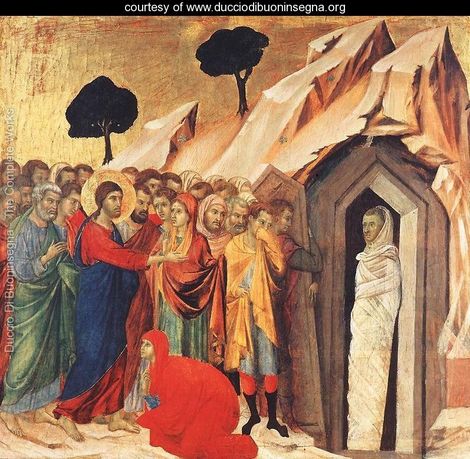
Resurrection of Lazarus by Duccio Di Buoninsegna (1308-11)Lent is a time for unbinding ourselves from the culture of death. Like Lazarus, we lay dead in a tomb beyond which we cannot see. We are bound in stinking grave clothes. But through the pilgrimage of Lent we are gently unwrapped, until the day we hear that powerful voice saying “Come out!”
Here’s a reflection by British theologian James Allison from his book On Being Liked (2004):
“When we are baptized, we, or our Godparents on our behalf, renounce Satan and all his vain pomps and empty works. And here we were, sorely tempted at least to find ourselves being sucked up into believing in just such an empty work and pomp. A huge and splendid show giving the impression of something creative of meaning, but in fact, a snare and an illusion, meaning nothing at all, but leaving us prey to revenge and violence, our judgments clouded by satanic righteousness.
When I say satanic, I mean this in two senses, for we can only accurately describe the satanic in two senses. The first sense is the sense I have just described: the fantastic pomp and work of sacrificial violence leading to an impression of unanimity, the same lie from the one who was a murderer and liar from the beginning [John 8:44], the same lie behind all human sacrifices, all attempts to create social order and meaning out of a sacred space of victimization.
But the second sense is more important: the satanic is a lie that has been undone. It has been undone by Jesus’s going to death, exploding from within the whole world of sacrifice, of religion and culture based on death, and showing it has no transcendence at all. Jesus says in Luke’s Gospel (and it is the title of Rene Girard’s book) “I saw Satan fall like lightning from heaven.” This is the solemn declaration of the definitive loss of transcendence of the satanic show: we no longer have to believe it, we no longer have to act driven by its compulsions. It has no power other than the power we give it. The pomp has nothing to do with heaven. It has nothing to do with God.”–James Allison


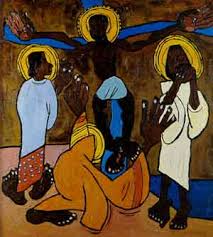 Mary Karr’s Descending Theology: The Resurrection
 On Good Friday, Pope Francis, the Bishop of Rome, led the Via Crucis, or Way of the Cross, service at the Roman Colosseum, where thousands accompanied Christ’s path to the Cross by the light of candles and torches.
 “The life of a monk ought always to be a Lenten observance. However, since such virtue is that of few, we advise that during these days of Lent he guard his life with all purity and at the same time wash away during these holy days all the shortcomings of other times. This will then be worthily done, if we restrain ourselves from all vices. Let us devote ourselves to tearful prayers, to reading and compunction of heart, and to abstinence.