-
Binders Full of (Catholic) Women?: Week in Review
 Betty Thompson at Solidarity with Sisters sent this roundup about Catholic women and equality in the church sparked by this week at the Synod on the Family in Rome:
10/7/15 – Church-history expert Phyllis Zagano applies current and historical insight to Archbishop Durocher’s call for ordination of women deacons.
10/7/15 – Theologian Mary E. Hunt on “Synod system stacked against women,” with bonus brief canon law lesson.
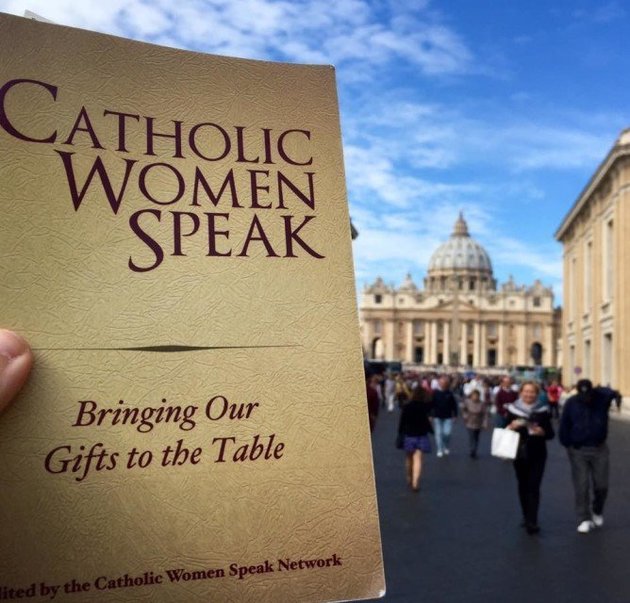
44 women from around the world speak to the Synod on Family in a new book, Catholic Women Speak: Bringing Our Voices to the Table. Many perspectives, e.g., Italian historian Lucetta Scaraffia (an appointed non-voting auditor at the Synod) says the absence of women in Church decision-making is like “breathing with only one lung.” Order through publisher Paulist Press, Amazon, etc. NCR reviews book as “compelling, expansive, diverse.” One of the authors is Rhonda Miska, who led us in song at our 2014 Spiritual Leadership conference.
Visitation Sisters in Minneapolis open their doors to welcome neighbors into their contemplative way of life. Part of Global Sisters Report’s 6-part series on contemplative religious life.
Want an evening of spiritual refreshment with people nationwide? By phone or in person, be part of the monthly hour of communal contemplation on Mon., Oct. 12, 7:30pm, with the Women’s Alliance for Theology and Ethics (Silver Spring, MD). For me, it’s like that drink of fresh spring water that Sister Janet Mock described at the LCWR Assembly in August.
Theologian Mary E. Hunt, in Baltimore Sun Op-Ed on Pope Francis’ USA visit, sees “disconnect between the pope’s rhetoric about equality and the…virtually all male-led [institution]…. To be a decision-maker in Catholicism requires ordination.” Also calls for strong Papal action on sex abuse, and an end to the “gay charade” in the Church.
Reflecting on Pope Francis’ visit, St. Joseph Sister Christine Schenk asks “Why wasn’t a woman invited to preside at a papal prayer service? …Our common prayer needs to mirror the whole church, not just those gifted with a Y chromosome.”
Powerful Carmelite and Ignatian insight into “Christ Consciousness: Part 1” in video (57:22) with Carmelite Sister Constance Fitzgerald and Jesuit Father Brian McDermott, part of Baltimore Carmel’s day of recollection for its 225th anniversary.
Note from Rose: I’ve issued a challenge for Catholic women to purchase 5 copies of the book Catholic Women Speak: Bringing Our Gifts to the Table and give them to 5 pastors of Catholic parishes. (The first run of this book from Paulist Press sold out almost immediately. So you may have to pre-order it on Amazon.)
-
Henry Louis Gates Jr: #BLM and the End of the 2nd Reconstruction
 Henry Louis Gates Jr. is the founding director of the Hutchins Center for African and African American Research at Harvard University. He’s one of America’s leading thinkers and has a great ability to put current social and political situations in their historical American context.
Last week, the Hutchins Center for African and African American Research awarded its W.E.B. Du Bois Medal to seven leaders: Muhammad Ali, Marian Wright Edelman, Mellody Hobson, Eric Holder, Charlayne Hunter-Gault, Nasir “Nas” Jones, and Carrie Mae Weems.
As part of that ceremony, Henry Louis Gates Jr. have a speech in which he looks at the Black Lives Matter movement through the lens of Du Bois and American history titled Is This the End of the 2nd Reconstruction?. I urge you to read the entire piece (it’s not very long), but below is an excerpt:
…My concern is that the end of the Second Reconstruction is upon us now, or that there are too many in power who are trying to achieve that pernicious end. W.E.B. Du Bois said of the beginning and end of the first Reconstruction, “The slave went free; stood a brief moment in the sun; then moved back again toward slavery. The whole weight of America was thrown to color caste. The colored world went down. … A new slavery arose.”
Following the first Reconstruction—that decade after the Civil War in which the Union was to become whole again, the slave was to become free and property was to become citizen—the economic relation of slave to master was essentially reconstituted through sharecropping and disenfranchisement mounted mischievously in fits and starts, and then confirmed and maintained as the law of the land. As Du Bois again put it:
The most magnificent drama in the last thousand years of human history is the transportation of ten million human beings out of the dark beauty of their mother continent into the new-found Eldorado of the West. They descended into Hell; and in the third century they arose from the dead, in the finest effort to achieve democracy for the working millions which this world had ever seen. It was a tragedy that beggared the Greek; it was an upheaval of humanity like the Reformation and the French Revolution. … [But] we fell under the leadership of those who would compromise with truth in the past in order to make peace in the present and guide policy in the future.
The legacy of the ending of Reconstruction, the redemption of the Confederacy, was a debilitating blow to the status of the newly freed slaves and their descendants: sharecropping, convict lease (both actually forms of neo-slavery), Jim Crow and lynch laws, poll taxes and literacy tests, and the scandalous sanctioning of separate but equal as the law of the land by the U.S. Supreme Court. These are just some of the items in the catalog of horrors that kept the majority of black people systematically separate and decidedly unequal throughout the first half of the 20th century. Still, miraculously, many of our ancestors persistently rose, and stories of success were beacons of hope and a promise of better days to come. …–Henry Louis Gates Jr.
Read the whole article.
Find out more about the W. E. B. Du Bois Medal. -
South Africa’s Thabo Makgoba: ‘The Price of Corruption is the Inequality of Equality’
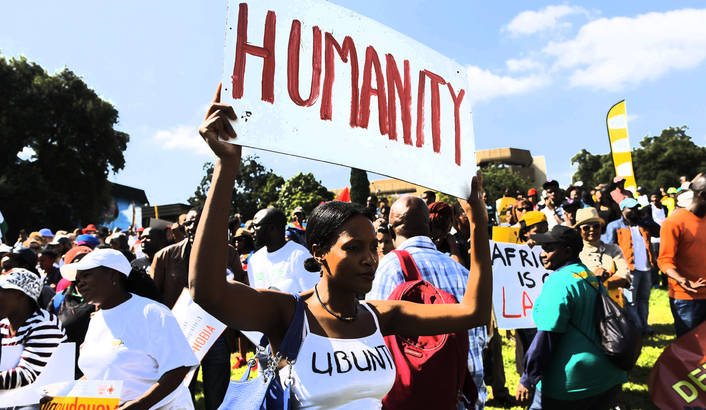
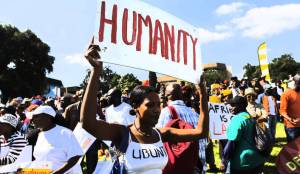 Thousands of South Africans have taken to the streets in the last week to reclaim the dream of a free South Africa from the clutches of corruption. In the United States we don’t call it corruption, we call it “money in politics” or the influence of “Citizens United.” But the gangrenous effect on the body politic is the same.
South African churches are once again rising to meet this injustice and providing the organizing and leadership underneath this movement.
A shout out to Siki Dlanga for her work on this effort. Below is an excerpt from the whole statement given by Cape Town’s Anglican Archbishop Thabo Makgoba:
…Today we shouldn’t be here rallying against corruption. Today we should be asking… Aren’t we ready to fulfill our country’s destiny, by showing the same level of courage that won our liberation from apartheid? Nothing less will work. Are we really so afraid of what our morally corrupt political and business leaders will do to us that we will be intimidated into silence? How many times have you read Madiba’s words, words that defined the Old Struggle, and felt your heart soar when he said: “I learned that courage was not the absence of fear, but the triumph over it. The brave man is not he who does not feel afraid, but he who conquers that fear.”
My friends, we need to face up to the reality of what corruption does to our society. We need what I call a cold shower of reality to shock our leaders to their senses. It is this: The price of corruption is the inequality of equality. Let me repeat these words, for they need to frame our new struggle: the price of corruption is the inequality of equality.
What do I mean by that? It is simple: while we and our leaders live under the delusion that we are promoting equality in our society, the corruption that is spreading its tentacles across our society actually entrenches inequality, step up step.
A little over a year ago, almost in this same location, I asked South Africans to turn themselves inside out and expose their sense of moral consciousness to the sun. Why? Because, the sun is God’s disinfectant. Our country, because of the ethical state of the nation, needs to be morally disinfected…Morally disinfected so that we can recapture THE dream of the South Africa we want.
What’s missing? It’s not the ideas. It’s not the realization that enough is enough. It’s the determination that we need to begin a new era of courageous action. We will clean up and disinfect South Africa only when the courage and the will of all our people puts local action behind our words. Over the last six months you have no idea how many South Africans have said to me, “Archbishop, I’m so tired of seeing the moral pollution. “I am so tired of seeing the pervasive unethical contamination.”
As painful as it is to see the corruption, it’s 100 times more painful to see the price of corruption… the inequality that is becoming embedded into the structures of our society. I want to address President Zuma and our national leaders, our provincial leaders, our local leaders and the business people who corrupt them… You are responsible for creating an historic era of sadness in South Africa … Worse, we have allowed you to do it. … —Thabo Makgoba, Anglican Archbishop of Cape Town‚ South Africa
Read Archbishop Makgoba’s whole statement.
-
‘Donte Manning’ Book Makes it to South Africa
 A shout out to South African artist and activist Siki Dlanga who smuggled a copy of my book, Who Killed Donte Manning?: The Story of an American Neighborhood, into South Africa with her.
She made this super cool meme based on her photos from visiting Baltimore this summer.
You can read Siki’s great commentary comparing South Africa’s freedom struggle and the U.S. Black Lives Matter movement in the forthcoming November issue of Sojourners magazine.
Learn more about the recent Unite Against Corruption march in South Africa that Siki and other Christian leaders organized.
-
Pope Francis: ‘Dialogue Is Our Method’
 “Dialogue is our method, not as a shrewd strategy but out of fidelity to the One who never wearies of visiting the marketplace, even at the eleventh hour, to propose his offer of love.”–Pope Francis to U.S. Bishops on Sept. 23, 2015
 -
Oscar Rodriquez on the ‘NAFTA of the Pacific’
 Oscar Rodríguez is coordinator for Mexico, Central America, and Dominican Republic in Public Services International. PSI is a global trade union federation representing 20 million working women and men who deliver vital public services in 150 countries. PSI champions human rights, advocates for social justice and promotes universal access to quality public services.
I recently wrote a piece for Sojourners on West Papua (November 2015), which is located on the front-lines of the global trade war between China and the U.S. West Papuans as well as unions and human rights activists around the world are struggling every day to bring human rights and transparency to the Trans Pacific Partnership free trade agreement that the Obama administration is pushing through.
As my mother says, “It’s the NAFTA of the Pacific and we know how NAFTA turned out.” Not good.
When Pope Francis talks about “land, lodging, and labor” for all, the details are worked out in these kind of trade agreements. In other words, trade agreements are moral documents. Below is an excerpt from Rodríguez recent overview of international trade agreements from the perspective of the workers:
Over 20 years have passed since the signing of two major free trade agreements in the Americas (NAFTA and CAFTA-DR), without signees like Mexico, Central America and the Dominican Republic being able to tangibly witness positive advantages as a result of them. On the contrary, the negative effects brought by these agreements have exposed an increasingly unequal trade relationship due to existing inequalities established by the rules of the international free-trade game.
In addition to the already fragile condition of the economies of these countries, the impacts of a new international economic context are starting to be felt in the region. This not only affects exports, stalls economic growth, and depletes social investment; it also clears the way for new free trade agreements that weaken the sovereignty of these countries and removes labor rights and social protections for its citizens.
There are two mega agreements that are being negotiated that fit into this scenario in our region: the TPP (Transpacific Partnership Agreement) and the TISA (Trade in Services Agreement). Both of these agreements are yet another tool to enhance the expansion of a free trade model that is notoriously voracious and perverse, and both are aimed at subduing countries by undermining their sovereignty and threatening their natural resources. — Oscar Rodríguez L. (Read the whole article here.)
-
On Black Lives Matter, Warren Says What Others Won’t
This is the most powerful analysis by a politician of the Black Lives Matter movement that I’ve seen. Thank you, Elizabeth Warren.
Elizabeth Warren says:
Fifty years later, violence against African Americans has not disappeared. Consider law enforcement. The vast majority of police officers sign up so they can protect their communities. They are part of an honorable profession that takes risks every day to keep us safe. We know that. But we also know — and say — the names of those whose lives have been treated with callous indifference. Sandra Bland. Freddie Gray. Michael Brown. We’ve seen sickening videos of unarmed black Americans cut down by bullets, choked to death while gasping for air — their lives ended by those who are sworn to protect them. Peaceful, unarmed protestors have been beaten. Journalists have been jailed. And, in some cities, white vigilantes with weapons freely walk the streets. And it’s not just about law enforcement either. Just look to the terrorism this summer at Emanuel AME Church. We must be honest: Fifty years after John Kennedy and Martin Luther King Jr. spoke out, violence against African Americans has not disappeared. And what about voting rights? Two years ago, five conservative justices on the Supreme Court gutted the Voting Rights Act, opening the floodgates ever wider for measures designed to suppress minority voting. Today, the specific tools of oppression have changed — voter ID laws, racial gerrymandering, and mass disfranchisement through a criminal justice system that disproportionately incarcerates black citizens. The tools have changed, but black voters are still deliberately cut out of the political process.
Read the whole transcript here.
-
Rose Marie Berger: What Pope Francis can teach the US Catholic Church about Thomas Merton
What #PopeFrancis can teach the US Catholic Church about Thomas Merton: http://t.co/U4uUXrJX4L pic.twitter.com/Ni1IO8tWna
— Religion NewsService (@RNS) September 25, 2015
-
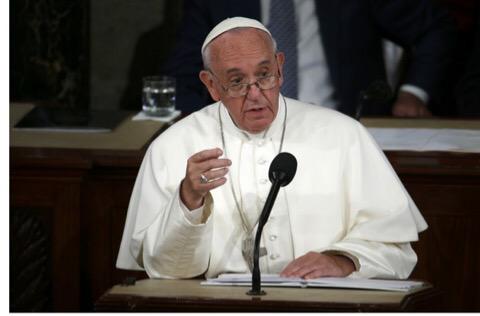
Pope Francis to Congress: Remember Lincoln, King, Day, and Merton
I spent a wonderful morning down on the national Mall watching Pope Francis address Congress. What an amazing speech. The air was electric! Not something you normally feel inside the political beltway of D.C.Tears sprang to my eyes when the pope said he would build his talk around four great Americans: Abraham Lincoln, Martin Luther King, Dorothy Day, and Thomas Merton. Wow! I finally felt like the church was done wandering in the wilderness and was ready to come home to the living gospel of at least the 20th century!
Here’s one excerpt:
My visit takes place at a time when men and women of good will are marking the anniversaries of several great Americans. The complexities of history and the reality of human weakness notwithstanding, these men and women, for all their many differences and limitations, were able by hard work and self-sacrifice – some at the cost of their lives – to build a better future. They shaped fundamental values which will endure forever in the spirit of the American people. A people with this spirit can live through many crises, tensions and conflicts, while always finding the resources to move forward, and to do so with dignity. These men and women offer us a way of seeing and interpreting reality. In honoring their memory, we are inspired, even amid conflicts, and in the here and now of each day, to draw upon our deepest cultural reserves.
I would like to mention four of these Americans: Abraham Lincoln, Martin Luther King, Dorothy Day and Thomas Merton. …
Here’s the link to the complete transcript of Pope Francis’ address to Congress:
11-EN-congressional-address
-
Fr. Ken Lavarone Greets Pope Francis

Fr. Ken Lavarone greets Pope Francis during canonization Mass for Junipero Serra.


-
Subscribe
Subscribed
Have a WordPress.com account? Log in now.

