-
Video: ‘Run It Straight (for West Papua)’
This 14-minute video is an excellent primer on the cry for justice for West Papua, currently an Indonesian-held colony in the South Pacific.
I had the honor of meeting with church leaders from West Papua in 2015. Here’s an excerpt of what I wrote from my interview with Pastor Matheus Adadikam, general secretary of the Evangelical Christian Church in Tanah Papua, representing 600,000 people:
“Justice, peace, and care of all of the Lord’s creation is the main mission of our church,” says Matheus, “but our experience has been that change happens fast, and external influences are changing who we are as a people.” His main mission now is traveling the world asking for help.
“The police and army have a personal economic interest in the mining companies,” Matheus says. “As a pastor, I can say that the government tries to blame local people for the violence, but it is not true.” The brutality of the Indonesian military in response to protest or self-determination can be seen in Joshua Oppenheimer’s award-winning companion documentaries The Look of Silence and The Act of Killing and in a film about East Timor, A Guerra da Beatriz.
“In 2006, Indonesia declared us a ‘separatist’ church because we support the right of self-determination,” Matheus says. “If we are not independent politically, then slowly but surely we will lose our Papuan life. … Indonesia makes agreements with corporations to take our trees, our water, our resources, and they don’t care at all about the people. They say, ‘We don’t need the Papuans, we just want their land.’
“As a pastor I have seen too many people killed,” Matheus continues. “When I was invited to speak at the World Council of Churches, while I was gone my family was terrorized … my wife and my kids … this is our experience.”–Rose Marie Berger (read the rest here.)
Learn more about the Free West Papua Movement, the Phoenix-based Freeport-McMoRan Mining Company, and West Papuan Christians fighting for justice.
-
Abbot Philip: ‘A Sense of Spiritual Combat’
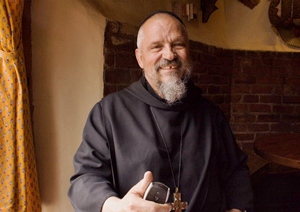
Abbot Phillip As I ponder questions of violence, nonviolence, peace, and the Peace of Christ, I found these reflections from Benedictine Abbot Philip at Christ in the Desert Monastery in New Mexico helpful grist:
“Daily spirituality in a monastery is more about how we relate to one another and to God than it is about how much time we spend in common prayer or even in private prayer. We monks learn from the Rule of Saint Benedict that the way we relate to one another is the way to evaluate the effects of the praying that we do each day. If we are praying regularly and treating our brothers badly, there is something that is not right in our spirituality. If we are praying regularly and yet are not aware of the presence of God in our normal living every day, there is also something amiss.
Living in a community day in and day out for years does not mean that we monks have become saints. It does mean, however, that we are challenged every day to find ways to live in peace and true Christian love with our brothers. Monastic life insists on us living together as a community, not just living together as in an apartment house! Sometimes it is an enormous challenge not to withdraw into oneself and ignore all of the brothers who are offensive to me.
Sometimes I find in the younger brothers a lack of a sense of the spiritual combat. Rather than see our brokenness as something that is simply part of us and against which we must struggle, they see our brokenness almost as an affront to them and they get discouraged because the struggle must go one day after day for a whole life time. Part of this, I think, comes from a modern sense that we can change everything and we can overcome every obstacle almost immediately. Young people seem not prepared for a struggle, a spiritual fight that will go on until we die.”–Abbot Philip
Read the whole post here.
-
5 Hidden Gems from Global Methodist Meet-Up
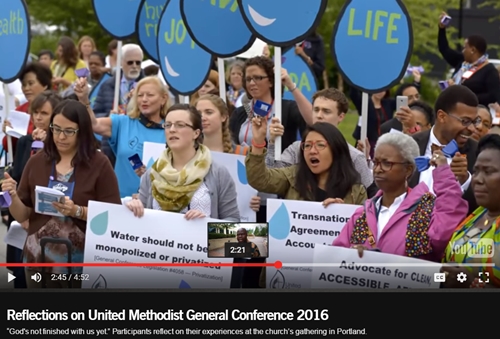
A few highlights from the United Methodist Church’s General Convention meeting held last week in Portland, OR. This is the top policy-making body of The United Methodist Church, which convenes once every four years.The conference can revise church law, as well as adopt resolutions on current moral, social, public policy and economic issues. It also approves plans and budgets for church-wide programs.
There was lots of coverage on the sexuality debates (Final: “We’ll talk about this later.”) and they voted on a new hymnal, increased the budget, voted to keep fossil fuels in their investment portfolios (Shame on you! You’re Bill McKibben’s denomination!), and are in the midst of learning how to understand themselves as a global church with significant expansion and leadership in Africa.
But here are 5 items that I found particularly heartening:
1. Hearing the Plea: Safe Water For All
What happens to a community when there is no safe water supply? Look at Flint, Michigan. The lead that has leached from pipes there remains an ongoing concern. “The problem with Flint right now is this is going to be a generation’s long issue,” says Michigan Area Bishop Deborah Kiesey. “The children of Flint, particularly, are the ones most affected by this poor water.”
From Michigan to Liberia, and Portland to Philippines and Honduras, poor and marginalized communities are struggling with water contamination that threatens everyday life. United Methodist Women called attention to their plight during a lunchtime rally on May 16 at the Oregon Convention Center plaza. The event was part of the UMW Day celebration during the United Methodist General Conference.
2. The Church’s Response to Ethnic and Religious Conflict (p 863-864)
Buried in the fine print was a significant change in language on issues of war and peace–the decision to quit using language of “nonresistance” and take up language of “nonviolence.”“We call upon our seminaries and United Methodist-related
colleges and universities to offer courses on alternatives to violence and to sponsor local community initiatives to diffuse ethnic and religious conflict. We also call on our seminaries to encourage the study of the theological roots of violence and of Jesus’ teachings on nonviolencenonresistanceand resisting evil; and …” -
The Vatican conference call for Just Peace theology gave Dan Berrigan a hopeful departure.
 At Dan Berrigan’s funeral celebration on Friday, homilist Steve Kelly recalled Dan and Phil Berrigan as as men who lived the Resurrection and challenged religious leaders to know “bomb-blessing has no place in Jesus’ self-giving.” He said that the Church called the Berrigans many things, but now he suggested they should be called “doctors of the church.”
Many are registering the connection between the watershed conference hosted by the Vatican and Pax Christi International last month calling for the church to develop a robust theology and praxis of active gospel nonviolence and the death and resurrection of Dan Berrigan. Below is an excerpt of a great piece by William Slavick in the Portland (Maine) Press Herald on Berrigan and the Nonviolence conference.
Jesus and his followers were peaceful, practiced love of neighbor, and for three centuries rejected violence, choosing martyrdom over engaging in violence.
The link with Constantine’s empire resulted in contradictory loyalties. Many Christians retreated to the desert; most shelved the Sermon on the Mount and served Caesar. Augustine employed Cicero and contemporary philosophy to fashion norms for just war and war conduct, expanded and refined by Aquinas and Spanish scholastics: Force may be necessary for “the tranquility of order.”
Save for large medieval peace marches, the post-Reformation peace churches, and Catholic Worker movement pacifism, Gospel nonviolence disappeared. Just war norms were ignored more often than respected, i.e., the Crusades and World War I. Yet, in 1957 Pope Pius XII said that Catholics could not be conscientious objectors. But many Christians remained uncomfortable killing those they supposedly loved.
Europe’s post-World War II recognition of the futility of war, John XXIII’s challenge of modern warfare, Vatican II’s embrace of primacy of conscience, and wide disapproval of the Vietnam carnage all challenged war as a means of conflict resolution. John Paul II embraced just war but never found one he could approve. Nowadays, wars have deceitful justifications and predominantly civilian casualties.
Dan Berrigan, who burned draft records to protest the Vietnam intervention and engaged in numerous acts of resistance to war leading to jail time and who died Saturday, argued that the Gospel calls us to be faithful, however remote the prospect of results. The U.S. Bishops’ 1985 pastoral, “The Challenge of Peace,” rejected nuclear weapons and legitimized Gospel nonviolence as an alternative theology to just war theory.
Read Slavick’s whole commentary.
-
Daniel Berrigan: Ten Commandments for the Long Haul
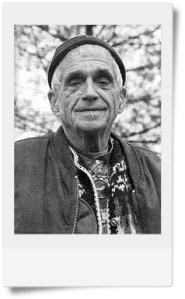
Daniel Berrigan (by Rose Berger) I’ve had the joy of reviewing Dan Berrigan’s generative and joyful life this past week. On Friday, I’ll take the 3:00 a.m. train from D.C. to New York to celebrate his resurrection. Below is a list by Dan that has inspired me since I first found it in the mid-1980s.
Daniel Berrigan: Ten Commandments for the Long Haul
1. Call on Jesus when all else fails. Call on Him when all else succeeds (except that never happens).
2. Don’t be afraid to be afraid or appalled to be appalled. How do you think the trees feel these days, or the whales, or, for that matter, most humans?
3. Keep your soul to yourself. Soul is a possession worth paying for, they’re growing rarer. Learn from monks, they have secrets worth knowing.
4. About practically everything in the world, there’s nothing you can do. This is Socratic wisdom. However, about of few things you can do something. Do it, with a good heart.
5. On a long drive, there’s bound to be a dull stretch or two. Don’t go anywhere with someone who expects you to be interesting all the time. And don’t be hard on your fellow travelers. Try to smile after a coffee stop.
6. Practically no one has the stomach to love you, if you don’t love yourself. They just endure. So do you.
7. About healing: The gospels tell us that this was Jesus’ specialty and he was heard to say: “Take up your couch and walk!”
8. When traveling on an airplane, watch the movie, but don’t use the earphones. Then you’ll be able to see what’s going on, but not understand what’s happening, and so you’ll feel right at home, little different then you do on the ground.
9. Know that sometimes the only writing material you have is your own blood.
10. Start with the impossible. Proceed calmly towards the improbable. No worry, there are at least five exits.Excerpted from Ten Commandments for the Long Haul by Daniel Berrigan, SJ, (Abingdon Press, 1981)
-
The Resurrection Will Be Televised: Livestream of Berrigan Funeral

Jerry Berrigan, left, and his brother the Rev. Daniel Berrigan with Sister Elizabeth McAlister in 1972. (Credit: UPI) Just a quick note to say that the Jesuit magazine America is hosting a livestream of Fr. Daniel Berrigan’s funeral events. Please share this widely.
http://americamedia.org/content/all-things/livestream-daniel-berrigan-sj-funeral-mass
Fr. Dan Berrigan is lovingly remembered by his family, including his Jesuit brothers, and his huge family of friends. His niece Frida Berrigan posted these plans for Thursday and Friday:
Wake and funeral arrangements for Father Dan Berrigan
Thursday, May 5:
2-5pm and 7-9pm, Wake
Church of St Francis Xavier
46 W 16th St, New York, NYFriday, May 6:
7:30am, Peace Witness and March to Xavier (gather at Mary House, 55 E. 3rd street ( between 1st and 2nd avenues). Bring beautiful signs and banners to celebrate Dan’s life.Mass at 10am
Church of St Francis Xavier, 46 W 16th St, New York
Reception to follow.There will be no public burial service. Practice Resurrection!
-
Joyce Hollyday on Dan Berrigan
 Joyce Hollyday remembers her friend Dan Berrigan:
I was a young associate editor at Sojourners magazine when Dan Berrigan sent a poem for a special issue sometime in the early 1980s. Accompanying it was a note that read “Here’s the poem—my first on a word processor. Seems a bit jumbled. Might have got a food processor by mistake.” He was not yet a friend, so I wasn’t familiar with the mischievous grin that likely spread across his face as he wrote it.
I had first learned of Dan, his brother Phil and sister-in-law Liz McAlister a decade before. I was a high school senior in Hershey, Pennsylvania—writing papers with such titles as “Stopping Communist Aggression in Vietnam” (well researched from a wide variety of issues of the Reader’s Digest)—while they were on trial thirteen miles away in Harrisburg for their opposition to the war.
I was a searching seminary student at Yale when I first heard Dan speak. It was the day before a Trident submarine, capable of creating multiple nuclear conflagrations more powerful than the one that had destroyed Hiroshima, was launched from the coast of Connecticut. That day Dan joined many others in a public act of resistance and was carted off to jail. I was just beginning to make connections between the gospel and peace and putting faith into action. …–Joyce Hollyday
Read Joyce’s whole essay.
-
Podcast: Rethinking Just War with Fr. Claude Mostowik

Fr. Claude Mostowik, Pax Christi Australia with Rose in Rome 2016. At the Vatican conference on Just Peace, held in April, I was so pleased to meet Fr. Claude (left), a leader in Catholic social justice movements in Australia-Oceania. He has a delightful artistic eye and brought a stunning image of the Aboriginal Christ by Richard Campbell into our gathering.
Fr. Claude is working with Asylum seekers in Australia who are living in brutal conditions under the anti-immigrant policies of the government. On the eve of ANZAC day, an event marking Australian and New Zealanders involved in military action in World War I, Fr. Claude participated in a discussion on national radio about how we can “rethink just war.” See more below and listen to the podcast.
Last week amidst the news of the Pope’s latest message on the family, the Pontifical Council for Justice and Peace and Pax Christi International hosted a conference titled “Nonviolence and Just Peace: Contributing to the Catholic Understanding of and Commitment to Nonviolence.”
The three day encounter brought together some 80 theologians and peace activists from many conflict zones, including Iraq, Syria, South Sudan, Colombia, Pakistan and the Philippines.
The goal of the conference was to explore ways in which their positive experiences of non-violent activism can shape theological thinking and Catholic teaching in schools, universities, seminaries and parishes, moving away from ‘Just War’ towards the concept of a ‘Just Peace’.
In a message sent to the meeting Pope Francis praised the initiative of “revitalising the tools of nonviolence”.
Around the world it raised headlines suggesting that the Catholic Church was moving to shift ground on one of it’s most venerable teachings, the Just War Doctrine.
So on this eve of ANZAC day, marking Australians participation in the War to End Wars, we are taking a look at just what sort of new thinking may be on the horizon.
-
Fr. Dan Berrigan: ‘Peace I Leave With You’
 Today, on the Feast of St. Joseph the Worker, we celebrate the life of Daniel J. Berrigan, a Jesuit priest of “uncommon conscience,” as William Stringfellow called him. (See my earlier post.)
Heidi and I attended St. Stephens & the Incarnation Episcopal Church today to hear our friend and pastor Linda Kaufman preach. When we made plans to attend, we didn’t know it would be the day after losing Dan. It was the perfect celebration.
It’s in this church that the Holy Week Faith and Resistance retreats, led by Phil Berrigan, Liz McAlister, Art Laffin and others of the East Coast Catholic Worker and Jonah House communities, have been held for decades. Dan Berrigan spent a lot of nights sleeping on the floor in this church basement.
Linda’s sermon drew on the readings for the sixth Sunday of Easter–Revelation 21 and John 14. The political poetry in Revelation was an apt memorial for Dan: Here the wounded lamb is the center of the healing of the nations. And in John 14 Jesus says to his disillusioned and confused disciples: “Peace I leave with you, my peace I give you. I do not give to you as the world gives. Do not let your hearts be troubled and do not be afraid.”
The mantle of the Berrigan brothers and the communities and families with them is laid down for us … to take up in community. We cannot be the peace of Christ alone.
A wake, public witness, funeral Mass and celebration of resurrection will be held in New York City on Thursday and Friday, May 5-6.
Wake and funeral arrangements for Father Dan Berrigan
Thursday, May 5:
2-5pm and 7-9pm, Wake
Church of St Francis Xavier
46 W 16th St, New York, NY
Friday, May 6:
7:30am, Peace Witness and March to Xavier (gathering location TBA)
Mass at 10am
Church of St Francis Xavier, 46 W 16th St, New YorkHere are bits and pieces of more news about Dan Berrigan’s death (and in us and Christ, his resurrection):
Poet and Prophet: The peacemaking legacy of Daniel Berrigan, SJ (America)
The Life and Death of Dan Berrigan by John Dear
Father Daniel Berrigan, Anti-War Activist & Poet, Dies at 94 (Democracy Now!)
Daniel J. Berrigan, Defiant Priest Who Preached Pacifism, Dies at 94 (New York Times)
Daniel Berrigan, poet, peacemaker, dies at 94 (National Catholic Reporter)
Daniel Berrigan, Activist Jesuit Priest Who Opposed Vietnam War, Dies (NPR)
Born on Iron Range, peace activist and priest Daniel Berrigan dies Minneapolis Star Tribune
Jesuit priest, peace activist Daniel Berrigan dies at 94 (CBS News)
-
Fr. Daniel J. Berrigan (1921-2016) : ‘A Priest of Uncommon Conscience’

Philip and Daniel Berrigan | Jan. 25, 1971 Fr. Daniel J. Berrigan (1921-2016) : ‘A Priest of Uncommon Conscience’
by Rose Marie BergerDaniel J. Berrigan–priest, prophet, poet–died today in New York City. He was 94.
In the coming days there will be joyful celebrations of Fr. Dan and gatherings to tell his mighty story. He was one of the great Christian witnesses of our time; a giant of the 20th century in America, along with Dorothy Day, Thomas Merton, Martin King, Fannie Lour Hamer, and Cesar Chavez.
He leaves an extended family of Berrigans, O’Gradys, and McAlisters, and an even larger community who called him “Uncle Dan.” But now, at last, he is pain-free and dancing with the angels and his beloved co-conspirator, brother Phil, who preceded him in death in 2002.
For me, I will remember a few small things: First, that my father kept above his desk a photo of Dan Berrigan’s arrest in 1968 at a Catonsville (Md) army draft board and recruitment center, where Dan and 8 others poured their own blood and homemade napalm on 378 draft files and burned them in the parking lot. Years later, Dan told me that he’d once been flying on a commercial airline and the pilot overheard his name from the ticket desk. The pilot walked up to Dan and asked if he could shake his hand. “You don’t know me,” he said, “but I owe you my life. My draft record was one of the one’s you burned that day. Because of all the mix up, I was never called up. Thank you for saving my life.”
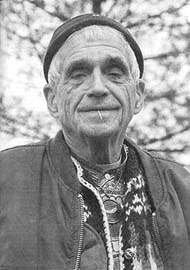
Daniel Berrigan by Rose Marie Berger Second, that I was able to study Isaiah with him on a Sojourners community retreat in the early 1990s (see photo at right I took on that retreat in rural Maryland). And I heard him read his Advent poetry one year–wild, frightening, unpredictable, incarnate–when he was visiting Dorothy Day house in Washington, D.C. (I also asked him to dance once at his 75th birthday celebration, but his back pained him too much to accept.)
Third, I was able to spend a time at Dan Berrigan’s summer house on Block Island, Rhode Island, given over to him by the radical Episcopalian lawyer and theologian William Stringfellow and his partner Methodist poet Anthony Towne. The tiny house teeters on an eroding cliff over the Atlantic. It’s a place where the primal forces of God are not obscured by human hubris. But it was here that Bill and Anthony “harbored” Dan there when he was a fugitive from the FBI after being convicted of felonies “by reason of the illegal activation of their opposition to the Vietnam war,” said the trial document. Framed on the wall of the house is a calligraphy with an excerpt of Bill and Anthony’s letter in defense of their actions of “harboring a fugitive.”
It says:
A Christian does what he must do as a Christian
Daniel Berrigan is our FRIEND
And is always welcome
in our home
any visit from him is an
honor for us
because he is a priest of
uncommon conscience
he his a citizen of
urgent moral purpose
and he is a human being of
exemplary courage ….Dan always was one to turn questions upside down. On his own death I suspect his mischievous grin has finally returned: “Death? What death? I’m only just getting started.”[]
Here’s an excerpt from one of the tributes in Sojourners magazine to Dan Berrigan from the 1990s. It’s taken from a court case:
Judge: “Father Berrigan, regardless of the outcome of these hearings, will you promise the court that you will refrain from such acts in the future?”
Dan: “Your honor, it seems to me that you are asking the wrong question.”
Judge: “OK, Father Berrigan, what do you think is the proper question?”
Dan: “Well, your honor, it appears to me that you should ask President Bush if he’ll stop making missiles; and, if he’ll stop making them, then I’ll stop banging on them and you and I can go fishing.”-From testimony at the Plowshares Eight resentencing, 1990.
For more about Fr. Berrigan, read Looking Back in Gratitude and his own autobiography To Dwell in Peace (1988). And every American should read The Trial of the Catonsville Nine by Daniel Berrigan. It is a classic of American resistance literature.
-
Subscribe
Subscribed
Have a WordPress.com account? Log in now.

