-
Abbot Phillip: Not Hermits, But Communal Creatures
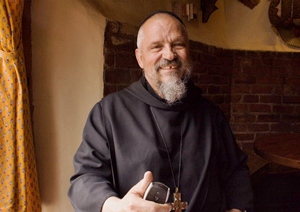
Abbot Phillip Abbot Phillip writes a weekly notebook from Christ in the Desert monastery in New Mexico. Here’s an excerpt from his recent offering:
More and more I see that an authentic human life has to be centered in this relationship of each person with God. This personal relationship with God always expresses itself in relationships with other people. Even hermits are not so apart from the human condition that their relationship is with God alone. Instead, in our Christian tradition, we always expect hermits to be praying for the world, for the Church and for other people.
Most of us are not hermits. Instead, we live in communities. We live in families or we live in religious communities. And families and religious communities live in a larger society as well. We are all connected in various ways. Often we think that the deepest connections are of our choosing. On the other hand, it is God Himself who has chosen us and who has given us our being, our bodies, our families of origin and who even now is working within us in the depths of our being.
Jesus almost presume that ti be human is to live in community. In every society there are people, both women and men, who live apart by choice—but most of them are not hermits. They are people who for one reason or another don’t have a bond to another person or to family in which they live.
Does it make any difference? At most levels, not much. No matter whether we live with others or not, we are still called to love everyone and to seek the face of this God who loves us. For me, it is very easy to forget about God and to live just trying to avoid difficulties in my life and in the life of others.
Spending time with God often feels to me like wasting time doing nothing. That is my challenge. Others have other challenges. Even the most active and extroverted person needs to take time along with God now and then. When I do take time with God, it is a very positive experience. I don’t know why I avoid it so much. Don’t think that I avoid God completely. Even on a normal day, without focusing on spending time with God, I probably spend about four hours in community prayer and another hour in lectio or private prayer.
What do I mean by spending time with God? For me, that indicates putting aside the other things that I do, such as correspondence, arranging schedules, being touch with brothers and sisters all over the world, checking on the business affairs of the community.
When I spend time with God, I have to put all of that aside and ignore if anything else is going to happen. Often I go into a room where no one will look for me and sit with the readings for the Mass that day—not trying to accomplish anything with the readings, but just being with God and with His Word. Sometimes I just sit an pray the Jesus Prayer: Lord Jesus Christ, have mercy on me, a sinner. Sometimes I seek to be aware of God’s presence without words. Sometimes such times of being with God are really easy. Other times, it is like doing exercise that I do not like!
The challenge for me is simply to do this, whether I feel like it or not. For me, it is like a commitment to be with the Lord, whether I feel His presence or not, whether I feel a drawing to His presence or not. It goes along with my commitment to be present at the common life in my community.–Abbot Phillip, Christ in the Desert Benedictine monastery
Ready Abbot Philip’s full reflection.
-
10 Commandments of Resistance in Trump’s America
-
Calling on Christ’s Redeeming Power
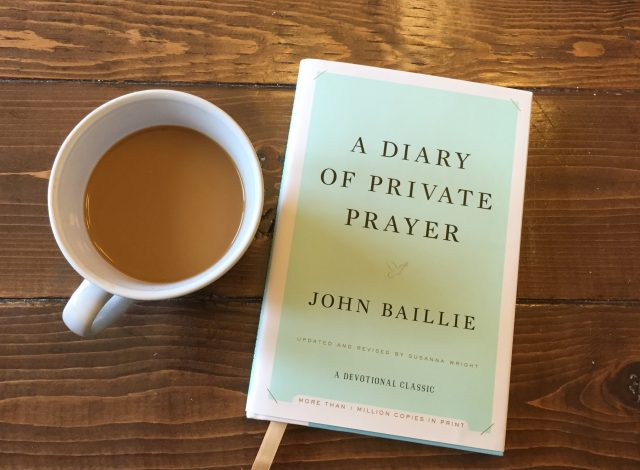
“Let the redeeming power that has flowed from his sufferings through so many generations now flow into my soul.”–John Baillie, A Diary of Private Prayer
I’ve been going to bed early and getting up early. After the election of Mr. Trump to the presidency, I’ve been feeling spiritually tangy–meaning there’s an acidic taste of grave danger accompanied by the sweetness of stepping into the Way of Christ. I’ve felt a need for more sleep and more prayer.
Years ago an Australian friend recommended keeping at my bedside John Baillie’s classic devotional A Diary of Private Prayer. I love this little book.
The phrase from evening prayer on November 16 was the one above:
“Let the redeeming power that has flowed from his sufferings through so many generations now flow into my soul.”
I need that redeeming power. Maybe you do too.
-
Thomas Merton on #StayWoke Christians
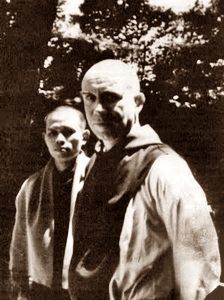
Thích Nh?t H?nh and Thomas Merton, 1966 We must awaken Christians to their “grave responsibility to protest clearly and forcibly against trends that lead inevitably to crimes which the Church deplores and condemns.”–Thomas Merton
Thomas Merton on Peace with introduction by Gordon Zahn (1968, pxi)
-
Initiate Emergency Protocols in All Houses of Worship
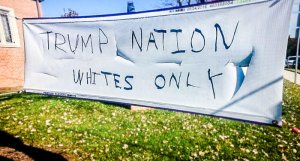
A Silver Spring, Md. church with a large immigrant population was vandalized with racist messages, Saturday, Nov. 12, 2016. (Courtesy Robert Harvey, Episcopal Church of Our Savior) by Rose Marie Berger
President-elect Trump has promised a White Nationalist agenda that is already impacting our communities. In response, we must form a circle of protection around those who are most vulnerable. As the new Vatican ambassador to the U.S. said this week, the church needs to “assume a prophetic role.”
In setting priorities we should ask ourselves three things: What things can President-elect Trump do easily and quickly (eg overturning executive actions like DACA/DAPA immigrant protections)? What actions by him will have high-consequence impact (eg Supreme Court justice appointment, permitting Keystone XL pipeline, enacting E-Verify)? What actions by him will be irreversible (e.g. rapid increase in deportations, changes to the Constitution, reversals on climate-change protocols)?
There are also things that Mr. Tump cannot do (such as “ban all Muslims”), but the inflammatory White Nationalist rhetoric encourages the rise of religious, race, and gender-based hate at the local level. All of which are generally accompanied by a rise of anti-Semitism and attacks on other vulnerable communities (LGBT, prostitutes, ethnic minorities, people with disabilities, and political dissidents). This is already occurring (see WJLA report that the vandals struck Episcopal Church of Our Savior in Silver Spring, MD. A sign reaching out to the Hispanic community was defaced to read: “Trump Nation whites only”).
We have less than 70 days to prepare.
5 actions you can take right now
1. Initiate emergency response protocols for immigrant communities – especially mixed status communities. Establish a team trained in “What to do if Immigration comes to your School (or Church).” I suggest making this widely available at churches and schools. Perhaps even printing them out for distribution.
2. Initiate “emergency sanctuary teams” in all houses of worship to prepare for work-site raids, silent raids, and massive job loss (if E-verify is enacted). Learn the mechanisms of making your house a worship a “sanctuary church.” Read history of D.C. Sanctuary Churches and the national Sanctuary Movement and learn more at New Sanctuary Movement.
3. Initiate conflict-reduction teams in all houses of worship to defuse, intervene, and respond to hate speech and hate crimes. Contact Pace e Bene training, DC Meta Peace Team, or Cure Violence to organize trainings.
4. Initiate inter-denominational and inter-faith outreach teams in all houses of worship to establish open lines of communication between local houses of worship. Multicultural and immigrant churches are most vulnerable right now. Christian churches should reach out to local imams, rabbis, and leaders of Sikh gurdwaras. See Ten Ways To Fight Hate: A Community Response Guide.
5. Initiate a “pledge of resistance” letter-writing campaign in your churches and communities addressed to President-elect Trump (c/o Trump Tower / 725 – 5th Avenue / New York, NY 10022), Senate majority leader Mr. Mitch McConnell, and Speaker of the House Mr. Paul Ryan. The body text would include:
If you pursue the policies you embodied during your campaign, the supremacy of white people over people of color, the literal and figurative creation of walls of division and hostility between people and nations, your misogynistic attitude and practice toward women, your disdain for the poor, disabled and marginalized, your disregard for and ignorance about the environment and your encouragement of the use of violence toward those who disagree with you, if your policies as President continue down that path, I make this pledge of resistance to you today.”
Spiritually, we must be clear-eyed about the level of threat and the ability for it to be carried out. We must not succumb to lethargy. We must also pray for a spirit of tenderness in our own hearts so that we refuse to allow hate or fear to take root. Pray continually for the conversion of Mr. Trump and our own conversion as well.
Rose Marie Berger is a Catholic peace activist and a senior associate editor at Sojourners magazine in Washington, D.C.
-
“I’m With Them” by Rose Marie Berger and JP Keenan
A Riff on Martin Neimoller and Matthew 25
For the morning after Donald J. Trump was elected president of the United States of AmericaFirst they came for the Muslims and Jews …
and I said “I’m with them,” even though I wasn’t a Muslim or a Jew.
Then they came for the immigrants …
and I said “I’m with them,” even though I wasn’t an immigrant.
They came for the Black Lives Matter activists and the LGBTQ folks …
and even though I was white and straight, I said “I’m with them.”
When they came for the hungry and for those who hunger for change and hunger for righteousness,
I said “I’m with them.”
I’m with the thirsty and the thirsty earth gasping for rain.
I’m with the stranger, the refugee, all those who scale walls for freedom.
I’m with the naked, those stripped of human dignity,
those without decent work, without the cloth of human compassion.
I’m with the sick, the disabled, the addicted, and all those
dependent on the kindness of strangers.
I’m with the prisoners, the journalists, the detained,
the deported, and the deplorables.
When they came for those, I said, “I’m with them.”
I AM with them. I’m with us.—Words by Rose Marie Berger (written on the feast day of the Holy Martyrs Onesiphorus and Porphyrius, 284 AD); video by JP Keenan
-
Advent Credo by Daniel Berrigan (to be read in case of a Trump presidency)
I offer this prayer-poem by Daniel Berrigan on this evening when Donald Trump prepares to take the stage with the assumption that he has won the American presidency. (Pennsylvania, Michigan, Wisconsin still not called.)–Rose
Advent Credo
by Daniel BerriganIt is not true that creation and the human family are doomed to destruction and loss—
This is true: For God so loved the world that He gave his only begotten Son, that whoever believes in Him shall not perish but have everlasting life;It is not true that we must accept inhumanity and discrimination, hunger and poverty, death and destruction—
This is true: I have come that they may have life, and that abundantly.It is not true that violence and hatred should have the last word, and that war and destruction rule forever—
This is true: Unto us a child is born, unto us a Son is given, and the government shall be upon his shoulder, his name shall be called wonderful councilor, mighty God, the Everlasting, the Prince of peace.It is not true that we are simply victims of the powers of evil who seek to rule the world—
This is true: To me is given authority in heaven and on earth, and lo I am with you, even until the end of the world.It is not true that we have to wait for those who are specially gifted, who are the prophets of the Church before we can be peacemakers—
This is true: I will pour out my spirit on all flesh and your sons and daughters shall prophesy, your young men shall see visions and your old men shall have dreams.It is not true that our hopes for liberation of humankind, of justice, of human dignity of peace are not meant for this earth and for this history—
This is true: The hour comes, and it is now, that the true worshipers shall worship God in spirit and in truth.So let us enter Advent in hope, even hope against hope. Let us see visions of love and peace and justice. Let us affirm with humility, with joy, with faith, with courage: Jesus Christ—the life of the world.
From Testimony: The Word Made Flesh, by Daniel Berrigan, S.J. Orbis Books, 2004.
-
2 a.m. November 9 – Which Side Are You On?
I’m With Them
I’m with the hungry, those who are hungry for change and those who hunger for righteousness.
I’m with the thirsty and the thirsty earth gasping for rain.
I’m with the stranger, the immigrant, the refugee, all those who scale walls to freedom.
I’m with the naked, those stripped of human dignity, those without decent work, without the cloth of human compassion.
I’m with the sick, the vulnerable, the addicted, and all those dependent on the kindness of strangers.
I’m with the prisoners, the detained, the deported, the detested, and the deplorables.
I’m with them. I’m with us.
—Rose Marie Berger, in Washington, D.C., 2 a.m. awaiting announcement of the next U.S. president
-
@Post16Election 3 Things You Can Do After the Election

The U.S. campaign for president has consumed every channel of media for a year.
It’s been contentious, coarse, and painful. All sides have engaged in an all out assault on what the Bible describes as truthful integrity: “Let your ‘yes’ be ‘yes,’ and your ‘no,’ ‘no.’ For whatever is more than these is from the evil one” (Matthew 5:37).
On the Sunday before the election, consider what the Body of Christ has to offer to a suffering, fractured nation. In Christ, there is no Republican or Democrat, no Libertarian or Green Party. We are one body, with Christ as our head and heart.
Here are three things you can do to help restore right relationships after the election:
- Seek out someone who has a diametrically opposed view and invite them to coffee to listen to try to understand their point of view. (See Chuck Gutenson’s short essay on talking across your disagreements.)
- As a church reach out to communities who are feeling more vulnerable as a result of the elections and engage with them in dialogue about how we can protect one another.
- Come together as people of faith for a community-based Forgiveness & Reconciliation Walk encompassing all of the decisions made in the elections. (Remember: Judgement paralyzes, but forgiveness walks. See Mark 2:1-12 and 2:13-17.)
In Catholic churches we are closing out the year of mercy, but mercy never goes out of style. Perhaps preach a “Keep Mercy Alive” sermon or insert it into your prayers. Mercy is always a vocation in the body of Christ.
Perhaps your community will be involved in voter protection initiatives such as Witness the Vote. The American democratic system of “one person, one vote” is the most successful nonviolent transfer of power that we have every seen. Protect it.
After the election results are in, there may be anger spewed across social media or even in the streets. Does your church have a peace team ready to respond? Do you have a social media meme or quotes or prayers ready that will de-escalate anger?
For many of us, the elections have become a poor substitute for “anger management.” Instead of dealing with the incredible isolation, racial resentment, lack of human dignity, economic disenfranchisement, and frustration in our country, we try to take it out at the polls. Ultimately this is very unsatisfying. Our “heroes” never really have our best interest at heart, no matter what they say on the campaign trail.
Christ has our best interest in mind. After the election? Do what Jesus would do.
Rose Marie Berger, a Catholic peace activist and poet, is a senior associate editor at Sojourners magazine in Washington, D.C.
-
Hot Off the Press! Reinhabiting Bioregional Faith and Practice

The book is out! Great work by the one of the most innovative Christian movements today. How do we bear forward the gospel at the end of the Anthropocene? Love the watershed you’re with (to paraphrase Crosby, Stills, and Nash).
Order lots of these books here.
My poem “Prophecies from the Watershed Conspiracy” is included in the foreword, along with an essay by Denise Marie Nadeau, a French and Mi’kmaq Canadian and dance movement therapist, who has made the Nibi ceremony for the protection of water.
This collection introduces and explores “watershed discipleship” as a critical, contextual, and constructive approach to ecological theology and practice, and features emerging voices from a generation that has grown up under the shadow of climate catastrophe.
Watershed Discipleship is a “triple entendre” that recognizes we are in a watershed historical moment of crisis, focuses on our intrinsically bioregional locus as followers of Jesus, and urges us to become disciples of our watersheds.
Bibliographic framing essays by Myers trace his journey into a bioregionalist Christian faith and practice and offer refections on incarnational theology, hermeneutics, and ecclesiology. The essays feature more than a dozen activists, educators, and practitioners under the age of forty, whose work and witness attest to a growing movement of resistance and reimagination across North America.
Contributors reread both biblical texts and churchly practices (such as mission, baptism, and liturgy) through the lens of “re-place-ment.” It’s a comprehensive and engaged call for a “Transition church” that can help turn our history around toward environmental resiliency and social justice, by passionate advocates on the front lines of watershed discipleship.
-
Subscribe
Subscribed
Have a WordPress.com account? Log in now.

