-
‘When Fortune Turns Against One of Us …”: In Defense of Liberalism
 Last night, at the end of his health care speech, President Obama gave one of the great defenses of the modern Liberal political tradition — the important role that government has to play in defending liberty and providing for the common good.
He layed out a healthcare reform platform that sets in place a cushion for those times “when forture turns against one of us.” It’s an organized way of making sure that we are “there to lend a helping hand.” We do this because it is right, because it makes us better human beings, because it’s spiritually enlivening, because it is fiscally appropriate, and because it’s what we want someone to do for us and our kids if we ever need it.
In some ways, the reactionary town-hall tiffs orchestrated by a few folks on the Far-Right forced Obama to teach a national civics lesson. Sixth grade civics covers the meaning of citizenship; how citizens exercise roles, rights, responsibilities of civic duty at local, state, and national levels; how power, responsibility, and authority are distributed, shared, and limited; the purpose, organization, and function of local, state, and national government, etc.
Obama framed the end of his speech with excerpts from a letter from Ted Kennedy: “What we face,” Kennedy wrote, “is above all a moral issue; at stake are not just the details of policy, but fundamental principles of social justice and the character of our country.”
Here’s the last section of Obama’s speech:
Everyone in this room knows what will happen if we do nothing. Our deficit will grow. More families will go bankrupt. More businesses will close. More Americans will lose their coverage when they are sick and need it the most. And more will die as a result. We know these things to be true.
That is why we cannot fail. Because there are too many Americans counting on us to succeed — the ones who suffer silently, and the ones who shared their stories with us at town halls, in e-mails, and in letters.
I received one of those letters a few days ago. It was from our beloved friend and colleague, Ted Kennedy. He had written it back in May, shortly after he was told that his illness was terminal. He asked that it be delivered upon his death.
In it, he spoke about what a happy time his last months were, thanks to the love and support of family and friends, his wife, Vicki, his amazing children, who are all here tonight. And he expressed confidence that this would be the year that health care reform — “that great unfinished business of our society,” he called it — would finally pass. He repeated the truth that health care is decisive for our future prosperity, but he also reminded me that “it concerns more than material things.” “What we face,” he wrote, “is above all a moral issue; at stake are not just the details of policy, but fundamental principles of social justice and the character of our country.”
I’ve thought about that phrase quite a bit in recent days — the character of our country. One of the unique and wonderful things about America has always been our self-reliance, our rugged individualism, our fierce defense of freedom and our healthy skepticism of government. And figuring out the appropriate size and role of government has always been a source of rigorous and, yes, sometimes angry debate. That’s our history.
For some of Ted Kennedy’s critics, his brand of liberalism represented an affront to American liberty. In their minds, his passion for universal health care was nothing more than a passion for big government.
But those of us who knew Teddy and worked with him here — people of both parties — know that what drove him was something more. His friend Orrin Hatch — he knows that. They worked together to provide children with health insurance. His friend John McCain knows that. They worked together on a Patient’s Bill of Rights. His friend Chuck Grassley knows that. They worked together to provide health care to children with disabilities.
On issues like these, Ted Kennedy’s passion was born not of some rigid ideology, but of his own experience. It was the experience of having two children stricken with cancer. He never forgot the sheer terror and helplessness that any parent feels when a child is badly sick. And he was able to imagine what it must be like for those without insurance, what it would be like to have to say to a wife or a child or an aging parent, there is something that could make you better, but I just can’t afford it.
That large-heartedness — that concern and regard for the plight of others — is not a partisan feeling. It’s not a Republican or a Democratic feeling. It, too, is part of the American character — our ability to stand in other people’s shoes; a recognition that we are all in this together, and when fortune turns against one of us, others are there to lend a helping hand; a belief that in this country, hard work and responsibility should be rewarded by some measure of security and fair play; and an acknowledgment that sometimes government has to step in to help deliver on that promise.
This has always been the history of our progress. In 1935, when over half of our seniors could not support themselves and millions had seen their savings wiped away, there were those who argued that Social Security would lead to socialism, but the men and women of Congress stood fast, and we are all the better for it. In 1965, when some argued that Medicare represented a government takeover of health care, members of Congress — Democrats and Republicans — did not back down. They joined together so that all of us could enter our golden years with some basic peace of mind.
You see, our predecessors understood that government could not, and should not, solve every problem. They understood that there are instances when the gains in security from government action are not worth the added constraints on our freedom. But they also understood that the danger of too much government is matched by the perils of too little; that without the leavening hand of wise policy, markets can crash, monopolies can stifle competition, the vulnerable can be exploited. And they knew that when any government measure, no matter how carefully crafted or beneficial, is subject to scorn; when any efforts to help people in need are attacked as un-American; when facts and reason are thrown overboard and only timidity passes for wisdom, and we can no longer even engage in a civil conversation with each other over the things that truly matter — that at that point we don’t merely lose our capacity to solve big challenges. We lose something essential about ourselves.
That was true then. It remains true today. I understand how difficult this health care debate has been. I know that many in this country are deeply skeptical that government is looking out for them. I understand that the politically safe move would be to kick the can further down the road — to defer reform one more year, or one more election, or one more term.
But that is not what the moment calls for. That’s not what we came here to do. We did not come to fear the future. We came here to shape it. I still believe we can act even when it’s hard. I still believe — I still believe that we can act when it’s hard. I still believe we can replace acrimony with civility, and gridlock with progress. I still believe we can do great things, and that here and now we will meet history’s test.
Because that’s who we are. That is our calling. That is our character. Thank you, God bless you, and may God bless the United States of America.
Read the whole transcript here.
-
Green “Super Hero” Van Jones VS the Kryptonite of the Far Right
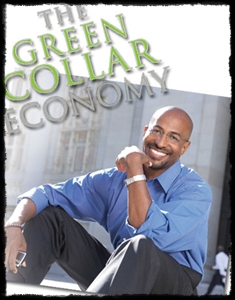 I’ve been tracking former Obama green czar Van Jones since his days as founder of the Ella Baker Center for Human Rights in Oakland. He’s a good guy with a good vision who is very grounded in the working-class neighborhoods of California.
Jones has got the deep West Coast understanding about environmental issues plus the analysis of race and class. It’s a very needed combination.
He and Far-Right propagandist Glenn Beck have been fighting each other since the presidential campaign. With Jones’ forced resignation from the White House Council on Environmental Quality, Beck struck a blow against Obama.
I’m afraid this shows that the virulent Far-Right spasm that’s rippling across the country has got the Obama crew scared and off their game. They should have backed Van Jones up and kept moving forward.
Maybe the West Wingers need to re-read The Politics of Unreason by Lipset and Raab and Richard Hofstadter’s essay “The Paranoid Style in American Politics.” It’s time for them to get caught up on the history of Far-Right backlash and how to handle it.
Van Jones is the kind of real “super hero” we need to organize us for the fight to save the planet. But Beck and others have the kryptonite to weaken even the best of leaders, unless we surround them with a shield of truth.
Here’s an excerpt from a commentary by Francesca Rheannon on Jones’ resignation:
Green jobs champion Van Jones was dropped from the White House Council on Environmental Quality (CEQ) last week after being targeted by a conservative smear campaign. Exceeded in its shamelessness only by its dementia, the right wing attack was spearheaded by Glenn Beck, a radical racist schlock jock host on Fox News.
Beck had a personal bone to pick with Van Jones, who was a senior advisor on the CEQ. After he called President Obama a “racist” who was “trying to enact a socialist agenda“, Beck’s show became the target of an effort to get advertisers to drop sponsorship. The campaign was mounted by Color of Change, an organization Jones co-founded but is no longer associated with. Fifty seven companies have already responded by pulling their ads. The roster includes some of Amerca’s best known corporations, including AT&T, Bank of America, Best Buy, General Mills, Johnson & Johnson, Lowe’s, Procter & Gamble, Verizon Wireless, Sprint, and Wal-Mart.
The White House didn’t show the same courage against Beck’s mendacious spew the companies did. It failed to back up Van Jones in the days leading up to his technical resignation, nor, tellingly, did the Administration urge him to stay on after he tendered it. Jones had been one of its most visionary appointments in the effort to promote green jobs and wrest the economy out of recession.
Read Rheannon’s whole commentary here.
California, class, Color of Change, Ella Baker Center for Human Rights, enivornment, Far Right, Francesca Rheannon, Glenn Beck, kryptonite, Lipset, Oakland, Obama, politics, Politics of Unreason, Raab, race, resignation, Richard Hofstadter, schlock jock, The Paranoid Style in American Politics, Van Jones, White House -
Beyond Health Care Debate to Viable Reform

James Smith, left, waits at the Wise County Fairgrounds (VA) to access a health clinic that offers free medical, dental, and vision care on a first-come, first-served basis, so lines start early and get long quickly. By Michael Williamson (Washington Post) Below is a good article, A Leading Health Researcher Looks Beyond the Reform Debate, on health care reform options beyond the hype. It’s out of the RAND Corporation – which has used its excellent researcher skills for ill (e.g. how to more effectively kill North Vietnamese and the most efficient way to nuke Soviets), rather than good at times.
But much of RAND’s current research provides balanced look at economic realities and long-term viability. RAND is going to err on the side of what’s good for business rather than care for “the least of these,” but it’s important to have as much information as possible as we wade through the issues.
I’d also recommend checking the RAND Compare Web site and and their hot health care legislation issues Web site for more on sorting through the health care debate.
Here’s an excerpt from the article:
Meet Elizabeth McGlynn. Associate director of RAND Health and one of the top 100 U.S. health care “innovators,” according to healthspottr.com, McGlynn is also codirector of the Comprehensive Assessment of Reform Efforts (COMPARE) initiative, which includes an online tool, developed at RAND, to help policymakers, the press, and others understand, evaluate, and design proposals for health care reform, not just for the current legislative session but also over the long term.
“Much of the information being provided in the health care debate comes from individuals or organizations that are advocates or opponents of particular ideas for fixing the health care system,” said McGlynn. In contrast, the COMPARE initiative offers “objective analysis from a neutral third party about the likely effects of policy choices on cost, quality, and access at the national level and for different stakeholders.”
She explained that the health care debate in Washington today revolves around two of the key pressing issues: expanding health insurance coverage and decreasing health care costs. “There is a philosophical debate about how best to fix the system,” said McGlynn. “Some people believe we should get everyone covered and that this will make it easier to control costs. Others believe that until we figure out how to reduce health care spending, we should not bring anyone new into the system.” McGlynn went on to observe that both issues, coverage and cost, would have to be addressed simultaneously.
Another key issue – health care quality – has received less attention in the current health reform discussion than have coverage and cost. Numerous RAND studies have shown that the United States faces a substantial gap between what is known to work in health care and what is actually provided. For example, McGlynn and colleagues have shown that American adults receive just half of recommended care for the leading causes of death and disability and that American children receive less than half of necessary care.
Read more here.
-
Ted Kennedy’s Letter to the Pope
 During the 3 days of funeral proceedings for Sen. Kennedy, I was very pleased to see the public display of support and solidarity for Sen. Kennedy by the institutional Catholic Church.
Kennedy was an embodiment of Catholic social teaching in every aspect of his political life. He also was emblematic of the complexities of living out that social teaching with integrity in our modern world–especially on the issue of abortion.
But one of the fundamental characteristics of the Catholic faith is our ability to maintain a large embrace. Our strength to do this is provided by the unifiying nature of the Eucharist.
I was especially touched by the exchange of letters between Sen. Kennedy and Pope Benedict, read by Cardinal McCarrick at the burial at Arlington. Here’s the most complete transcript I could find.
Excerpts of the letter from Sen. Edward M. Kennedy that President Barack Obama delivered to Pope Benedict XVI earlier this year and an account of the pope’s response, as read by Cardinal Theodore E. McCarrick, archbishop emeritus of Washington:
”Most Holy Father I asked President Obama to personally hand deliver this letter to you. As a man of deep faith himself, he understands how important my Roman Catholic faith is to me, and I am so deeply grateful to him. I hope this letter finds you in good health. I pray that you have all of God’s blessings as you lead our church and inspire our world during these challenging times. I am writing with deep humility to ask that you pray for me as my own health declines.
”I was diagnosed with brain cancer more than a year ago and although I continue treatment, the disease is taking its toll on me. I am 77 years old and preparing for the next passage of life. I have been blessed to be part of a wonderful family and both of my parents, particularly my mother, kept our Catholic faith at the center of our lives. That gift of faith has sustained and nurtured and provides solace to me in the darkest hours. I know that I have been an imperfect human being, but with the help of my faith I have tried to right my path. I want you to know Your Holiness that in my nearly 50 years of elective office I have done my best to champion the rights of the poor and open doors of economic opportunity. I have worked to welcome the immigrant, to fight discrimination and expand access to health care and education. I have opposed the death penalty and fought to end war.
”Those are the issues that have motivated me and have been the focus of my work as a United States senator. I also want you to know that even though I am ill, I am committed to do everything I can to achieve access to health care for everyone in my country. This has been the political cause of my life. I believe in a conscience protection for Catholics in the health field and I will continue to advocate for it as my colleagues in the Senate and I work to develop an overall national health policy that guarantees health care for everyone. I have always tried to be a faithful Catholic, Your Holiness, and though I have fallen short through human failings, I have never failed to believe and respect the fundamental teachings of my faith. I continue to pray for God’s blessings on you and on our church and would be most thankful for your prayers for me.”
——
An account from the Vatican of the pope’s response, according to McCarrick:”The Holy Father has the letter which you entrusted to President Barack Obama, who kindly presented it to him during their recent meeting. He was saddened to know of your illness, and asked me to assure you of his concern and his spiritual closeness. He is particularly grateful for your promise of prayers for him and for the needs of our universal church.
”His Holiness prays that in the days ahead you may be sustained in faith and hope, and granted the precious grace of joyful surrender to the will of God, our merciful Father. He invokes upon you the consolation and peace promised by the Risen Savior to all who share in His sufferings and trust in His promise of eternal life.”Commending you and the members of your family to the loving intervention of the Blessed Virgin Mary, the Holy Father cordially imparts his Apostolic Blessing as a pledge of wisdom, comfort and strength in the Lord.”
You can also watch the video here:
http://embed.crooksandliars.com/v/OTY2NS0zMDgzNQ?color=173466 -
‘The Ethics of Sustainable Healthcare Reform’
 Here’s an interesting article The Ethics of Sustainable Healthcare Reform by bioethicist Jessica Pierce and Dan Bednarz, co-editor of Health after Oil, on the necessity of approaching the healthcare system from the perspective that Wendell Berry calls “solving for pattern.”
Pierce and Bednarz look at the healthcare system costs in our national economy (16% of national economy) and why reform is necessary to get us out of the economic death-spiral in which U.S. market-capitalism finds itself. They also look at how the medical industry builds up massive ecological debt–a debt that will have to be paid sooner, rather than later.
Simply stated, the present healthcare system is unsustainable for two sets of (interconnected) reasons, fiscal and ecological. The fiscal side receives attention in the current debate, but most discussion underestimates the problems and proposes solutions that provide little more than temporary band-aids. It is in the main unappreciated that the nation is in socioeconomic decline—primarily in the form of massive debt and defaults on that debt, deflation of asset values, and unemployment—which threatens the present healthcare system. Our collective understanding of the ecological dimension is abysmal, especially its connection to the economy, and if grasped would lead to the abandonment of politics and business as usual in medicine and throughout society.
Read the whole article here.
-
Canadian Churches Speak Out on U.S. Healthcare Debate
 The General Secretary of the Canadian Council of Churches, Karen Hamilton, sent a letter last week to the directors of the U.S.-based National Council of Churches, Catholic Bishops Conference, and the National Association of Evangelicals on how the Canadian Churches handled health-care reform since the mid-1960s when Canada ushered in a “publicly-administered system with universal coverage.”
Canada’s Ecumenical Health Care Network also has A Health Care Covenant that’s well worth reading in the midst of our current national debate. Here’s Rev. Hamilton’s letter below:
Dear sisters and brothers in Christ,
Aware of the current passionate debates concerning health care reform in the U.S.A., I write to you today to share some of our experiences and reflections in similar debates that have taken place, and continue to take place, in Canada.
While we have been following the American health care debate with interest, our hope is that our own work on the topic might be of some service to you. We have no wish to advocate specific positions on the various public policy options being proposed by politicians in your country. Canadians are aware that certain lobby groups and media outlets in the United States regularly use critical references to Canada’s health care system and interviews with Canadian citizens to support their arguments. We are also aware that a publicly administered, single-payer system such as we have in Canada has not been proposed by Washington law makers. By means of this letter and its enclosures, we simply wish to inform you of our Christian reflection on health care in Canada, the implications of this reflection in our ministries, and the action we have taken to discern an appropriate role for Canadian Christians in terms of health care and health care advocacy.
Members of the Canadian Council of Churches have been involved in health care ministry since the earliest times, as you can read in the historical chapter (beginning on page 18) of our August 2007 publication, A Health Care Covenant. Before 1966, Canada had a health care system that failed to provide over 30% of the population with medical insurance. This created enormous human suffering and ethical problems for those who believed with Paul in 1 Corinthians 12:26, “If one member suffers, all suffer together with it…” With varying degrees of fervour, Canadian churches publicly began to advocate for the establishment of Medicare.
Canadian churches wanted health care for all. We rejected a structure that would force thousands into bankruptcy due to unforeseen medical expenses, would promote different levels of service in the many disparate regions of this vast land or would end health insurance for those who found themselves unemployed, for example. Beginning with the enactment of the Medical Care Act in 1968 a publicly-administered system with universal coverage was designed as one of Canada’s hallmark policies towards social inclusion and the alleviation of suffering related to poverty.
In recent years the Ecumenical Health Care Network (EHCN) of churches in Canada was established to strengthen Canada’s public health care system. We agreed that health care need not be treated as a commodity (page 67) and in a submission to a Royal Commission the EHCN testified that, “The Medicare system is an expression of our belief that medical needs are too fundamental to be responded to solely on the basis of market forces and for reasons of profit” (page 55). The Ecumenical Health Care Network advocated for the expansion of public health services to cover prescription drugs (see pages 97-99) home care (pages 91-93) and to maintain and improve Canadian health care.
Canadian churches working together through the EHCN had an important impact on the Royal Commission on the Future of Health Care, which reported in 2002. Our recommendation that Canada develop a “Health Care Covenant” (pages 51-57) and our list of elements to be included in such a proposal (pages 69-73), was designed to allow churches to begin the debate on the future of health care by clarifying our values as a community. It was gratifying to see the first recommendation of the final report of this Commission (entitled, “Building on Values,” November 2002) adopt this very same call for a Health Care Covenant for Canada.
Throughout our engagement on the provision of health care in Canada, churches have discerned that health care advocacy in our country is directly related to God’s call to discipleship. We have seen firsthand that “public health care limits economic hardship” (page 15.) In the eloquent words of our former General Secretary, “Medicare can be the Good Samaritan parable writ large” (page 48.) We further believe that, “the principles guiding our health care system have an unmistakable affinity with the love of neighbour urged on us by God’s word in Scripture (page 45.)
These are our heartfelt beliefs. We believe, with you, that health care is a moral enterprise, firmly rooted in Matthew 25, “for I was sick and you took care of me.”
By sharing these words with you, we also offer our heartfelt prayers for the success of health care reform in your own country, based on your own values and the needs of your communities.
We are sending this to you as an organization representing traditions that correspond to our own membership. May our compassionate Lord and Healer grant you the grace to reflect, discern and act to bring health and peace to your people in the weeks and months ahead!
Sincerely yours in Christ,
Rev. Dr. Karen Hamilton
General Secretary, Canadian Council of Churches -
‘We Will Continue to Sing’: Civil Rights Leader Ruby Sales on the Life of Ted Kennedy
 In 2002, I interviewed civil rights leader Ruby Sales for Sojourners magazine (see Long Train Runnin’.) Ruby is one of my heroes in the faith. She’s a courageous, funny, generous, fiercely committed sister in the struggle for justice. She now directs the SpiritHouse Project in Columbus, Georgia.
I was very touched by her reflection on the life of Ted Kennedy, set in the historical context of the fight for justice. She asks: What is it about a White upper class senator’s life that touches me as a Southern Black woman who grew up during segregation and economic exploitation …? Read her answer below. Ruby Sales is My Kinda Christian.
A Generational Narrative by a Black Woman on the Life and Legacy of Senator Edward Kennedy–by Ruby Nell Sales
This morning I awakened to the sound of news reporters telling the world that Ted Kennedy died just as the night turned into morning. As I heard Senator Edward Kennedy’s voice booming from the television the words “For those whose cares have been our concern… The Hope Still Lives, The Dream Shall Never Die…” when he lost his bid for president in 1980 – my eyes filled with tears that carried with them the hopes and dreams of a generation and community of people of all colors who imagined a new day in America and worked hard to achieve it. As I thought about this man who lived a life committed to “making a better world,” it touched the grief and celebration that run throughout the lives of my generation who rode and still rides a long train towards justice. In many ways, his life reflects the hills and valleys of our lives… our “victories and our defeats.”

This morning in a very special way, I remembered my young brothers and sisters in the Student Non Violent Coordinating Committee and local communities throughout the South who worked unrelentingly to advance democracy during the heat and violence of White supremacy without thinking of money or benefits. We lived and worked from freedom houses that lacked hot water, inside bathrooms and sturdy foundations to protect us from the violence and terror of White night riders. Most of us were young. We were idealistic. We were Black, White and Brown. We were determined. Despite generations of America’s broken promises of democracy, we still passionately believed in the dreams of our mothers and fathers: that America was large enough for everyone regardless of race, sex, class, color or creed.
Believing this, we put our youth on the line to make real their dream. We were wounded at the core of our young selves under the weight of White lies, White racism and White violence. America’s bad faith, violence and oppression fractured us into tiny unclaimed bits which lay on the road from Mississippi to Alabama to Washington to New York to Los Angeles. Yet, like Ted Kennedy, many of us did not die or lose our will to struggle. We kept on believing, working, and struggling despite hearts that were broken by White men who killed our relatives and murdered our friends. I admit that sometimes we did not always carry our grief well or wisely. However unlike the Trumpet blowers of White Supremacy and injustice, we harmed ourselves more often than we did others. Unlike them, love rather than hate stirred our passions and ignited our imaginations. Even as we watched right wing communities vigorously and intentionally roll back the gains of the Southern Freedom /Civil Rights Movement, like Senator Edward Kennedy, we “kept the faith” and found it over and over again despite the hopeless despair that the right wing communities spread throughout America like a dirty blanket. Because their language and ideals lacked hope, moral authority and meaning, they stole our freedom language. They called death squads in Nicaragua freedom fighters. Even in the midst of this grand theft, we knew like Senator Edward Kennedy that they might steal our language and images, but they could not kill this dream that still burns in us. (more…)
-
Catholic Hospitals “Walk the Talk” on Healthcare

Here’s a nice commentary on Catholics and healthcare reform by Sr. Mary Ann Walsh, director of communications for the US Catholic Bishops Conference.
She talks about Catholic hospitals, founded largely by the orders of Catholic sisters now being investigated by the Vatican, as places where healthcare is seen as a human right and sacred duty. I think we need more of that in our current discussion. Here’s an excerpt:
The Catholic Church walks the walk on health care. Its voice deserves to be heard. The church seeks four things in health care reform:
1. Respect for life and dignity, from conception to natural death.
2. Access for all, especially the poor and legal immigrants.
3. Pluralism, both through freedom of conscience and a variety of health care options.
4. Equitable cost, applied fairly across the spectrum of payers.What the church does not want is abortion. Abortion does not cure people; it snuffs out human life. The Hyde Amendment precludes using federal funds for abortion, and that same restriction ought to govern programs emerging from health care reform.
Read her whole commentary here.
-
Video: Rose’s Cameo in the Nico Colombant Mini-Doc “Summer of Protests and Rage”
At the pro-healthcare rally on Capitol Hill last Thursday, (see Water-Gun Rights at Health Care Reform Rally) I was interviewed by Nico Colombant for his mini-documentary called Summer of Protests and Rage. You can watch it below. My quote is in the first minute.
See more of Nico’s work here.
-
Merton: Love and Solitude
 Catholic monk, author, and mystic Thomas Merton reflects here on the relationship between love and solitude. Our culture has put these two in opposition to each other–to be alone is to be loveless, to be loved is to never be lonely. Merton understand the connection quite differently.
All I know is that here I am, and the valley is very quiet, the sun is going down, there is no human being around, and as darkness falls I could easily be a completely forgotten person, as if I did not exist for the world at all. (Though there is one who remembers and whom I remember.) The day could easily come when I would be just as invisible as if I never existed, and still be living up here on this hill. … And I know that I would be perfectly content to be so.
Who knows anything at all about solitude if he has not been in love, and in love in his solitude? Love and solitude must test each other in the one who means to live alone: they must become one and the same thing in him, or he will only be half a person. Unless I have you with me always, in some very quiet and perfect way, I will never be able to live fruitfully alone. –Thomas MertonFrom Learning to Love, edited by Christine M. Bochen (Harper SanFrancisco, 1997, p. 314-315)
-
Subscribe
Subscribed
Have a WordPress.com account? Log in now.

