-
Why Didn’t Germany Support Libya ‘No Fly Zone’?
Sadly, the UN-led military intervention in Libya will not end violence. It will not protect civilians. It will not topple a dictator. Only locally-based trained strategic nonviolence can do that. In Libya, there was no broad-based civilian nonviolent resistance movement who had been trained or who had a long-term strategic plan. The rebellion quickly devolved into violence, playing right into Gadafi’s strong suit.
As a Christian committed to peace with justice, what do I do when a dictator turns his army against his own people, as in the case of Libya? The first answer is: Pray. And pray hard. First for the victims; second, for a conversion of heart by those who perpetrate violence; and third for discerning wisdom for ourselves.
Escalating the violent confrontation in Libya will weaken the amazing success of nonviolent civil resistance in Egypt and elsewhere because it shifts the energy in the region from creative democracy-building to the dull, blunt-force trauma of war.
UK-based Christian peace activist Symon Hill commented: “People across North Africa and the Middle East have inspired the world with their courage and commitment to challenging injustice. It is local movements for change that lead countries away from tyranny. Freedom cannot be imposed top-down, least of all by a military intervention. More bombs will mean more deaths, not more democracy.”
Below is a good roundup from Ekklesia (21 Mar 2011):
The German government has responded robustly to critics who say that it should endorse the current US, UK and French bombing raids on Libya. “The alternative to military operations is hardly inaction.” said German Foreign Minister Guido Westerwelle in an interview with Der Speigel magazine.
“After examining the repercussions of a military mission, with all of its uncertainties, which could possibly go as far as deploying ground troops and maintaining a military presence for years, I came to the following conclusion: ‘No, we will not take part with German troops, no matter how honourable the motives of our partners who have decided differently’,” he declared.
He also said that it is understandable that the rebels have asked for support – but asked why the West was being expected to determine the best approach, rather than the countries of the region, and above all the Arab League.
Westerwelle continued: “Incidentally, we Germans have already had discussions with the Libyan opposition. But we also asked them if they were looking to introduce a clan-based society or a democratic society with free and fair elections. These are justified questions.”
Alternatives to bombing, critics of the US, UK and French strategy maintain, include financial assistance and intelligence-sharing with anti-Gaddafi movements, working with the Arab League to prevent the flow of non-Libyan mercenaries to Gaddafi’s forces in Libya, economic action, and regionally-based political and diplomatic pressure.
In response to the Western bombing raids, forces loyal to Libyan leader Muammar Gaddafi are “bringing civilians from nearby towns to the rebel-held city of Misrata to use as human shields”, Reuters reports.
The bombing raids appear to have constructed a no-fly zone that offers some protection to people in Benghazi, but ground and missile attacks in Misrati and the West of the country have intensified since the Western action began.
One Arab commentator, Issandr El Amrani, suggests that, in effect, “[t]his UN resolution is not just about preventing a massacre of civilians, it’s about taking sides. The Gadaffi regime is over as far as the international community is concerned, and mission creep will ensure that things will swiftly move from imposing a no-fly zone to more direct efforts, including ground missions. This might be good for the insurgents, might split them, and might not be so good for the countries leading the intervention. Time will tell.”
“Prolonged civil war is one possible outcome,” he writes, given the diversity of the opposition and the possible responses of the regime to the current wave of attacks. “We don’t know what the insurgents want aside from a Gaddafi-free Libya. We don’t know what Western powers (if they are united on this) want to see. We don’t know what the Arabs want to see. Libya will get increasingly porous and subject to external interference as well as possible splits on the inside.
“Ideally, a new government [will] emerge that is generally seen as legitimate by Libyans and works to prevent further splits, paving the way for the creation of a new political system (a constitution, parliament, etc.) I really hope this happens, but we can’t realistically expect it to be easy. We just don’t know what the political forces are on the ground,” writes El Amrani.
-
100 Years After the Triangle Shirtwaist Fire
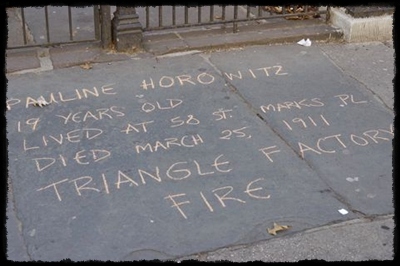
Triangle Chalk Project: Annually, volunteers chalk memorials to the women who died on the doorsteps in New York where they lived. Today marks the 100th anniversary of the Triangle Shirtwaist Fire in New York City on March 25, 1911. One hundred and forty six people died, either from the fire or by jumping from the factory to their deaths trying to escape. Most were young women, almost entirely Jewish or Italian immigrants, many still in their teens, one just 14. It was from this incident that many of our contemporary worker safety laws originated.
Poet Chris Llewellyn’s collection Fragments From the Fire poignantly recalls the event:
‘I could see them falling,’
said Lena Goldman. ‘I was sweeping out
in front of my cafe. At first some thought
it was bolts of cloth – till they opened
with legs! I still see the day
it rained children’
(From the poem “March 25, 1911” by Chris Llewellyn)The battles that arose in the wake of Triangle over worker safety, worker rights and whether government should regulate business are alive today. Washington Post columnist Harold Meyerson admirably traces this important history in his column this week titled The mind-set that survived the Triangle Shirtwaist fire. He writes:
In Triangle’s wake … Al Smith and state Senate President Robert Wagner … aided by Frances Perkins, a young social worker who was in Washington Square looking on in horror as the seamstresses jumped to their deaths … authored and enacted legislation that required certain workplaces to have sprinklers, open doors, fireproof stairwells and functioning fire escapes; limited women’s workweeks to 54 hours and banned children under 18 from certain hazardous jobs. …
Businesses reacted as if the revolution had arrived. The changes to the fire code, said a spokesman for the Associated Industries of New York, would lead to “the wiping out of industry in this state.” The regulations, wrote George Olvany, special counsel to the Real Estate Board of New York City, would force expenditures on precautions that were “absolutely needless and useless.” “The best government is the least possible government,” said Laurence McGuire, president of the Real Estate Board. “To my mind, this [the post-Triangle regulations] is all wrong.”
Such complaints, of course, are with us still. We hear them from mine operators after fatal explosions, from bankers after they’ve crashed the economy, from energy moguls after their rig explodes or their plant starts leaking radiation. We hear them from politicians who take their money. We hear them from Republican members of Congress and from some Democrats, too. A century after Triangle, greed encased in libertarianism remains a fixture of — and danger to — American life.
Stuart Appelbaum, president of the Jewish Labor Committee and president of the Retail, Wholesale and Department Store Union (UFCW) notes the biblical mandate to support workers safety and their rights to secure safe working conditions — and especially ties the Triangle fire to labor union uprisings in Wisconsin, Ohio, and other states.
“The Triangle Shirtwaist Factory Fire that took place in New York City a century ago is now being memorialized in programs across the country. It took that fire on March 25, 1911, and the deaths of 146 innocent garment workers – mostly women, mostly Jewish, mostly immigrants – to bring about meaningful safety regulations, and to respect the call of workers struggling to secure the benefits of union membership. Many of our grandparents and great-grandparents played a critical role in building a strong and vibrant labor movement with the hope that it would endure and remain a permanent feature of American life. Through their actions and their struggle, our lives and the lives of most Americans were made better. Today, those hard-fought gains are under threat in communities across the United States.
What has emerged in Wisconsin, Ohio, Indiana and across America is an attack against working men and women in both the public and private sector. The targets are the public employees now, but their intention is to come after all unionized workers. … Many Jewish texts, from the Torah through the Talmud, deal specifically with the treatment of workers. The Torah urges “justice, justice, shall you pursue.” There is, then, a deeply moral, historical and theological basis for our efforts to close the widening gap between the rich and poor, and to prevent growing economic instability that will be detrimental for all Americans. This demands that we strengthen, not weaken, private and public sector unions to ensure that current and aspiring middle class Americans attain a decent standard of living and greater economic security.”
Traditional Catholic teaching on the rights of workers is pretty straightforward. Workers have the right to form and belong to unions and other associations. They have the obligation to address difficult problems with respect for the rights and needs of all. As the archbishop of Milwaukee, Wisconsin, said recently, “hard times do not nullify the moral obligation each of us has to respect the legitimate rights of workers.”
To learn more about the Triangle Shirtwaist Fire, see PBS’ American Experience Fire in the Sky. Also read David Von Drehle’s Triangle: The Fire that Changed America
From The Triangle Shirtwaist Fire Through Madison by Stuart Appelbaum
For more about Chris Llewellyn, read The Braided River of Language by Rose Marie Berger and read her collection of poems Fragments from the Fire
-
Lessons from Behind Bars
 In 2010, Hope House DC received a grant from the Humanities Council of Washington, D.C. to support participation in the National Endowment for the Arts’ Big Read project. Hope House placed about 100 copies of Earnest J. Gaines’ classic A Lesson Before Dying in two prisons that have high concentrations of District of Columbia inmates.
After reading the book, I led inmates through a two-day writing workshops at each facility, as their Humanities Scholar. During this time, participants worked with the study guide materials provided by the National Endowment for the Arts, as well as creating unique writing exercises. You can read more about my experience in Dispatch from Prison: How Strong is Hope?
Using A Lesson Before Dying as a springboard, workshop participants documented their own lessons as essays, which are curated and published on a new web site Lessons From Behind Bars. The writings give powerful voice to the unique legacies that many individuals otherwise silenced by incarceration wish to leave for their children and communities. They have been a catalyst to expand this project to include incarcerated voices from around the country.
This project hopes to help bring home the voices and experiences of residents who have been removed from our neighborhoods and communities, and to keep us mindful of the many ways incarceration affects each and every one of us. For example, James Malone writes:
If I knew that my death was days away, beyond my control, I would pray for a peaceful death, knowing that I have fulfilled my duties on Earth. I would cherish each moment knowing that my existence in this world was not in vain. …
I would change my way of thinking, and apply the wisdom “as a man thinketh in his heat, so is he,” therefore I would understand when no one else would that it’s the mental attitude that determines how we die. I would cherish creative thoughts of courage and calmness. The Bible, in the book of Genesis, says that “God gave man dominion over the whole Earth. I would each day pray and ask for dominion over myself, dominion over my fears, dominion over my mind and over my spirit to face each moment that I have left to live. …
-
St. Benedict: Pray. Work. Read.
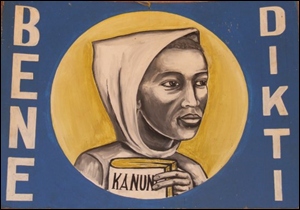
Painting of Benedict from Peramiho, Tanzania. Kanuni means "Rule" in Swahili. Today is the feast day of St. Benedict. If you’ve had a chance to see the amazing movie Of Gods and Men – about Trappist monks in Algeria in the mid-1990s – then you’ll appreciate learning more about St. Benedict of Nursia, one of the founders of monasticism. Below is a short reflection on Benedict from Sr. Joan Chittister, a Benedictine sister.
There is one thing Benedict teaches us before all other possible insights about the spiritual life and that is this: God is with us. It is as simple as that. God does not need to be earned. God cannot be merited. God is not persuaded by human behavior to attend to us. God is not intent on ignoring us. “The divine presence is everywhere,” St. Benedict tells us.
God is the very breath of our souls, the creative energy that gives us life and carries us through all our days. God, our hope, is the magnet that draws us and the spirit that carries us from dark to light through life. Our beginning and our end is God, our present hope and life eternal.
We come to rest in that assurance, St. Benedict says, by realizing that whatever happens to us in life — when things go wrong, when our plans go awry, when our future seems dashed and the present seems impossible — God’s will for us is our welfare and not our woe.
Along the way, God sends guides to light our path — spiritual mentors and models to lead us, taskmasters to train us, disciplines to curb us — so that, for those “who endure and not grow weary,” growth from the trivial to the significant may be complete. Then, aware of our own limitations, honest in our sense of self, subdued in our demands of the world and simple in our needs, we lose the demons of exaggerated expectations. We are ready now to take life as it comes to us, unafraid and secure in the presence of God to lead us through it.–Joan Chittister, OSB
From Searching for Balance by Joan Chittister (Abbey Press)
-
Lent and Life in the ‘Affluent Fifth’
 Lent is an opportunity to right-size our relationships with our neighbors. Today, less than one-fifth of the world’s people have more than four-fifths of the global wealth, but the poorest billion have less than one-fiftieth, according to the U.S. Catholic bishops. The most affluent fifth control 80 percent of world trade, savings, and investment.
Sometimes we who live in the “affluent fifth” feel immediately uncomfortable or guilty at reading this information. But our faith gives us the opportunity at Lent to think creatively about our balance in the world–and to act in new ways with our time, money, possessions. We are invited to refresh our hearts through prayer and scripture. We can lay down the burdens accumulated in an over-sated society. We can fast and rest; sing ancient songs; draw closer to God. Lent is an invitation.
“Over a few short generations,” observes Alan Durning, “we in the affluent fifth of humanity have become car drivers, television watchers, mall shoppers, and throwaway buyers.” But many in our culture are concerned about the prevalence of greed, selfishness and conspicuous consumption, which seem to be crowding out meaningful family, community and spiritual values. We fail to think about the damaging consequences of our lifestyle for the future of our children – and our planet.
The 10th commandment is straightforward: “Thou shalt not covet thy neighbor’s goods.” And Jesus was often blunt about over-consuming and attachment to material goods: “Do not store up for yourselves treasures on earth, where moth and rust consume and where thieves break in and steal.” (Matthew 6:19)
Christian simplicity is not frugality for the sake of penny-pinching or deprivation. Rather, we want to become aware of how our personal choices and spending habits are connected to the issues of global poverty and care for creation. Our faith motivates us to develop life-styles that respect the limitations of our planetary resources and protect the creation for the future of our children. The hallmark of such a life-style is not greedy accumulation, but compassionate sharing, and heartfelt contentment. That is the abundant life which Jesus promised.–From Lent 4.5 on Christian Simplicity
-
Lenten Reflections on Marina Abramovic, Todd Bentley, and Performance Healing
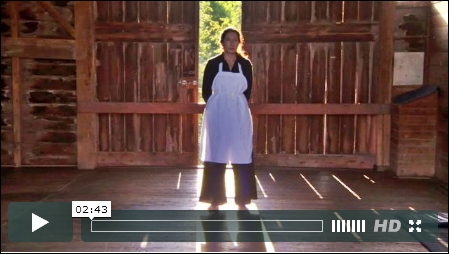
Tip of the Hat to Vintage Jeannie‘s eclectic tastes that led me to performance artist Marina Abramovic and “Our America with Lisa Ling,” a new TV series on OWN. Both have prompted some esoteric reflections on Lent, Lenten disciplines, prophetic witness, and social healing.From the Lenten prayer of St. Augustine: “O Lord, the house of my soul is narrow; enlarge it that you may enter in.”
First, the strange world of Marina Abramovic. Abramovic, born in Belgrade, is one of the leading artists from the “live act” performance art movements from the 1960s and ’70s in Eastern Europe. The performance art and body art movements in Europe can be traced back to the Dadists in 1915 who created “anti-art” to shock and critique the values of a society that preferenced the pretensions of high culture while countenancing the brutality of World War I.
In Abramovic’s performance pieces, her body is the primary medium–taking her and her audience to the limits of emotion. She creates dangerous spaces. She says, “I’m interested in art that disturbs and pushes that moment of danger.” After the terrorist attacks in New York city on Sept. 11, Abramovic performed “House With an Ocean View” at a gallery in Manhattan in which she publicly mourned for 12 days, including fasting, weeping, sometimes tearing her clothes.
“For those twelve days, in perfect silence, she ate nothing and drank only water,” wrote art critic John Haber. “She had nothing with which to read or write. Nothing stood in the way of thought or sleep but lightheadedness and danger. She sought to ‘change my energy field.’ By the end, her flesh fed on muscle, just as in an earlier work, of incisions into her skin, muscle fed on flesh.” And hundreds came to the gallery to participate with her in the public ritual, her prophetic witness. So like Jeremiah weeping for an unrepentant people.
Last year, in preparation for a retrospective of performance art pieces at the Museum of Modern Art in New York, Abramovic led a workshop at her farm in upstate New York called “Cleaning the House.” Participants slept outside and did not eat nor speak for four days. They engaged in a regimen of individual and group exercises, such as walking backwards in slow motion, counting grains of rice, and observing a single object for hours. The goal of these exercises was to enable them to become aware of their limits and to find their own “charismatic space.” They pushed their bodies and minds to learn something about their souls.
The trailer to the movie Marina (see above) tracks one of those workshops. Individuals are led through a series of exercises meant to sharpen their minds and shock their bodies. They go through a 4-day process of “cleansing.” Abramovic walks through the group with an “offertory basket” collecting everyone’s cell phones, IPAs, Iphones, etc. They are asked to temporarily sacrifice communication in order to be present to themselves and their surroundings. They take a vow of silence. They sleep in the open, in the cold. They bathe in the river. They find a spiritual space where they can identify their own limits, the spiritual boundaries of another, and the impenetrable mystery that lies in the gap between the two. Participants come away completely transformed–shocked at how much more “human” they have become in just 4 days of intense study and training.
In “Our America with Lisa Ling,” the premier episode is devoted to exploring faith healing through Todd Bentley at Morning Star Ministries in Ft. Mill, South Carolina. Ling describes Bentley as a “rock star among faith healers,” and also points out he is a former drug addict whose adultery nearly derailed his ministry.
Bentley runs a school for would-be faith healers. Those who come are the addicted, the abused, the formerly incarcerated, the poor, the needy. With the praise band wailing in the background, Bentley – who looks like a biker in his black t-shirt, full-sleeve tattoos, and body piercings – mows down the line of the desperate, slaying them in the Spirit. It is powerful and pitiful, prayerful and spiritually pornographic.
It is also performance art: Bodies in space; the interacting of charismatic energies. Also with painful, though less dangerous, social commentary.
Ling visits two middle-aged sisters who have paid $600 each to attend Bentley’s workshops, hoping that when they bring their mother to one of Todd Bentley’s worship services she will be cured of her untreatable cancer. “Faith healing is,” Ling points out, “a multibillion dollar industry, and the sisters say these sessions are cheaper than medical treatments their mother’s insurance does not entirely cover.”
One commenter on the episode said, “Many turn to faith healing because they cannot afford treatment from conventional medicine (like the woman in the show with cancer who had to stop her chemo). There are many who want to go the route of conventional medicine, but when that is no longer an option for them, where do they turn? I hope that this show, and those like it, help others to see that we need to find ways of helping everyone have access to medical treatment (no matter what their financial situation may be).”
When the faithful are not cured of cancer or paralysis, Ling reframes (as people of faith have done for centuries in these situations trying to understand the mysterious ways of God). She looks at how the individuals have transformed their own lives with God’s help–turning away from drugs, leaving abusive relationships, gaining emotional and psychological strength–rather than emphasizing the somewhat suspicious snake oil of Todd Bentley.
At the end of the episode Steve, a man paralyzed for years who is convinced that the Lord will heal him through Todd Bentley, is not able to walk again. But when Ling kneels before him in his wheelchair asking how he understands what has happened, he instead pours out his prayers on her. He is compelled to release the spiritual energy built up inside him. He lays his hands on Ling’s head and she receives a peculiar annointing. All of which calls into question who or what was actually being healed.
Liturgy and ritual, stripping away illusions, prayer and healing, surprise and danger, temptations all are part of Lent. We experiment with who we are in our humanness, when masks are ripped away. We expose our wounds. We are vulnerable to Satan/hucksters selling us cheap grace.
Lent is a time to “Clean the House.” St. Augustine’s prayer continues: “My soul is ruinous, O repair it! It displeases Your sight. I confess it, I know. But who shall cleanse it, to whom shall I cry but to you?” We are such peculiar creatures. We choose such strange sins.
-
St. Paddy’s Day: ‘Those in Power Write the History; Those Who Suffer Write the Songs’
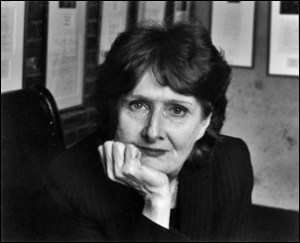
Irish poet Eavan Boland “Those in power write the history, while those who suffer write the songs, and, given our history, we have an awful lot of songs,” quipped Irish singer Frank Harte.
On St. Patrick’s Day – when all the world “is Irish” – it seems fitting to lift up one of Ireland’s finest contemporary poets, Eavan Boland. Her poems rise from that sung suffering of the Irish.
Boland was born in Dublin in 1944 and published her first book of poetry, New Territory, in 1967. Along with her prolific poetry, she also has consistently advocated for the rights of women, the voices of women, and promoted the power of women in Irish history. In a 2006 essay, Boland addresses the question: Can Poetry Console a Grieving Public? She writes:
Years ago my father saw the keen, or caoine. It was the 1920s; he was a student at Trinity College. On a trip one Easter, he went a hundred miles west and a whole century back to Connemara and the Atlantic coast of Ireland.
There, one morning, he saw the emigrant boat, about to leave for Liverpool. There was a small group of old women gathered on the pier. They were the keeners. They could be hired for a few pennies to come to a wake or a funeral or, as here, to a final emigrant farewell on the Galway docks. As the passengers disappeared on board and the boat drew out—or so my father told me—the old women put their shawls over their heads and began the keen. He remembered it as eerie, powerful, terrible.
What the Irish give the world – more than green beer or even the rich trove of poetry – is a the memory of public imagination. Irish verse carries in its DNA an ability to understand deep human emotions and yearnings that transcend cultures and time. The dangers of an over individualized culture, such as is heralded in the U.S. – is the loss of public imagination. We can’t see where we are going together. We can only strive for an uneasy balance of rules and regulations that protect me or mine. The keeners that Boland recalls act out a public liturgy that taps deep into Irish imagination.
“If poetry does not address public grief in some way,” writes Boland, “it runs the risk of abandoning one of its great roles and one of its great genres, which is elegy. The origins of elegy are not private: they are sacred and public.”
As we celebrate the day when all the world is Irish, let’s do it with poetry and public dancing, and remembering that the keeners who lamented the loss of Ireland’s daughters and sons a few generations earlier, now speak Spanish. The keeners are in Mexico, and El Salvador, and Guatemala, and Honduras. The mothers cover their heads and cry out to see their children go north.
Below, is Boland’s wonderful poem on what maps don’t tell us about lives lived in actual places.
That the Science of Cartography Is Limited
– and not simply by the fact that this shading of
forest cannot show the fragrance of balsam,
the gloom of cypresses
is what I wish to prove.
When you and I were first in love we drove
to the borders of Connacht
and entered a wood there.
Look down you said: this was once a famine road.
I looked down at ivy and the scutch grass
rough-cast stone had
disappeared into as you told me
in the second winter of their ordeal, in
1847, when the crop had failed twice,
Relief Committees gave
the starving Irish such roads to build.
Where they died, there the road ended
and ends still and when I take down
the map of this island, it is never so
I can say here is
the masterful, the apt rendering of
the spherical as flat, nor
an ingenious design which persuades a curve
into a plane,
but to tell myself again that
the line which says woodland and cries hunger
and gives out among sweet pine and cypress,
and finds no horizon
will not be there.
–Eavan Boland -
Lenten Poem: ‘Boast of Quietness’ by Jorge Luis Borges
 This beautiful poem by Argentinian poet Jorge Luis Borges reminds me of Psalm 137. “By the rivers of Babylon we sat and wept when we remembered Zion. There on the poplars we hung our harps, for there our captors asked us for songs, our tormentors demanded songs of joy; they said, ‘Sing us one of the songs of Zion!”
Boast of Quietness
by Jorge Luis BorgesWritings of light assault the darkness, more prodigious than meteors.
The tall unknowable city takes over the countryside.
Sure of my life and death, I observe the ambitious and would
like to understand them.
Their day is greedy as a lariat in the air.
Their night is a rest from the rage within steel, quick to attack.
They speak of humanity.
My humanity is in feeling we are all voices of that same poverty.
They speak of homeland.
My homeland is the rhythm of a guitar, a few portraits, an old
sword, the willow grove’s visible prayer as evening falls.
Time is living me.
More silent than my shadow, I pass through the loftily covetous multitude.
They are indispensable, singular, worthy of tomorrow.
My name is someone and anyone.
I walk slowly, like one who comes from so far away he doesn’t
expect to arrive.From Moon Across the Way by Jorge Luis Borge
-
In the Wake of Japan Disaster, Must We Accept Nuclear Power?
 The U.S. Navy reported today that it had detected low levels of airborne radiation at the Yokosuka and Atsugi bases, about 200 miles to the north of the Japan’s Fukushima nuclear reactors. They are moving ships out of range.
“While there was no danger to the public, Commander, Naval Forces Japan recommended limited precautionary measures for personnel and their families on Fleet Activities Yokosuka and Naval Air Facility Atsugi, including limiting outdoor activities and securing external ventilation systems as much as practical,” a statement said. “These measures are strictly precautionary in nature. We do not expect that any United States Federal radiation exposure limits will be exceeded even if no precautionary measures are taken,” it added.
News reports, scientists, nuclear energy corporate officials, and government spokespersons are reiterating that the nuclear reactor meltdown in Fukushima, Japan, is not like Chernobyl. It’s more like Three Mile Island. Apparently, this is supposed to allay public concern.
For anyone who lived down-wind of the Three Mile Island reactor when the radioactive core was breached on March 28, 1979, this news is anything but comforting. (Read “In the Valley of the Shadow: Ten Years after the Accident at Three Mile Island” by Joyce Hollyday.)
The arguments made by the nuclear industry today are that huge improvements have been made in the safety and efficiency of nuclear energy production — much of which is true. But the nuclear corporations still have no answer to radioactive waste or the multi-generational devastation to all living creatures when the unforeseeable occurs — as has happened in Japan.
Below, Sojourners reprints a commentary by Vince Books written at the time of the Three Mile Island disaster. Vince actually worked on the construction crew of the plant and eventually became a committed advocate against nuclear power:
The Metropolitan Edison Company (Met-Ed) is proud. Proud of progress on that island. Proud to be helping to solve America’s energy problems. And proud to be splitting atoms, heating water, forcing steam, turning generators, and producing electricity. It is, however, Met-Ed’s other contributions that will long be remembered. These include iodine 131, cesium 137, strontium 90, and plutonium, to be followed perhaps by an assortment of cancers and birth defects. Met-Ed is leaving more than footprints on the sands of time.
The residents of central Pennsylvania are sleeping. Or at least they were when something went terribly wrong out there on Three Mile Island. It was 4 a.m. March 28, 1979. There was a mal-function in the secondary cooling system of Unit 2. More malfunctions followed, and the trouble was compounded by what appeared to be human error. Inside the four-foot thick concrete walls of the containment building the Unit 2 reactor was heating up and beginning to destroy its fuel. A plume of radioactive gas was released. The wind was blowing north. (more…)
-
Joan Chittister: Lent is a Chance to Grieve
Benedictine sister Joan Chittister had a nice column on Lent in Huffington Post last week. Here’s an excerpt:
The scripture for the opening of Lent, Joel 2:12-18, takes us back to a time of great danger in Israel. The land has been ravaged by locusts, the crops are failing. The very life of the population is in question. The prophet Joel, convinced that the people have brought the disaster upon themselves by virtue of their unfaithfulness, summons the House of Israel to repent its ways. But, interestingly enough, he does not call them to attend penance services in the synagogue. He does not require them to make animal sacrifices in the temple. He does not talk about public displays of remorse, the time-honored tearing of garments to demonstrate grief. No, Joel says instead, “Rend your hearts and not your clothing.”
Lent is a call to weep for what we could have been and are not. Lent is the grace to grieve for what we should have done and did not. Lent is the opportunity to change what we ought to change but have not. Lent is not about penance. Lent is about becoming, doing and changing whatever it is that is blocking the fullness of life in us right now.
Lent is a summons to live anew.

-
Subscribe
Subscribed
Have a WordPress.com account? Log in now.

