Word and World believes that it is time to bring our energy and join the movement work happening in Detroit, a city that has been “ground zero” not only of economic crisis, but also of hope and resistance.
This “Land and Water” movement school will focus on cultural organizing bringing together theologies of justice, indigenous resistance, and hip hop spirituality.
Get your application here. If you can’t come, send financial support here.
Flossenberg memorial to resistance members killed April 9, 1942. 2 Timothy 1:7: “For God did not give us a spirit of timidity, but a spirit of power, of love and of self-discipline.”
Bill Wylie-Kellermann studied Bonhoeffer with Paul Lehmann, Bonhoeffer’s friend and colleague at Union Seminary NYC. The life and times of Bonhoeffer are instructive for us today. Below is both Bill’s reflections for today, 70 years after Bonhoeffer’s execution by the Nazis.
And also reflections from Victoria Barnett, staff director of the Committee on Ethics, Religion, and Bonhoeffer scholar at the Holocaust at the U.S. Holocaust Memorial Museum. Both reflect on Bonhoeffers 1942 Christmas letter.
“We have for once learnt to see the great events of world history from below, from the perspective of the outcast, the suspects, the maltreated, the power-less, the oppressed, the reviled – in short, from the perspective of those who suffer.”— Dietrich Bonhoeffer, Christmas letter to friends and co-conspirators (1942)
Seventy years ago today, just weeks before the fall of Berlin in 1945, Dietrich Bonhoeffer was marched naked into the yard of Flossenberg Concentration Camp and hanged with piano wire for being an enemy of the Nazi state. He was 39.
Bonhoffer may be said to have literally written the book on radical discipleship. For several generations his Cost of Discipleship has provoked conversion, focused hearts, signified the way. It is perhaps most famous for its opening meditation contrasting “cheap grace” – grace as commodity, principle, doctrine – with “costly grace” which is grace to die for – the way of discipleship and the cross. “When Christ calls someone, he bids them come and die.” … — Bill Wylie-Kellermann
Read the rest of Bill’s post at Radical Discipleship here.
Vicky Barnett is the coeditor of the Dietrich Bonhoeffer Works project, the English translation series of Bonhoeffer’s complete works (Fortress Press). Bonhoeffer and the Confessing Church movement are viewed quite differently between Christians and Jews.
In December 1942, Bonhoeffer sent a Christmas letter (“After Ten Years”) to his closest friends in the resistance. In a bitterly realistic tone, he faced the prospect that they might fail, and that his own life’s work might remain incomplete. He may have wondered, too, whether his decision to return to Germany and to work in military intelligence had been the right one. “Are we still of any use?” he wrote:
We have been silent witnesses of evil deeds: we have been drenched by many storms; we have learnt the arts of equivocation and pretence; experience has made us suspicious of others and kept us from being truthful and open; intolerable conflicts have worn us down and even made us cynical. Are we still of any use?
The necessities of subterfuge and compromise had already cost him a great deal. He pondered the different motives for fighting evil, noting that even the finest intentions could prove insufficient. “Who stands firm?” Bonhoeffer asked:
Only the one for whom the final standard is not his reason, his principles, his conscience, his freedom, his virtue, but who is ready to sacrifice all these, when in faith and sole allegiance to God he is called to obedient and responsible action: the responsible person, whose life will be nothing but an answer to God’s question and call.
In this letter, one of Bonhoeffer’s most moving and powerful writings, the various threads of Bonhoeffer’s life and work came together. He had been one of the few in his church to demand protection for the persecuted as a necessary political step. He had called upon his church, traditionally aligned with the state, to confront the consequences of that alliance. The church struggle, as he wrote Bishop George Bell in 1934, was “not something that occurs just within the church, but it attacks the very roots of National Socialism. The point is freedom. . . .”
Sanctuary Movement co-founder and Quaker theologian Jim Corbett (author of Goatwalking and Sanctuary for All Life) gave this lecture for the plenary sessions of the 1986 Friends General Conference gathering at Carleton College in Northfield, MN. Pat Corbett, wife to Jim, speaks concerning her involvement with the sanctuary movement.
“There are a few individuals in every age who live outside their own time. Galileo, Leonardo Da Vinci, Sor Juana de la Cruz and … Jim Corbett. The great prophets often dome from some dusty, out-of-the-way, God-forsaken corner of the world … like Bethlehem or, in Jim’s case, the Sonoran Desert hinterlands. God willing, Jim Corbett’s Sanctuary for All Life will be considered in two hundred years as holy writ.”–Rose Marie Berger
by Fay OcampoPope Francis today called for prayers for families and offered this beautiful one as an example:
Jesus, Mary and Joseph,
In you we contemplate
The splendor of true love,
We turn to you with confidence.
Holy Family of Nazareth,
Make our families, also,
Places of communion and cenacles of prayer,
Authentic schools of the Gospel,
And little domestic Churches.
Holy Family of Nazareth
May our families never more experience
Violence, isolation, and division:
May anyone who was wounded or scandalized
Rapidly experience consolation and healing.
Holy Family of Nazareth,
May the upcoming Synod of Bishops
Re-awaken in all an awareness
Of the sacred character and inviolability of the family,
Its beauty in the project of God.
Jesus, Mary and Joseph,
Hear and answer our prayer. Amen.
A few weeks ago, Franciscan Richard Rohr stopped by the Sojourners offices. It’s been several years since I’ve seen him and it was great to reconnect. He spent some quality time with our Sojourners’ pastor, Juba, a rescued pound pup with an incredibly joyous disposition.
Richard spoke with us about the nature of a contemplative life and laying down dualistic thinking, the binary mind. This is something that didn’t really make sense to me when I was younger, but now I’m beginning to glimpse a way into it.
A paradox is something that initially looks like a contradiction, but if you go deeper with it and hold it longer or at a different level, it isn’t necessarily so. Holding out for a reconciling third, a tertium quid, allows a very different perspective and gives a different pair of eyes beyond mere either/or. You’d think Christians would have been prepared for this. Notice that Jesus in many classic icons is usually holding up two fingers as if to say, “I hold this seeming contradiction together in my one body!” Jesus is the living paradox, which, frankly, confounds and disturbs most of us. Normally humans identify with only one side of any seeming contradiction (“dualistic thinking” being the norm among humans). For Jesus to be totally human would logically cancel out the possibility that he is also totally divine. And for us to be grungy human beings would cancel out that we are children of God. Only the mystical, or non-dual mind, can reconcile such a creative tension.
That’s why Jesus is our icon of transformation! That’s why we say we are saved “in him.” We have to put together what Jesus put together. The same reconciliation has to take place in my soul. I have to know that I am a son of earth and a son of heaven. You have to know that you are a daughter of God and a daughter of earth at the same time, and they don’t cancel one another out.
All of creation has a cruciform pattern of loss and renewal, death and resurrection, letting go and becoming more. It is a “coincidence of opposites” (St. Bonaventure), a collision of cross-purposes waiting for resolution–in us. We are all filled with contradictions needing to be reconciled. The price we pay for holding together these opposites is always some form of crucifixion. Jesus himself was crucified between a good thief and a bad thief, hanging between heaven and earth, holding on to both his humanity and his divinity, a male body with a feminine soul. Yet he rejected neither side of these forces, but suffered them all, and “reconciled all things in himself” (Ephesians 2:10).–Richard Rohr, OFM
I wrote earlier about The Photo Not Taken as I sped through Moneygall, Ireland, birthplace of Barack Obama’s great-great-great grandfather a few days before the historic 2008 U.S. elections.
What do you know? Canon Stephen Neill, Anglican priest in the diocese of Limerick, Killaloe who blogs at Paddy Anglican, sent me the photo that I missed!
Today I was researching the creation care teachings that will likely undergird Pope Francis’ forthcoming encyclical on climate change. I found this epiphany reflection by Orthodox Father John Breck.
The deep wisdom in the Eastern church reminds us of the distinctives that Christians bring to our relationship with God’s creation. We do not recognize the earth as a god in herself. We do not believe that the earth is more holy or more perfect than humans. We do believe that both earth and human communities are “fallen” or “in the far country” (as Meiser Eckhart puts it). Our human call to fidelity with creation is so much more than that of caretaker or steward or even pastor or priest. We are family (creaturely together) striving to find our way home.–Rose
Here’s an excerpt from Breck’s reflection on theophany (when God becomes visible) and water:
“… There is another aspect of Theophany that also needs to be stressed, today perhaps more than ever before. This is a motif that appears very clearly in icons of the feast but goes unmentioned in the Gospels. Its earliest formulation seems to be that of St Ignatius of Antioch, who died as a martyr in Rome between 110 and 117 AD. In his letter to the Ephesians (ch. 18), Ignatius makes a statement notoriously difficult to translate: “Our God, Jesus the Christ, was conceived by Mary according to the plan (oikonomian) of God from the seed of David [cf. Rom 1:3] and [by] the Holy Spirit; he was born and was baptized so that by the passion (tô pathei) he might purify the water.”
Without going into the difficulties presented by the language of this verse, we can note its basic theme. It is the same as depicted in icons and liturgical hymns of the Theophany feast. Christ descends into the waters of the Jordan not only to submit himself to the hands of John and to lay the foundation for the sacramental act of baptism. He also goes down into the Jordan in order to purify or sanctify those waters, and in so doing he symbolically (really, through this sign-act) sanctifies all of creation.
Theophany celebrates the baptismal renewal of God’s people, members of the Body of Christ. But it also provides the perspective we are to assume with regard to the entire created world. Stated otherwise, it provides the foundation for a genuinely Christian “ecology.”
Elizabeth Theokritoff has written a book entitled, Living in God’s Creation, with the subtitle “The Ecological Vision of Orthodox Christianity.” The author points out that our relation to the created world is less that of “steward” than it is of priest. We are called not only to preserve and care for the created order. Our vocation relative to the world we live in, both natural and human, is to make of it an offering to God, with the ongoing supplication that he bless, restore and make fruitful this planet over which he has granted us dominion. That dominion implies responsibility and respect toward all living things. But it means, too, that we recognize the “fallenness” of creation and its need for restoration, even redemption (Rom 8:18-23). …”–Father John Breck, Sanctify the Waters (Epiphany 2015)
(30 minutes) President Obama delivers remarks from the Edmund Pettus Bridge in Selma, Alabama, marking the 50th anniversary of the marches from Selma to Montgomery. Rumor has it that Obama wrote most of this speech himself. We glimpse the best of Obama and the best of the American story. (Read the transcript here.)
Who was Edmund Pettus? See here. Learn why this bridge in Selma is part of a long contest of wills in America.
The president quotes Langston Hughes, Emerson, and Walt Whitman, so I’ve included the sources for those quotes below:
“We build our temples for tomorrow, strong as we know how, and we stand on top of the mountain, free within ourselves.” From the 1926 essay “The Negro Artist and the Racial Mountain” by Langston Hughes
“Not gold but only men can make / A people great and strong;/ Men who for truth and honor’s sake / Stand fast and suffer long.” From the poem “A Nation’s Strength” by William Ralph Emerson (not Ralph Waldo Emerson)
“The health of the eye seems to demand a horizon. We are never tired, so long as we can see far enough.” From Natureby Ralph Waldo Emerson
“Do I contradict myself? / Very well then I contradict myself, / (I am large, I contain multitudes.)” From Song of Myself by Walt Whitman



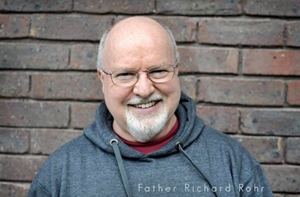 A few weeks ago, Franciscan Richard Rohr stopped by the Sojourners offices. It’s been several years since I’ve seen him and it was great to reconnect. He spent some quality time with our Sojourners’ pastor, Juba, a rescued pound pup with an incredibly joyous disposition.
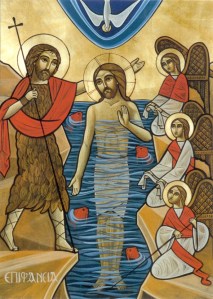 Today I was researching the creation care teachings that will likely undergird Pope Francis’ forthcoming encyclical on climate change. I found this epiphany reflection by Orthodox Father John Breck.