-
Park Regent’s Peace Banners
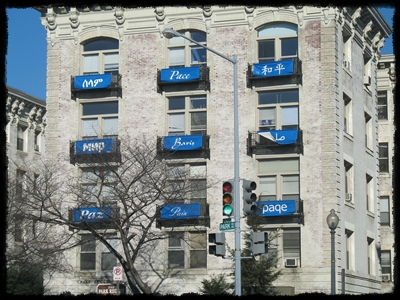
by Rose Marie Berger For many years, I’ve enjoyed this tradition of the Park Regent Apartments at the intersection of Park Road and Mt. Pleasant Street in Washington, D.C. From the buildings prime location, the owners hang bright blue banners with the word for peace emblazoned in white font in a dozen different languages.
Out of pure curiosity, I called the Park Regent Apartments to ask about the history of hanging these peace banners. The very helpful property manager, Art Buildman, told me:
“We’ve been doing this for the eight years that I’ve been around here. I’ve been hanging them myself for the last three years. I don’t really know how it got started. I think maybe the Mount Pleasant Citizens Association suggested it. We usually put them up sometime before Christmas and take them down in January. We’ve got a larger size banner that says ‘peace’ in English, but I’m afraid to hang it because I’m afraid I’ll damage the roof by attaching it. I don’t dare hang any longer ones, because of the wind. There used to be banners in red, but we can’t find those. I’ve got a picture of the red banners here in the office that you are welcome to come by and see. “
Personally, I remember seeing longer ones hung from the Park Regent in the 1990s, then there were several years when they didn’t hang them at all. But now the tradition seems firmly back in place. And they now hang them on both buildings in the Park Regent complex. It used to be that they hung only on the building right at the corner. The Mount Pleasant Historical Society says this about the Park Regent (See more about historic Mount Pleasant.):
In 1910 the Park Regent was constructed at the intersection of Park Road and Mount Pleasant Street. The buff brick U-shaped building is imaginatively sited on its difficult trapezoidal site through the extension of one wing. A bold bracketed cornice and paneled brickwork crown the Beaux-Arts style building.
Below are a few more photos of the Park Regent by local photographers:
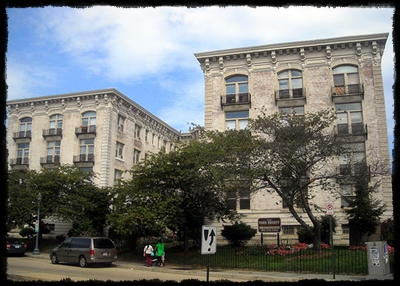
By NCinDC 
By Amber M. Wiley -
Read “Architectural Detail” in New Beltway Poetry Issue
I’m very happy to announce that my poem “Architectural Detail” is published in the new issue of the online journal Beltway Poetry. Read “Architectural Detail” here.

I started writing this poem while I was on six weeks of grand jury duty in Washington, D.C. It was an awful experience of listening to countless drug cases mixed in with child abuse and child prostitution cases. During lunch breaks, I would slip away to the National Building Museum and rest my soul in its cathedral-like expanse. I liked watching the workers go about their daily routine. It calmed me. Below is a little intro to the newest issue of Beltway Poetry:
Beltway Poetry opens 2009 with a new issue devoted entirely to poems about museums. Thirty-three poets write about museums, historical sites, and other public places devoted to preservation and exhibition. The poems address the institutions and “their collections, their workers, and the many ways in which they fulfill their founders’ hopes of enlarging the scope of civic life,” as guest co-editor Maureen Thorson writes in her introduction. “In these poems, poets engage in conversations with artists, their subjects, and with art itself. They stand in witness to the forces of history.”
Saundra Rose Maley asks King Tut,”…is there a crossing over/ Or is this life just what it is, a sandal strap/At best?”
Kendra Kopelke lets the woman in a Hopper painting speak: ” He put me here/like a candle/to ignite the room.”
Stephen Cushman imagines painter’s models, “posing in a yoga twist,/head going one way, torso another.”
David Gewanter writes of a museum store clerk, ” I love to see my mother behind//the counter, tidying up the fossil fish/and reptile rulers.” Linda Pastan contemplates death from a safe distance, asking, ” Whose skulls are these,/and isn’t it dread/that informs our pleasure//in this canvas?”
Special thanks to Kim Roberts for her wonderful dedication to Beltway Poetry. Beltway Poetry Quarterly, now in its ninth year of online publication, is available for free online at http://www.beltwaypoetry.com. For a free subscription, go to: http://lists.mutualaid.org/mailman/listinfo/beltwaypoetryquarterly.
-
People-less Houses Movement
According to a recent Associated Press story, the Take Back the Land folks in Florida are making the sub-prime debacle work for those living on the streets. “We’re matching homeless people with peopleless homes,” said TBL activist Max Rameau. Yep! They are moving homeless folks into beautiful, spacious, foreclosed upon houses.
Here’s an excerpt from the article:
Max Rameau delivers his sales pitch like a pro. “All tile floor!” he says during a recent showing. “And the living room, wow! It has great blinds.”
But in nearly every other respect, he is unlike any real estate agent you’ve ever met. He is unshaven, drives a beat-up car and wears grungy cut-off sweat pants. He also breaks into the homes he shows. And his clients don’t have a dime for a down payment.
Rameau is an activist who has been executing a bailout plan of his own around Miami’s empty streets: He is helping homeless people illegally move into foreclosed homes.
Rameau and a group of like-minded advocates formed Take Back the Land, which also helps the new “tenants” with secondhand furniture, cleaning supplies and yard upkeep. So far, he has moved six families into foreclosed homes and has nine on a waiting list.
“I think everyone deserves a home,” said Rameau, who said he takes no money from his work with the homeless. “Homeless people across the country are squatting in empty homes. The question is: Is this going to be done out of desperation or with direction?”
“There’s a real need here, and there’s a disconnect between the need and the law,” he said. “Being arrested is just one of the potential factors in doing this.”
I think the TBL movement is a great riff on the Landless People’s Movement in South Africa and the Landless Workers Movement in Brazil and elsewhere. TBL is just doing it “American-style.”
With the suicide of capitalism comes the blurring of what has been narrowly understood as “private property.” At the top, the Bush administration has been forced to “nationalize” the banking industry and, apparently, at the bottom, in Miami, TBL is reclaiming as public property those abandoned houses now owned by the banks due to foreclosures. Interesting.
-
Pope Goes Green and Straight for Christmas
In case you are tracking the news on Pope Benedict’s Christmas message–which I sincerely hope you are not–I thought I’d jot down a couple of explanatory notes. Il Papa surprised folks this week by comparing “saving the rainforest” with “saving opposite sex marriage.” I’m sure his theological logic is impeccable. It’s what he does best. But it is usually a path that leads to decimal points about numbers of angels on pin heads. This is generally not very helpful to everyday Catholics.
So, the Pope’s Christmas message on joy also included the following (full text of Pope’s speech in Italian here, in English here):
Since faith in the Creator is an essential part of the Christian Credo, the Church cannot and should not confine itself to passing on the message of salvation alone. It has a responsibility for the created order and ought to make this responsibility prevail, even in public. And in so doing, it ought to safeguard not only the earth, water, and air as gifts of creation, belonging to everyone. It ought also to protect man against the destruction of himself. What is necessary is a kind of ecology of man, understood in the correct sense. When the Church speaks of the nature of the human being as man and woman and asks that this order of creation be respected, it is not the result of an outdated metaphysic. It is a question here of faith in the Creator and of listening to the language of creation, the devaluation of which leads to the self-destruction of man and therefore to the destruction of the same work of God. That which is often expressed and understood by the term “gender”, results finally in the self-emancipation of man from creation and from the Creator. Man wishes to act alone and to dispose ever and exclusively of that alone which concerns him. But in this way he is living contrary to the truth, he is living contrary to the Spirit Creator. The tropical forests are deserving, yes, of our protection, but man merits no less than the creature, in which there is written a message which does not mean a contradiction of our liberty, but its condition. The great Scholastic theologians have characterised matrimony, the life-long bond between man and woman, as a sacrament of creation, instituted by the Creator himself and which Christ – without modifying the message of creation – has incorporated into the history of his covenant with mankind. This forms part of the message that the Church must recover the witness in favour of the Spirit Creator present in nature in its entirety and in a particular way in the nature of man, created in the image of God. Beginning from this perspective, it would be beneficial to read again the Encyclical Humanae Vitae: the intention of Pope Paul VI was to defend love against sexuality as a consumer entity, the future as opposed to the exclusive pretext of the present, and the nature of man against its manipulation.
The key phrase that has caused controversy is: “That which is often expressed and understood by the term “gender”, results finally in the self-emancipation of man from creation and from the Creator.”
It’s really important to note here that there is a translation problem between Italian and English. What gets translated as “gender” is an inadequate translation of the Italian phrase “transgender”–which means in the Italian context anyone who is not 100% opposite sex oriented (gay, lesbian, transgender, third sex, bisexual, pansexual, yadda yadda yadda).
So when the Pope talks about “gender” he is addressing a gay and lesbian issue, not a male and female issue. Having this clarification however does NOT endear me any more to his outcome, but it does explain a few things.
Especially when the Pope’s message is put in the context of the recent United Nations move to “decriminalize homosexuality.”
A non-binding resolution titled “Statement on Sexual Orientation and Gender Identity” was put before the UN General Assembly in mid-December seeking decriminalization and won support from 66 countries in the Assembly and less than 60 opposed it. The resolution was not supported by: the United States, Russia, China, the Vatican, and the Islamic Conference, among others. Every member of the European Union signed on in support. The Vatican and the U.S. were quick to point out that they support human rights for gay and lesbian folks but there were “slippery slope” technicalities in the UN proposal that made it impossible for them to support it. (Read “Vatican Backs Decriminalization but Not wording of UN proposal“.)
So, whatever else the Pope was going on about this Christmas, part of it was related to his fight against the “secularization of Europe” (of which he sees homosexuality as one part).
Having said all that, the Pope extended his Christmas message of Joy to the World, saying:
Joy is the gift in which all the other gifts are included. It is the expression of happiness, of being in harmony with ourselves, that which can only come from being in harmony with God and with his creation. It belongs to the nature of joy to be radiant, it must communicate itself. The missionary spirit of the Church is none other than the impulse to communicate the joy which has been given.
It seems to me that the Pope doesn’t address the essential question of whether same-sex orientation could also be a gift from God. It seems to me that Christian Catholic gay folks seek the same joy of Christ as the rest of the church; seeking joy that is “the expression of happiness, of being in harmony with ourselves, that which can only come from being in harmony with God and with God’s creation.”
-
Spend Christmas Eve with Mirabai Starr
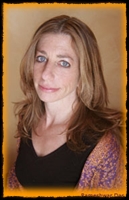 My friend Mirabai Starr, translator of Theresa of Avila and John of the Cross, will be interviewed on Christmas Eve on New Dimensions Radio. She’ll talk about why St. John of the Cross is the “Rumi” of Spain, which Christian mystic coined the term “dark night of the soul,” how Our Lady of Guadalupe merges the spiritual traditions of several cultures, why St. Francis suffered so deeply, and why the sword of a spiritual warrior is a sword of peace and truth.
Mirabai was raised in a secular Jewish household, has maintained a Buddhist meditation practice since the age of sixteen, has engaged the ecstatic mystical traditions of Sufism, and now lives within the indigenous spiritual traditions of Taos, New Mexico.


I met her when I mentioned her translation of John of the Cross in a spirituality column (My House At Last Grown Still) for Sojourners. She dropped me a note in response and a lovely friendship has developed. Here’s an excerpt from that column:
It is three in the morning. There is no sound but the house creaking. A siren in the distance. Somewhere monks are rising for Vigils. In Catholic spirituality this hour is associated with St. John of the Cross and the “dark night of the soul.” It is a time of nothingness, when life’s futility is foremost in the mind. It is Jonah’s time in the whale. Where is God? asks the soul.

John of the Cross was a 16th-century Spanish mystic and Carmelite priest. He grew up in abject poverty in an itinerant family. The Carmelites offered to educate him if he joined the priesthood, which he did. Eventually, he joined a movement led by Teresa of Avila to return the Carmelites to a simple life of prayer and service. For this he was imprisoned and tortured by his fellow priests. The story goes that it was near 3 a.m. when he escaped from his prison cell and collapsed in the archway of Teresa’s chapel, weeping to hear the nuns singing.
John is remembered because of his poetry about the soul’s progress toward God and his commentary on the poetry—collectively called Dark Night of the Soul. (Mirabai Starr’s new translation is accessible and profound.) He describes two stages of spiritual desolation that some souls go through. The first is the “night of the senses,” followed by the “night of the spirit.”
Mirabai has spent the past several years sitting in the presence of the great Christian mystics-or so it seems. As a translator of the works of St. John of the Cross, Theresa of Avila, Our Lady of Guadalupe, the archangel Michael, St. Francis of Assisi, and Hildegard of Bingen, she immersed herself in their essence, and found herself forever altered.
She brings a rare breadth of understanding to the teachings of religious mystics of several traditions. She echoes their familiar words, “Not my will but thine,” “Be present,” and “Open your heart,” and infuses them with the sensitivity and perspective of a gifted modern-day teacher.
If you want to rediscover the mystic traditions of the Jesus Way in a totally fresh and engaging voice, listen to Mirabai and read her books–especially the Devotions, Prayers & Living Wisdom series by Sounds True.
-
Poet Elizabeth Alexander to read at Obama’s Inauguration
Elizabeth Alexander, poet and Yale
 professor, has been chosen to read her poetry at President Obama’s inauguration. Very cool! One of D.C.’s leading ladies of letters gets to come home and do her thing on the South Lawn. Alexander is a native of Washington and one of America’s leading poets.
I don’t know if Obama’s Joint Congressional Committee on Inaugural Ceremonies reads E. Ethelbert Miller’s E-Notes, but he suggested Elizabeth Alexander back in July. That’s what I call visionary! (He also suggested Aretha and/or Stevie Wonder to sing. Let’s see what happens.)
Here’s Ethelbert’s poem in honor of Elizabeth Alexander from his collection Whispers, Secrets & PromisesElizabeth Alexander
I like to say your
name because it sounds
like an era or period
in time when kingdoms
were won…I suggest reading Alexander’s essay Black Alive and Looking Straight at You: The Legacy of June Jordan as a nice introduction to her thoughts on poetry, activism, and politics. “Poetry,” she writes, “is sacred speech that marks the sacred in our lives.” Below is an excerpt from that essay:
I have been thinking for a long time about poetry and politics through the instructive examples of June Jordan, the woman and her work. What is the “job” or the work of a poem, and what are its limitations? Why would a writer speak in the morning in the poems, in the afternoon their body while teaching or doing other activist wok, and in the evening in prose essays? What can each form do that the other cannot? Most specifically, what do we want to protect in poetry if we believe, as I do and as Jordan did, that poetry * is* sacred speech that marks the sacred in our lives?
There are poetry people who think that politics, per se, has no place in poetry. This is silly, and it is amazing how strong a hold this idea has had when it is so empty. For time immemorial, across geographies and peoples, poetry has taken as its subject politics, that is, the affairs of the polis, the community and its people. Some people think of themselves as gatekeepers, defenders of a culture, as though culture is something that can be owned by anyone. Culture is like ambient gas; once it is released, there is no collecting it and bringing it back home. This is a great and magical thing: Culture belongs to the world that occasions it. But we could usefully think about the rich and edifying aspects of form that mark discourses in particular genre. How should a poem attend to the business of its chosen form, the care and style with which the box is made rather than what is put inside the box?
Poets do have responsibility to make images that compel, to distill language, to write with model precision and specificity that is what poetry has to offer to other genres. It makes something happen with language that takes the breath away or shifts the mind. For the poem, which is after all not the newspaper, must move beyond the information it contains while simultaneously imparting the information it contains. Jordan’s commitment to poetry was constant, and it is in those words that we find her simultaneous devotion to the largest possible picture–her keen analyses of the world situation–and to the smallest detail–her tending of language.
-
Al-Zaidi’s Shoe Protest and “Weapons of the Weak”
There is something of the biblical prophets in Iraqi journalist Mutadar al-Zaidi’s protest against President Bush at yesterday’s news conference with Iraqi Prime Minister Nouri Maliki.
Bush was in Baghdad to sign a “security agreement” with Prime Minister Maliki, which calls for U.S. troops to leave Iraq in 2011 – eight years, and thousands of lives, after the America’s 2003 unwarranted invasion.

Al-Zaidi, a cameraman for Cairo-based al-Baghdadiya TV, who had been kidnapped last year by Shia militants, apparently just snapped when President Bush said that the Iraq invasion had been “necessary for US security, Iraqi stability, and world peace” and that the “war is not over.” Al-Zaidi hurled his shoes – a devastating cultural insult – at President Bush’s head from a distance of about 12 feet, before he was thrown to the ground and hauled away. (Video.)
While most news reports have turned the incident into a joke and focused on President Bush’s quick evasive action and his quip about the shoes being size 10, it’s worth looking at what al-Zaidi actually said.
President Bush: “The war is not over.”
Mutadar al-Zaidi: “This is a farewell kiss, you dog!”
When the first shoe missed its target, al-Zaidi grabbed a second shoe and heaved it too, causing the president to duck a second time.
Mutadar al-Zaidi: “This is from the widows, the orphans, and those who were killed in Iraq!”
There is something of the biblical prophetic curse in al-Zaidi’s actions and words.
In Deuteronomy 27, Moses says: ‘Cursed be he who perverts the justice due to the sojourner, the fatherless, and the widow.’ And all the people shall say, ‘Amen.’ (Deuteronomy 27:19)
Proverbs 26 is disgustingly clear about fools: “As a dog returneth to his vomit, [so] a fool returneth to his folly.” (Proverbs 26:11)
Lamentations 5 reflects the desperation of a conquered people: “Remember, O LORD, what is come upon us: consider, and behold our reproach. Our inheritance is turned to strangers, our houses to aliens. We are orphans and fatherless, our mothers [are] as widows. We have drunken our water for money; our wood is sold unto us. Our necks [are] under persecution: we labor, [and] have no rest.” (Lamentations 5:1-5)
Al-Zaidi is currently being “questioned” (God help him and us!) by security forces to determine whether he acted alone. The streets of Baghdad are filled with people in support of al-Zaidi’s prophetic protest.
This “shoe protest” against President Bush is an example to me of a particularly effective symbolic protest against the oppressor by the oppressed. It’s an example of using “the weapons of the weak“, everyday acts of cultural and political resistance by those who would otherwise be viewed as powerless, against the the powerful.
-
Sojourners’ SciFi spirituality
Since I’m on a little scifi kick here amidst the apocalyptic readings of Advent, I thought I’d also point the way to the November 2008 issue of Sojourners.
My interview with Mary Doria Russell, author of The Sparrow and Children of God, is a witty read. She’s the only Jew I know who can write scifi novels about Jesuits in space and get given honorary membership in that esteemed Company, the Society of Jesus.
Also see Elizabeth Palmberg’s list of scifi and spirituality books in This World and the Next.
There’s other great stuff in the November issue too, so be sure to browse..
-
Ethics in the New Battlestar Galactica Webisodes
I’m a Sci-Fi junkie. The best theology and ethics discussions have always taken place first in the sci-fi genre. Battlestar Galactica (the remake) did not disappoint in the way it weaved the discomfort with prophets, the nature of an individual’s personal choice to sacrifice for the common good versus the state’s decision that an individual should sacrifice for the common good (of the state), and the ever-present allure to do limited evil in search of ultimate good.
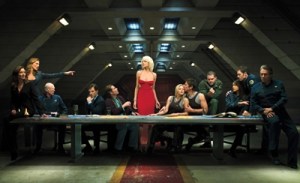
Check out SF Gospel and Dyalogues Blog for fun posts on such things. Its where the question finally gets asked: Is there Cylon redemption for human sin?
Now, SCIFI.COM announced the launch of a new 10-part series of Battlestar Galactica webisodes, “The Face of the Enemy,” starting Dec. 12 at noon ET. Two webisodes will debut weekly, leading up to the on-air return of the series on Jan. 16, 2009.
Each of the three- to four-minute chapters will complement and enhance the action broadcast on SCI FI and give viewers more insight into characters and events from the fourth and final season. “The Face of the Enemy” (written by the excellent Jane Espenson and Seamus Kevin Fahey) follows the action and suspense inside a stranded Raptor carrying a group of passengers, including Lt. Felix Gaeta (Alessandro Juliani) and a Number 8 Cylon (Grace Park).
When passengers suddenly start dying in alarming ways, fear, panic and chaos erupt within the confines of the small ship as suspicion grows that there is a killer among them. Michael Hogan (Col. Tigh) and Brad Dryborough (Lt. Hoshi) also star. Check out here for more information..
-
‘Waiting for Real Change’ in Columbia Heights
Sara Stahlberg, an American University student, who blogs at Trust Me: I’m A Reporter, has got a nice piece up about Columbia Heights and the public art installation at 11th and Park Roads NW done by Albus Cavus that I wrote about here. She includes a quote from yours truly:
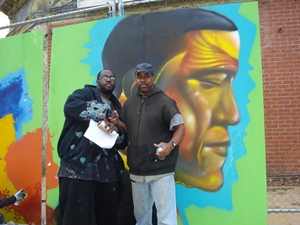
Columbia Heights resident and author Rose Berger enjoyed what the exhibit represented in terms of the direction of the community.
“The Albus Cavus project with its panels of creative graffiti (as opposed to rage/wound-based graffiti) placed on the construction fence of the abandoned Bi-Rite represent a new generative force in the life of the neighborhood,” she said, explaining also that the “reclaiming of the Bi-Rite by a local green architectural firm committed to Columbia Heights (as opposed to the megalith big box stores that tower over 14th St) seems to have created a renewed affection for the neighborhood and the neighbors.”

-
Subscribe
Subscribed
Have a WordPress.com account? Log in now.

